
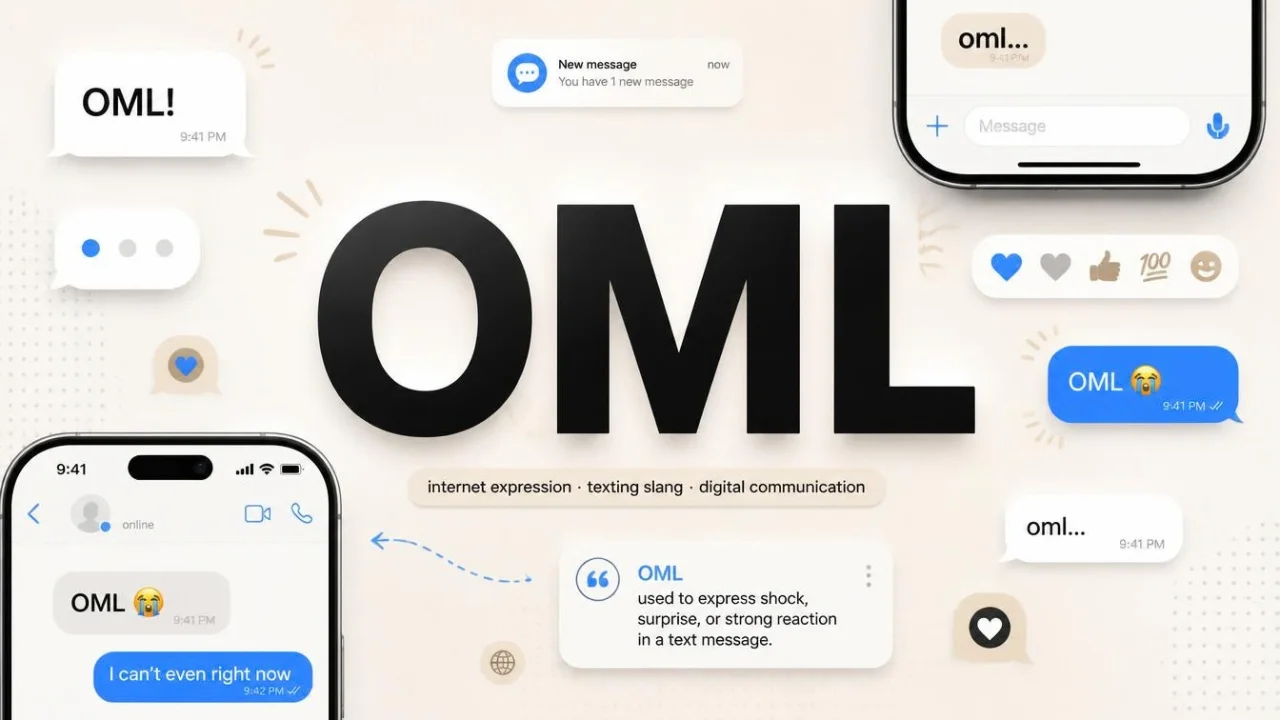

You spot it at the end of a text, or by itself as an entire reply: OML. No punctuation, no explanation, just three letters left hanging in the conversation.
OML most commonly means “Oh My Lord.” It’s a casual reaction used in texting and on social media to express surprise, shock, excitement, disbelief, or frustration: basically the same emotional territory as “OMG,” just with a slightly different flavor.
But that’s not the whole story. OML doesn’t always mean the same thing, and knowing when it doesn’t mean “Oh My Lord” is actually where most of the confusion around this term comes from. This guide covers the real meaning, the lesser-known second meaning, how tone changes everything, where you’ll run into it, and how to reply when someone sends it your way.
What Does OML Mean in Text?
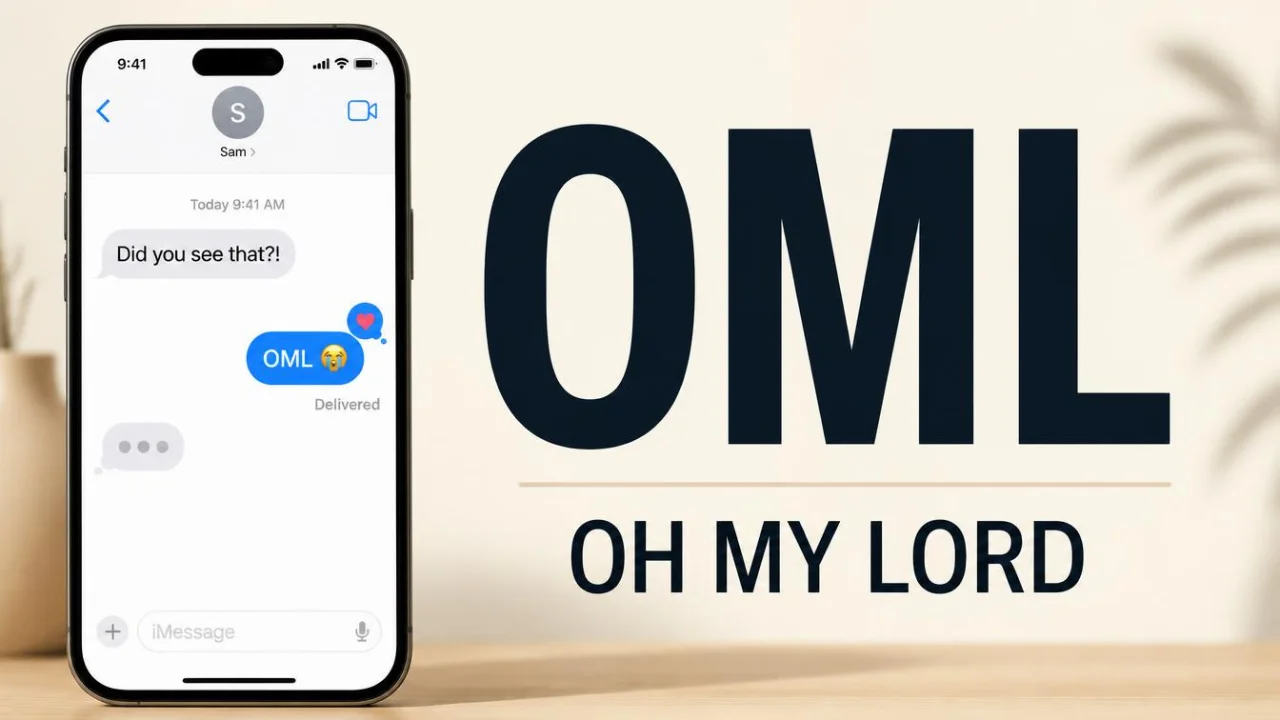
In texting and on social media, OML stands for “Oh My Lord.” It works as a quick emotional reaction: something you type when a message hits you with surprise, excitement, disbelief, or frustration, and a full sentence would take too long to type.
Example:
Friend: “I just got the job!!”
You: “OML congrats!! 🎉”
Functionally, it does the same job as “OMG.” Someone reaches for OML instead either out of habit, because it feels a little less overused, or just because it’s what shows up first when they’re typing fast. The core idea is the same either way: something happened, and the reaction needed to come out quickly.
OML Has More Than One Real Meaning
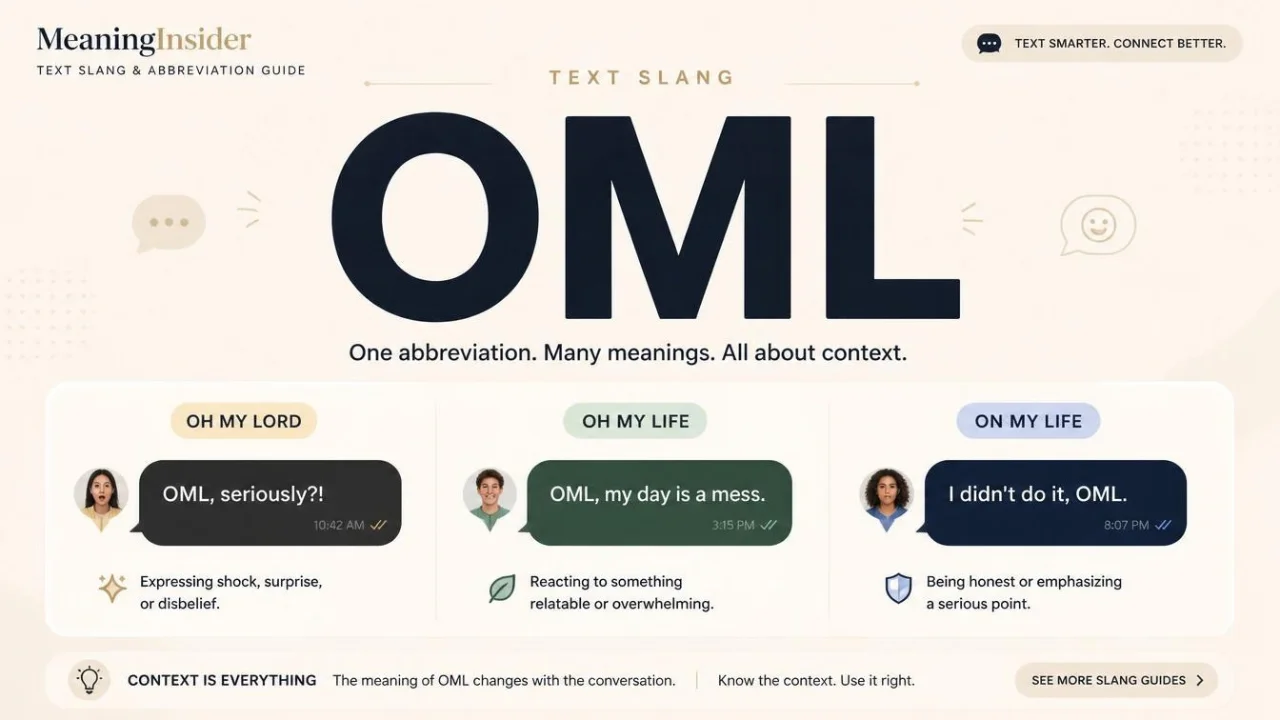
Here’s the part most explanations skip past: “Oh My Lord” isn’t the only thing OML stands for. Depending on the sentence, it can mean something structurally different: not just a different emotion, but a different kind of statement entirely.
Oh My Life
“Oh My Life” sits in the same emotional lane as “Oh My Lord”: surprise, frustration, disbelief. But it tends to feel a bit more self-directed. Where “Oh My Lord” often reacts to someone else’s news, “Oh My Life” leans toward reacting to your own situation:
“OML I spilled coffee on myself again.”
It’s a subtle difference, and in most cases you could swap one for the other without changing much. But it’s worth knowing that this variation exists, especially if the sentence feels more personal than reactive.
On My Life
This is the one that actually changes the meaning of a sentence. “On My Life” isn’t an exclamation at all: it’s a sincerity phrase, closer in function to “I swear” or “I’m being serious” than to “wow” or “no way.”
“I didn’t take your keys, OML.”
Here, OML isn’t reacting to something surprising: it’s backing up a claim, the same way someone might say “I swear on my life” to add weight to a denial or a promise. If you read this use as an exclamation, the sentence stops making sense; read as a sincerity marker, it clicks immediately.
This is the single biggest reason OML trips people up. Two completely different sentence functions, same three letters.
If you’re into these sincerity-markers, RS is worth knowing too, it does the same “I’m dead serious” job, just without needing the word “life” attached to it.
Is OML “Oh My Love”?
Short answer: not really. “Oh My Love” isn’t an established meaning of OML: it’s an easy guess to make, since it sounds like it could fit alongside “Oh My Lord” and “Oh My Life,” but it doesn’t show up as a standard reading in actual usage. If someone’s being romantic or flirty, that comes through in the rest of the message and the emojis around it, not from the letters “OML” carrying a hidden romantic meaning on their own.
Is OML Religious? Why “Lord” Doesn’t Mean What You’d Expect
Even though the letter L technically stands for “Lord,” OML isn’t typically used as a religious statement. It functions the same way plenty of people use “oh my God”: as a built-in exclamation, not a literal invocation. Nobody sending “OML that dog is so cute 🐶” is making a theological statement; they’re reacting to a dog.
This also answers a question that comes up a lot: is OML rude? No, not inherently. Whatever edge a message has comes from the words around OML, the punctuation, or the situation, not from the abbreviation itself. It’s a neutral reaction tool. What you do with it is up to you.
OML vs. OMG: What’s the Difference?
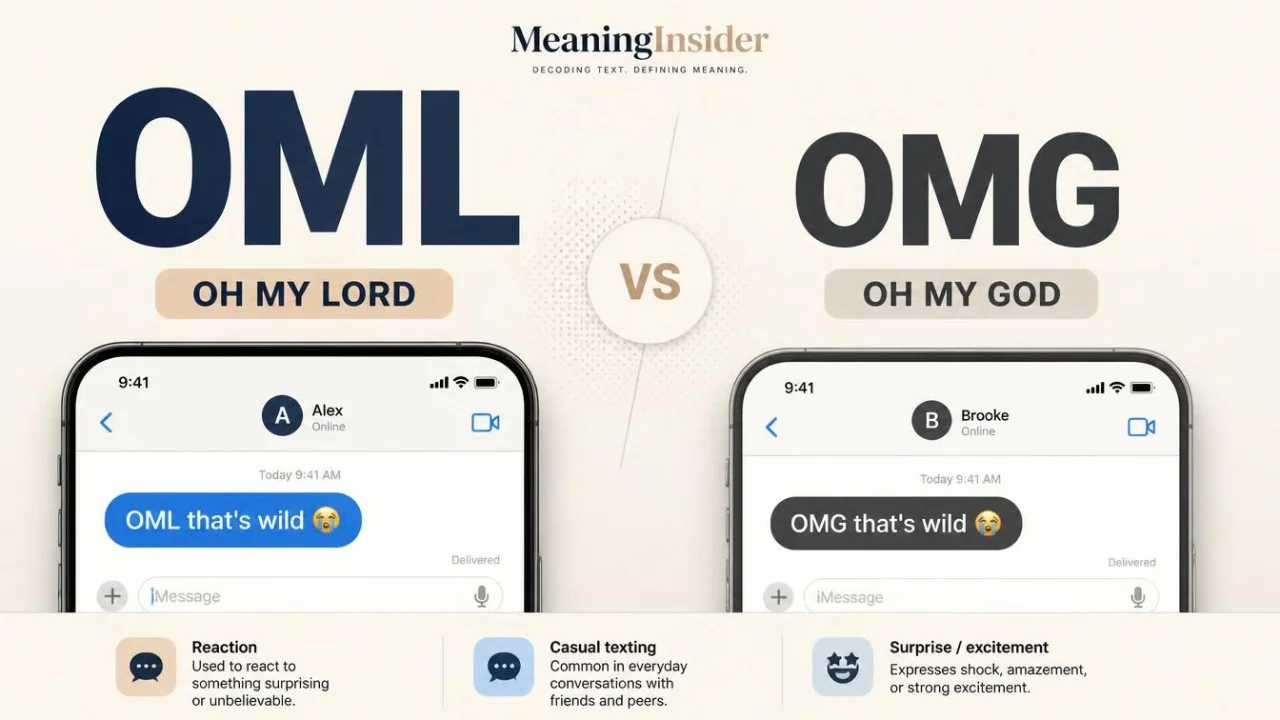
These two get used almost interchangeably, but they’re not identical.
| OML | OMG | |
|---|---|---|
| Full form | Oh My Lord | Oh My God |
| Recognition | Common, but not as universal | Extremely widely recognized |
| Feel | Slightly softer, a bit more personal | More generalized, familiar to basically everyone |
| Typical use | Texts, comments, casual chat | Texts, everyday speech, all platforms |
In practice, most people could swap one for the other and nothing would really change. The choice usually comes down to personal texting style: OML sometimes feels like the less-worn-out option, since OMG gets used constantly across every possible context. Neither is more “correct.” It’s preference, not rule.
How Tone Changes What OML Means
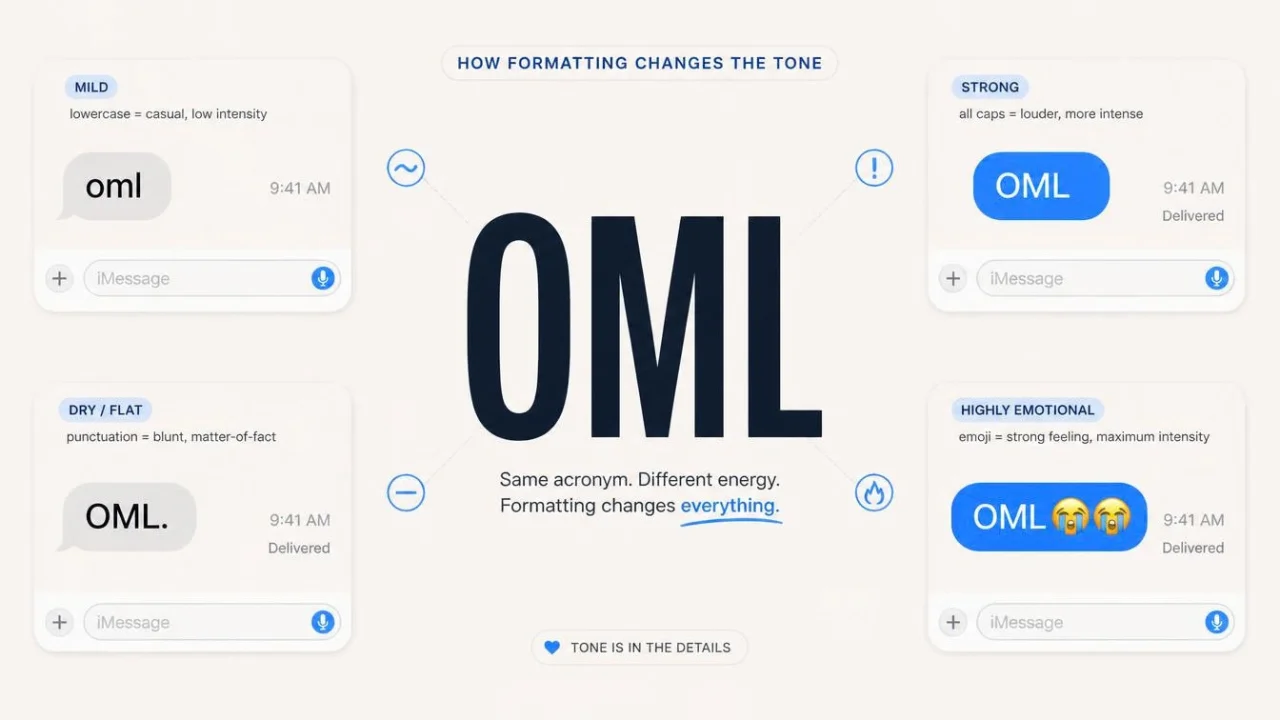
Since OML doesn’t have one fixed emotion attached to it, the way it’s typed does a lot of the work. Small formatting choices shift the entire read:
- Lowercase, no punctuation (“oml”) tends to read mild or offhand: a shrug more than a reaction.
- All caps or repeated (“OML OML OML”) reads as much more intense, sometimes even a little dramatic.
- A period at the end (“OML.”) can flatten the tone into something dry, or even mildly annoyed.
- Emojis and exclamation points usually push the message toward excited or amused rather than upset.
This is really the key to reading OML correctly: the letters set the category (strong reaction), but the formatting around them tells you which reaction it actually is.
That flat, worn-down tone is also where ATP lives, it’s less of a reaction and more of a “I’ve officially had enough” sigh in three letters.
Where People Actually Use OML
The core meaning of OML doesn’t really shift from platform to platform. What changes is how it gets used, depending on whether the conversation is public or private.
In public, performative spaces (think Instagram comments, TikTok comments, or replies on X/Twitter), OML shows up reacting to something other people can also see: a photo, a video, a viral post. It’s often paired with emojis and is part of the visible conversation happening around content.
In private messages (WhatsApp, iMessage, Snapchat chats, group texts), OML tends to feel more personal. It’s a quick, genuine reaction between people who already know each other, without an audience to perform for.
In gaming and community chats (Discord and similar spaces), OML shows up as a fast reaction to something happening in real time, like an unexpected play or a chaotic match moment.
On Snapchat specifically, this holds true too: it’s used the same way it is in any private chat, as a quick emotional reaction to a snap, story, or message: nothing platform-specific changes about what it means there.
Does OML Mean Something Different From a Girl or a Guy?
Not really: the meaning itself doesn’t change based on who’s typing it. What actually varies is personal texting style: some people lean heavily on emojis and exclamation points, others keep their reactions short and dry, and that has more to do with individual habit than with gender.
What does shift the read is context. “OML you look amazing 😍” clearly reads as a compliment or admiration. “OML” with no emoji and a period at the end might read flatter or slightly annoyed. Either way, that’s the surrounding punctuation and situation doing the work, not the sender’s identity.
OML in a Real Text Example
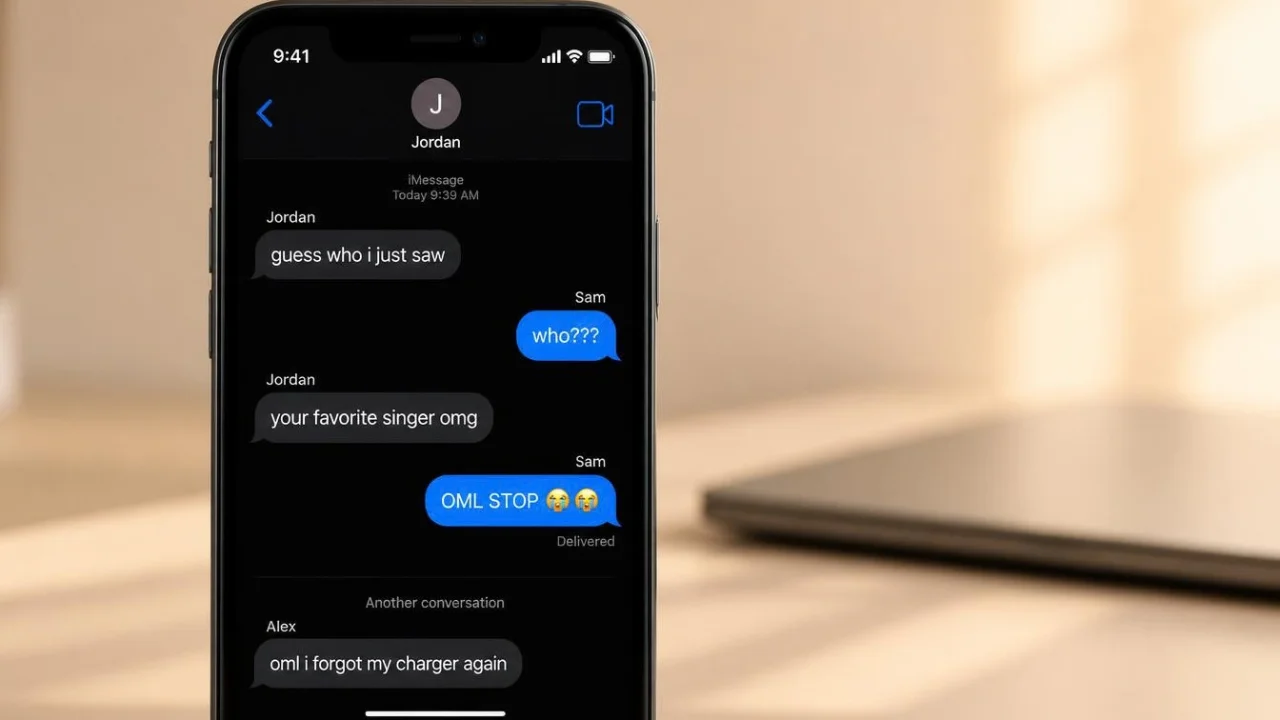
Shock and excitement:
Jordan: “guess who i just saw at the airport”
Sam: “who???”
Jordan: “your favorite singer omg no joke”
Sam: “OML STOP 😭😭 are you serious”
Self-directed frustration:
“oml just realized I left my charger at the gym. again.”
“how does that keep happening to you 💀”
“honestly no clue at this point”
How to Reply When Someone Says OML
The right response depends on matching whatever energy the OML was sent with.
- If it read excited: “I KNOW right?!” or “That’s amazing!!”
- If it read shocked or unclear: “Wait, what happened??” or “Tell me everything”
- If it read frustrated: “Ugh, that’s so annoying” or “I’m sorry, that sucks”
- If you genuinely can’t tell: it’s completely fine to just ask, “good OML or bad OML?” Nobody’s going to find that question weird.
The goal isn’t to overthink it: just don’t reply with something flat and excited-sounding if the original message was clearly stressed, or vice versa.
Words Similar to OML (Related Slang)
OML belongs to a small family of short reaction phrases people reach for instead of typing out a full sentence. These are the ones that genuinely share its function: a compressed emotional reaction, or in one case, the sincerity-phrase cousin that parallels “On My Life.”
| Term | Full Form / Meaning | Typical Use |
|---|---|---|
| OMG | Oh My God | General shock or excitement: the most universally recognized version of this reaction |
| OMFG | Oh My F***ing God | A much more intense, more explicit version of OMG |
| SMH | Shaking My Head | Disapproval or disbelief, often with a hint of disappointment |
| BRUH | (expression) | Disbelief or exasperation, usually at something ridiculous |
| SHEESH | (expression) | Being impressed or amazed, often at something extreme |
| IKR | I Know Right | Agreeing enthusiastically with someone’s reaction |
| ISG | I Swear To God | A sincerity phrase: functions like “On My Life,” not the exclamation side of OML |
Common Mistakes People Make With OML
- Treating OML and OMG as fully identical. They’re close, but not the same phrase, and occasionally the slight difference in feel matters.
- Assuming it’s always negative. OML shows up just as often for good news as bad.
- Using it in professional or formal writing. It reads as too casual outside of friendly, informal contexts.
- Misreading “On My Life” as the exclamation. If a sentence sounds like a denial or a promise (“I didn’t do it, OML”), it’s the sincerity meaning, not a reaction to something surprising.
- On the more frustrated end of that spectrum, you’ll also run into PMO, which skips the ambiguity entirely and just means someone’s annoyed.
When to Avoid Using OML
OML works well in casual, informal spaces, but there are a few places it doesn’t belong:
- Professional emails or work chats: it reads as too casual for most workplace communication.
- Academic writing: essays and formal assignments call for full, written-out language.
- Formal messages: texting a teacher, landlord, or someone you don’t know well.
- Genuinely serious or sensitive conversations: if someone’s sharing something painful, a casual reaction can land as dismissive rather than supportive.
FAQs
What does OML mean in Gen Z texting?
Same core meaning: “Oh My Lord” as a reaction to something surprising, exciting, or frustrating. It’s simply common across the younger, social-media-heavy texting style without being a fundamentally different term.
Oml meaning in text funny?
In a funny or lighthearted context, OML usually reacts to something ridiculous, relatable, or too accurate: think reacting to a meme or a friend’s embarrassing story rather than genuine shock. It’s the same core reaction, just aimed at something amusing instead of something serious.
Onl meaning text?
This is most likely a typo of OML rather than its own established abbreviation. If you see “ONL” and it doesn’t make sense as a typo, the meaning will usually be clear from context rather than from the letters alone.
What does OML mean on Snapchat?
The same as everywhere else: a quick, usually private reaction to something surprising, funny, or unexpected in a snap or chat.
Oml meaning text on my life?
“On My Life” is a sincerity phrase, not an exclamation: it means something closer to “I swear” or “I’m being completely serious,” often used to back up a denial or a promise.
Final Thoughts
OML looks simple: three letters, one obvious meaning. But the real skill isn’t memorizing “Oh My Lord.” It’s noticing which OML you’re looking at: a reaction, a personal complaint, or a promise dressed up as a swear. Once you’re reading the tone and the sentence around it instead of just the acronym itself, OML stops being confusing and starts being exactly what it’s meant to be: a fast, flexible way to say a lot with three letters.
Confused by a word in a text? MeaningInsider has you covered with the real meaning, examples pulled from actual conversations, and the perfect way to reply, all in one place.
