

You’re scrolling through a comment section or a group chat, and there it is: ISG. No punctuation, no explanation, just three letters sitting at the start of someone’s message. It’s not a random keyboard slip and it isn’t code either: it’s one of those texting abbreviations that spreads through DMs and comment threads until it becomes second nature to everyone except the person seeing it for the first time.
ISG stands for “I Swear to God.” People drop it into a message to back up whatever they just said: proving they’re telling the truth, letting off steam, or reacting to something that caught them off guard.
Below, you’ll find exactly how the term functions, the platforms where it pops up most, and the handful of other things it can stand for once you step outside casual texting.
So What Does ISG Actually Mean?
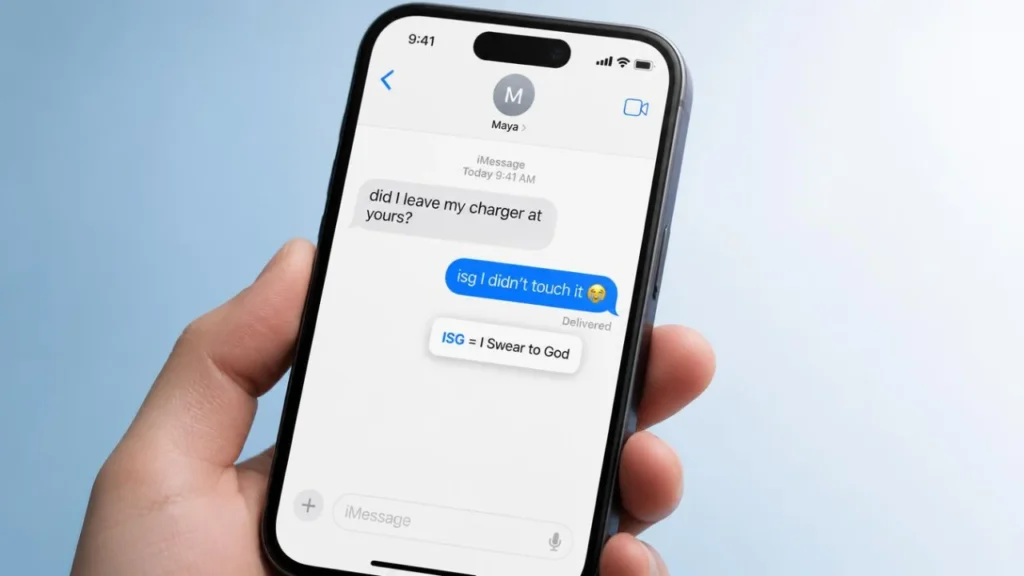
At its core, ISG is a shorthand way of writing “I swear to God,” and it’s almost never used as an actual religious statement. It’s really a stand-in for “I’m being completely serious right now,” typed in three keystrokes instead of four words.
You’ll spot it doing a few different jobs depending on the mood of the conversation:
- Backing up honesty: “isg I didn’t touch your charger”
- Venting: “isg if this app crashes one more time”
- Reacting to something wild: “isg that video was so funny”
Across every one of those examples, it isn’t adding new information to the sentence: it’s cranking up the intensity of what’s already there. “That test was hard” reads as a plain observation. “isg that test was brutal” reads like someone who genuinely needs you to believe them.
Where This Term Shows Up on Social Media
The definition stays fixed no matter which app you’re using: it’s still “I swear to God” whether it’s sitting in a TikTok comment or a Snapchat reply. What actually shifts is the way it’s used from platform to platform.
On TikTok and Instagram, it usually shows up attached to a comment about something funny, shocking, or painfully relatable, or slipped into a caption to make the post feel more genuine and less rehearsed. Snapchat tends to see it in fast, back-and-forth conversations rather than public posts. On WhatsApp or in group chats, it’s more likely to show up when someone’s mid-argument and trying to defend a claim.
So if you’ve been wondering whether it means something different on Instagram than it does on Snapchat, the answer is simple: it doesn’t. The word stays the same: only the setting around it changes.
Where Did ISG Come From?
There’s no clean origin story here: no confirmed date, app, or online community that gets credit for inventing it. What is clear is that it follows the exact same path as most texting shorthand: a phrase people already say out loud gets shortened because typing the full version slows down a fast-moving conversation. “I swear to God” collapsing into this shorthand isn’t all that different from “oh my god” becoming OMG or “be right back” turning into BRB.
Its closest cousin is ISTG, which keeps the “T” from “to” and shows up just as often, arguably even more. Both terms mean exactly the same thing, and neither version is more “correct” than the other.
Seeing It Used in a Real Conversation
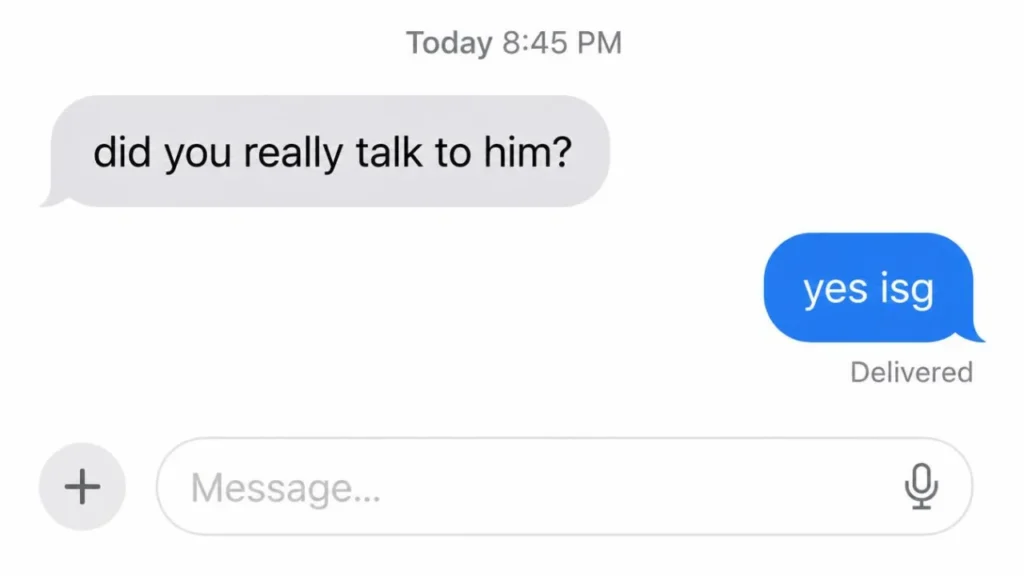
Definitions only get you so far. Seeing ISG in an actual exchange usually makes it click instantly:
Ana: did you really talk to him? Lisa: yes isg
Thomas: you ate the last slice again? Robert: no isg it wasn’t me
Tom: that party was so boring Elbert: what? isg I had the best time
A: are you being serious right now B: dead serious, not joking
Notice where it tends to land: almost always at the very beginning or the very end of a message, rarely buried in the middle. That placement is exactly why it reads naturally instead of awkward: it functions less like an ordinary word in the sentence and more like a stamp confirming the person means what they said.
How to Respond When Someone Sends You “ISG”
Replying to it doesn’t usually take much thought, since it isn’t really posing a question: it’s asking to be taken at their word.
- If you believe them: “okay okay I believe you”
- If you’re playfully skeptical: “sure you didn’t 👀”
- If you want the full story: “wait what happened, tell me everything”
The easiest approach is to mirror their energy. If someone used it to convince you of something, a quick reply confirming you believe them wraps things up neatly. If they used it to hype up a story, matching that same enthusiasm keeps things moving.
If ISG had you stumped, wait until you see what JSP actually means in a text.
Terms That Mean the Same Thing as ISG
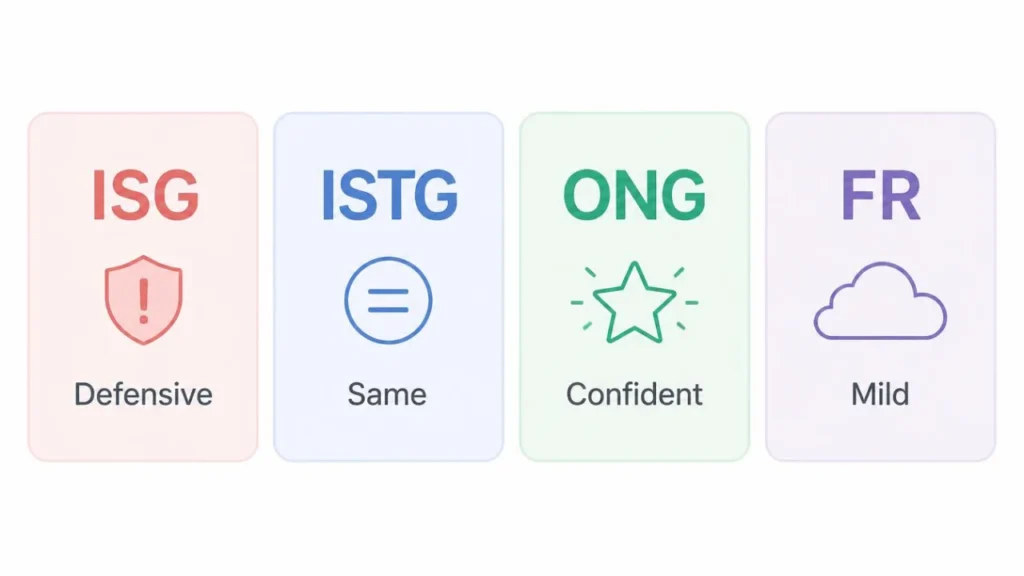
A handful of other abbreviations do similar work, even if the tone underneath each one is a little different.
| Term | Meaning | Typical Feel |
|---|---|---|
| ISTG | I swear to God | Basically identical to ISG, maybe even more common |
| ONG | On God | Reads as more confident and matter-of-fact |
| FR | For real | Softer, closer to plain agreement than a sworn statement |
| No cap | Not lying | A casual way of denying exaggeration |
The contrast between ISG and ONG is a good example of how close these terms can feel while still landing a little differently. Framing a denial with it comes across as slightly defensive, like you’re trying to prove something. Framing the same denial with ONG sounds flatter and more matter-of-fact, like you’re simply stating what happened. Neither carries more weight than the other: they just deliver sincerity in a different tone.
Other Things This Abbreviation Can Stand For
Step outside of texting, and it stops being locked to a single meaning. Depending on the setting, it can point to something entirely unrelated:
- Infinite Sword Glitch: a term that comes up in certain gaming communities
- I Speak Geek: sometimes used in tech or gaming spaces as a lighthearted label for someone into coding, niche fandoms, or tech culture
- A company or industry abbreviation: several organizations and business groups use it as shorthand, and which one it refers to depends entirely on where you’re reading it
If you spot it in a personal chat, a comment thread, or a caption, it’s almost certainly “I swear to God.” If it turns up in a business document, an industry report, or a gaming-specific conversation, it’s very likely referring to something else: the surrounding context usually makes the intended meaning obvious.
Mix-Ups People Commonly Make With This Term
A few misunderstandings come up often enough that they’re worth calling out directly:
- Mixing it up with IG. IG is almost always shorthand for Instagram, not ISG. They look alike at a glance but have nothing to do with each other.
- Assuming it’s always about religion. For the vast majority of people typing it, this carries zero religious weight: it’s purely an emotional intensifier, not a literal oath.
- Assuming it’s only used by Gen Z. It’s especially common with younger texters, but plenty of millennials and other age groups use it too, particularly on social media.
- Assuming it only appears with bad news. It shows up just as often attached to exciting news as it does to complaints or frustration.
Wrapping Up
ISG is a small abbreviation that carries a surprising amount of emotional weight for just three letters. In nearly every casual chat, comment, or caption, it means “I swear to God.” Outside of that context, the setting you found it in will usually tell you right away if something else is meant instead.
FAQs
Is ISG the same as ISTG? Yes. Both spell out “I swear to God,” and ISTG is just the slightly longer version of the same phrase.
What does “no ISG” or “no ISTG” mean? It’s an emphatic denial: essentially “no, I swear to God, that’s not true.” Same intensifier, just paired with a “no” instead of a “yes.”
Is ISG rude or offensive? Not really. A small number of people might find casual references to swearing “to God” a bit off in religious settings, but in day-to-day texting, it reads as neutral, everyday slang.
Can ISG mean something other than “I swear to God”? Yes: in gaming chats it can mean “Infinite Sword Glitch,” in tech circles it’s occasionally “I Speak Geek,” and in business contexts it’s used as an organizational abbreviation. These are far less common than the texting meaning of the term.
Is it fine to use ISG at work or in formal writing? No. It reads as casual slang, so professional settings are better served by plain phrasing like “I assure you” or “honestly.”
If you’re into decoding internet slang like this, Meaning Insider breaks down dozens of similar texting and social media terms.
