
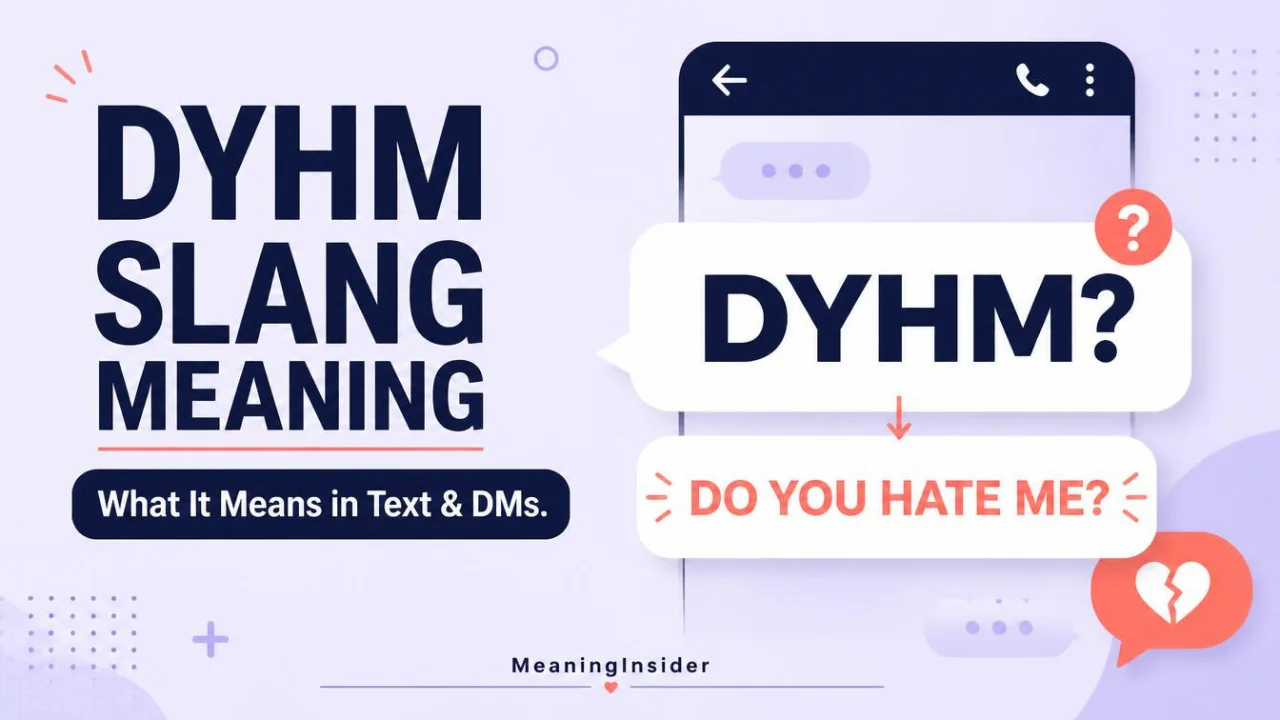

A message lands on your phone and it’s four letters and a question mark. No context, no emoji, nothing else.
DYHM means “Do You Hate Me?”
It’s a short way of asking whether someone is upset with you, annoyed, or pulling away. Sometimes the worry is real. Sometimes it’s a joke about nothing at all. This page covers how to tell the difference, how it shows up in DMs and comment sections, and what to send back.
| Term | DYHM |
| Stands for | Do You Hate Me? |
| What it is | Texting slang, usually an emotional check-in |
| Tone | Worried or joking, depending on the situation |
| Common use | Asking if someone is upset with you, or teasing after a slow reply |
| Where you’ll see it | DMs, group chats, comments |
| Formality | Informal |
What Does DYHM Mean in Text?
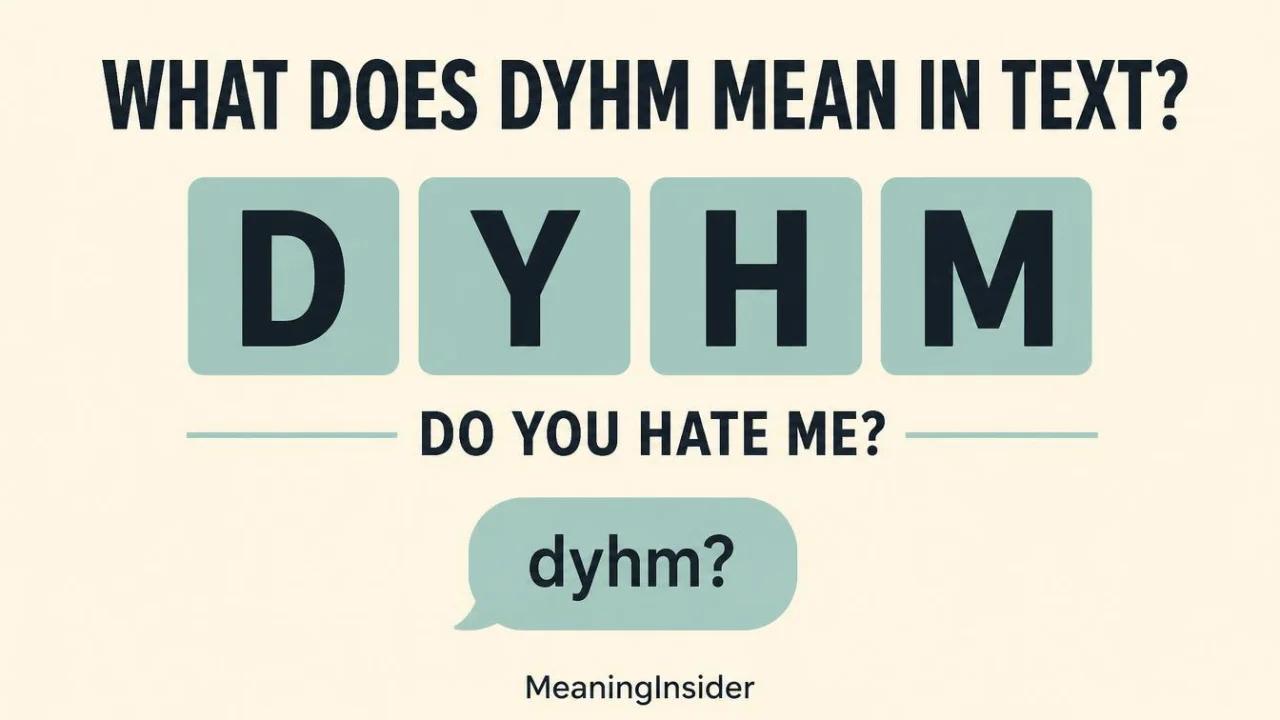
Spelled out, it’s “do you hate me.” People type it as DYHM or dyhm, and the question mark often goes missing.
It’s a question, not an accusation, and it’s rarely literal. The sender isn’t claiming you hate them. They’re checking whether things are okay between you, which makes it an emotional check-in more than anything else. Most of the time, they’re looking for reassurance or trying to get a laugh.
Can DYHM Mean Anything Else?
It’s an acronym, so other expansions are possible on paper. “Do You Hear Me” shows up on a couple of pages, but no reliable source backs it up, so treat it as unconfirmed. Some summaries also list “Don’t You Hate Me?” as a variant. That’s the same question worded slightly differently, though it isn’t confirmed anywhere reliable either. DYHM is informal texting shorthand, not an official abbreviation of anything.
If the “hate me” interpretation doesn’t fit the conversation, don’t assume that’s what they mean. Ask the sender what they meant.
Why Do People Send DYHM?
The word “hate” carries a lot of weight here. It’s the biggest possible way to ask “are we okay?”, and that’s why the phrase can express both genuine worry and a dramatic joke. The message itself doesn’t tell you which one you got. The situation around it does.
When It’s a Real Worry
This version usually follows something specific. A long silence. A message that sat unanswered. An argument that never fully got resolved. Something the sender said that might have landed badly.
The person is often overthinking, and they’d rather ask than keep guessing. They want a clear answer, and a vague one tends to make the worry worse.
When It’s a Joke
Here the exaggeration is the whole point. A friend sends a meme and gets no reaction. Someone answers “k” to a long message. A reply comes in three hours late. The sender acts mock-offended, and “DYHM” is the punchline.
It’s common between close friends and partners, where the teasing is understood. Nobody involved actually thinks anyone hates anyone.
How to Tell Which One You Got
Look at what surrounds the message.
| Clue | Points to a real worry | Points to a joke |
| Emoji and punctuation | A flat “dyhm?” on its own | A laughing or crying-laughing emoji, or a stretched-out “DYHMMM” |
| Your relationship | Someone who rarely teases you | People who already joke with you |
| What just happened | An argument or an awkward moment earlier | Nothing unusual, just a slow reply |
| Timing | A day or more of silence | A short gap in replies |
| A follow-up | They explain what’s bothering them | They add a laugh or a meme |
Text strips out face and voice, so even people who know each other misread this one. If you still can’t tell, reply warmly. A warm answer works for both versions.
Before you read too much into a silence, check whether the message even landed. Sometimes it went to another chat, which is exactly what people use cyc for.
DYHM on TikTok, Instagram, and Other Chats
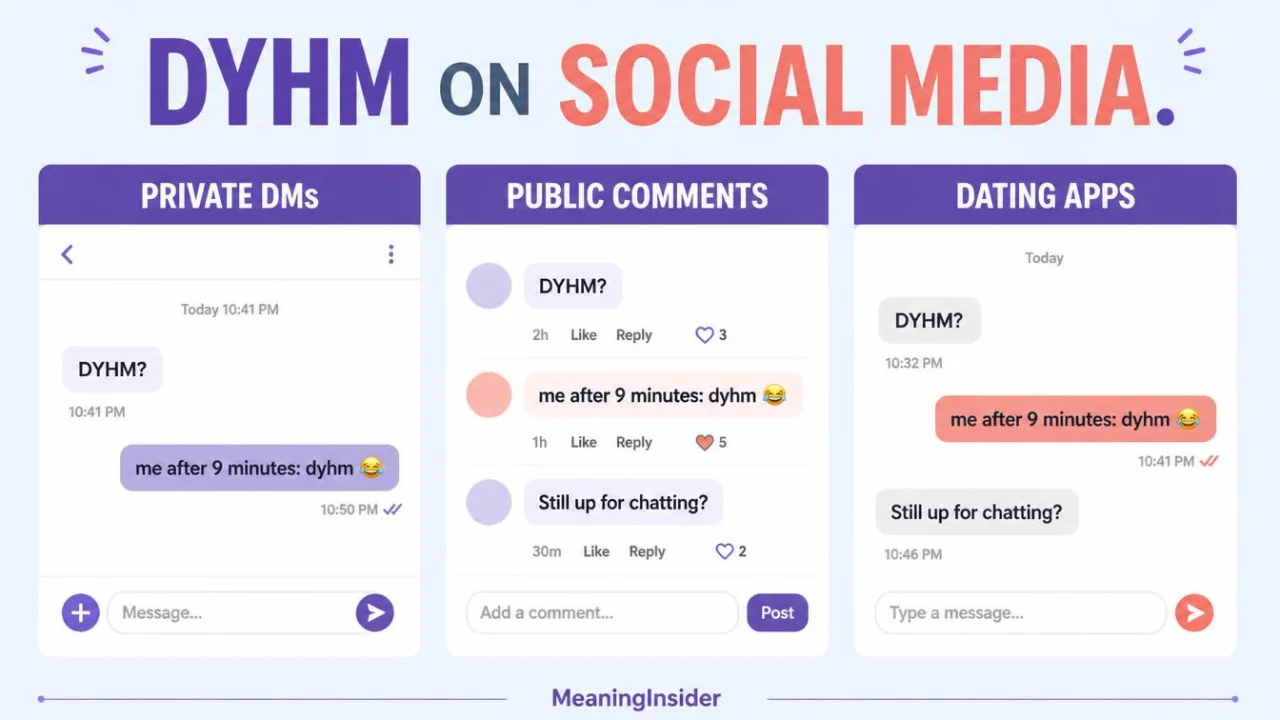
The meaning doesn’t change from app to app. What changes is the setting, and the setting affects how seriously it lands.
Private Chats and DMs
On WhatsApp, Snapchat, Instagram DMs, or in a story reply, the message goes to one person or a small group. That makes a sincere check-in more likely, though teasing is common too, especially after a slow reply. Since the person is talking directly to you, it tends to feel personal.
TikTok Comments and Public Posts
In a comment section or caption, the audience is everyone. Here it usually reads as exaggerated, relatable humor, the kind of thing people drop under a video about being ignored. It can also appear as a hashtag on video clips, where the meaning depends on the joke rather than a literal question.
DYHM on Dating Apps
Dating apps change the stakes. You’ve only been talking for a short while, there’s no shared history to lean on, and a quiet afternoon can feel like the conversation is fading. That’s often when it gets sent: a match goes silent after a good chat, or a joke may not have landed.
With so little to go on, it’s harder to tell whether it’s sincere or just playful flirting. With someone new it can also land heavier than the sender intended. If you’re the one on the receiving end, keep the reply light but clear. If you’re thinking about sending it, something like “no pressure, just checking you’re still up for chatting” is easier to answer.
DYHM From a Guy or a Girl
The abbreviation means the same thing no matter who sends it. What changes the message is the relationship and the situation. From a close friend it’s often casual. From a crush or partner, the stakes can feel higher. Read the context, not the gender.
Where Did DYHM Come From?
There’s no documented origin. It’s a shortened form of an ordinary question, and nobody has traced a first use, a date, a platform, or a community behind it. Anyone giving you a clean origin story is guessing.
DYHM in a Real Chat Example
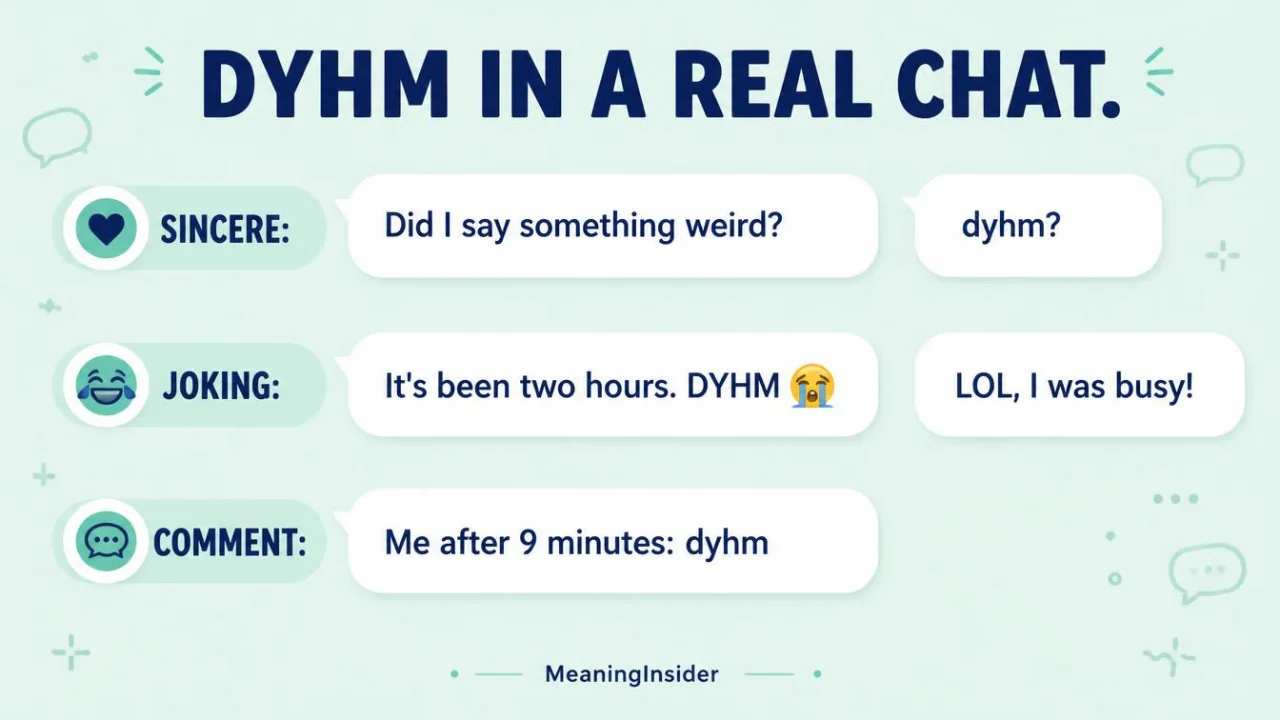
The sincere one
them: hey. did i say something weird at dinner
them: you got really quiet after
them: dyhm
you: no!! i was just tired, i swear. you didn’t say anything weird
The joke
you: [sends a 40-second video of the dog]
you: …
you: it’s been 2 hours. dyhm 😭
them: LMAO i was in a meeting, it’s adorable
The public comment
under a video about people who read texts and never answer:
me after 9 min of no reply: dyhm
The first expects a real answer. The other two just want a laugh.
How to Reply When Someone Sends DYHM
The right reply depends on what you think they meant. A single “no” can feel cold, even when it’s true.
If They Sound Worried
Reassure them and give a reason for the silence or the distance. “Not at all, I’ve just been buried at work” says more than a simple “no.” If something earlier upset them, acknowledge it. You can also ask, “Did something make you feel that way?”
To sound properly sure, plenty of people add something like “nah ong, just been busy.”
If They’re Joking
Play along. Keep it light and return the energy. “Never, I’m just a terrible texter 😂” works.
If You Actually Are Upset, or Just Need Space
Don’t dodge the question or pretend everything’s fine. Say it kindly and plainly: “Not hate, but I’m a bit annoyed about earlier. Can we talk tonight?” If you need time, say that instead of going quiet, which usually makes the worry worse.
A lone “wtv” or “k” after a long message is a classic trigger for this exact question, so it’s a poor way to show you’re upset.
Words Similar to DYHM
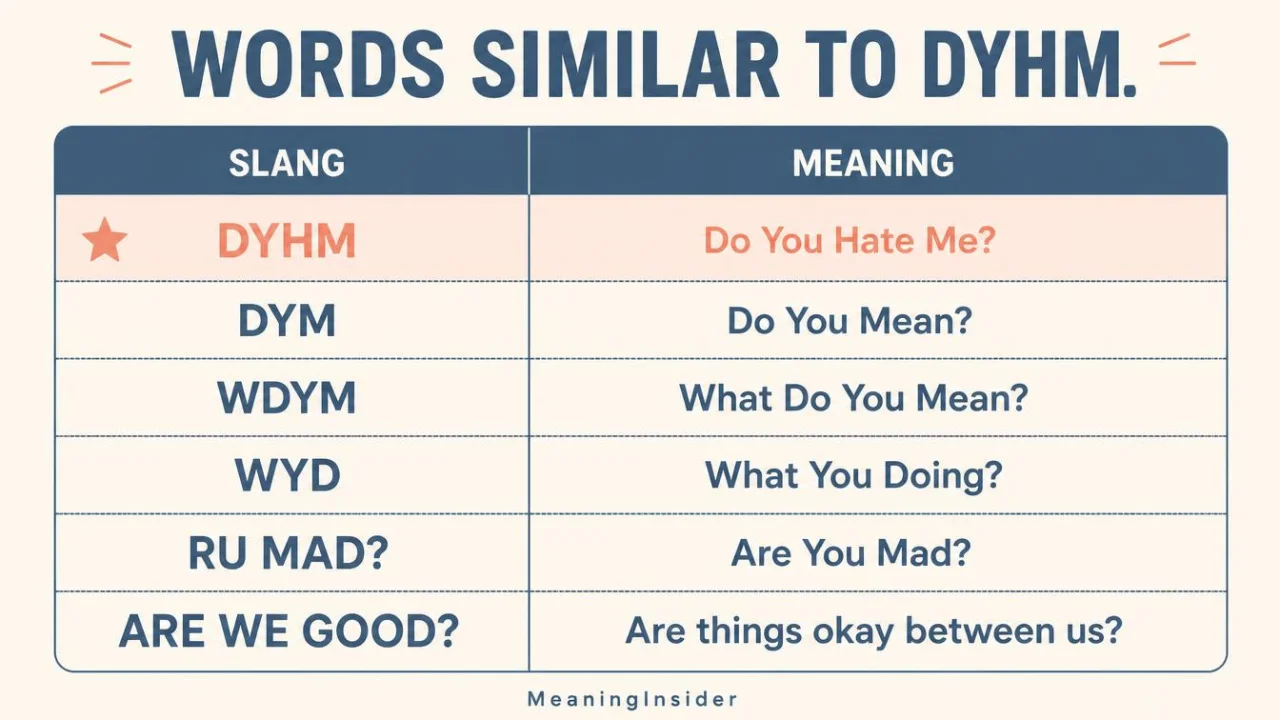
Some phrases ask the same thing in plainer words. Others look similar but ask something else.
| Phrase | What it asks | How it differs |
| Are you mad at me? / ru mad | Whether you’re angry | More direct, less dramatic |
| Are we good? | Whether things are okay between you | Neutral and low-key |
| Did I do something wrong? | Whether the sender caused a problem | Points at a specific cause |
| WDYM | “What do you mean?” | Asks for clarification, not reassurance |
| WYD | “What you doing?” | A casual check on activity, not feelings |
The first three do the same job as DYHM with less drama. WDYM and WYD only look alike. Neither asks about feelings.
Common Mistakes and Misreadings
- Taking it as an attack. It’s usually the opposite. The sender is being vulnerable.
- Replying with a flat “no.” It’s technically an answer but often leaves the person unconvinced.
- Assuming it’s always romantic or always serious. Friends use it all the time, and a lot of the time it’s a joke.
- Using it in work or school messages. It’s casual, personal shorthand. A manager or teacher won’t read it the way a friend would.
- Sending it again and again. Repeated check-ins can start to feel needy or put pressure on the other person.
- Using it in a mixed group chat. People who aren’t close to you may not know the abbreviation or the tone.
Flat replies are one of the common reasons these check-ins happen. Even a bare “idm” with nothing around it can read as checked out.
Final Words
DYHM is a small message carrying a bigger question: are we okay? Read the tone first, then answer warmly. If you’re the one worried, a plain “are we good?” often gets you a clearer answer.
FAQs
Is DYHM the same as DYM or DYLM?
No. Different letters mean a different question. DYM is usually read as “do you mean,” a request for clarification, and has nothing to do with feelings.
What does DYHM mean from a guy or a girl?
The same thing. The abbreviation doesn’t change with gender. What shifts the weight of the message is the relationship: casual from a friend, and often heavier from a crush or partner.
Is it rude to send DYHM?
Not on its own. It’s usually a vulnerable question rather than an aggressive one. It can feel heavy if it’s sent repeatedly or at the wrong moment.
Should I send DYHM if I think someone is upset with me?
You can, but a plain question often works better. Something like “hey, are we good?” or “did I do something wrong?” is more straightforward and easier to respond to, especially when the other person isn’t familiar with the abbreviation.
Can I use DYHM in a work chat?
It’s best avoided. It’s casual and emotional, and colleagues may not recognize it. A complete sentence like “Is everything okay between us?” ” is clearer.
Someone Texted You a Word You Don’t Understand?
MeaningInsider Gives You the Real Meaning, Real Examples, and How to Reply All in One Place.
