
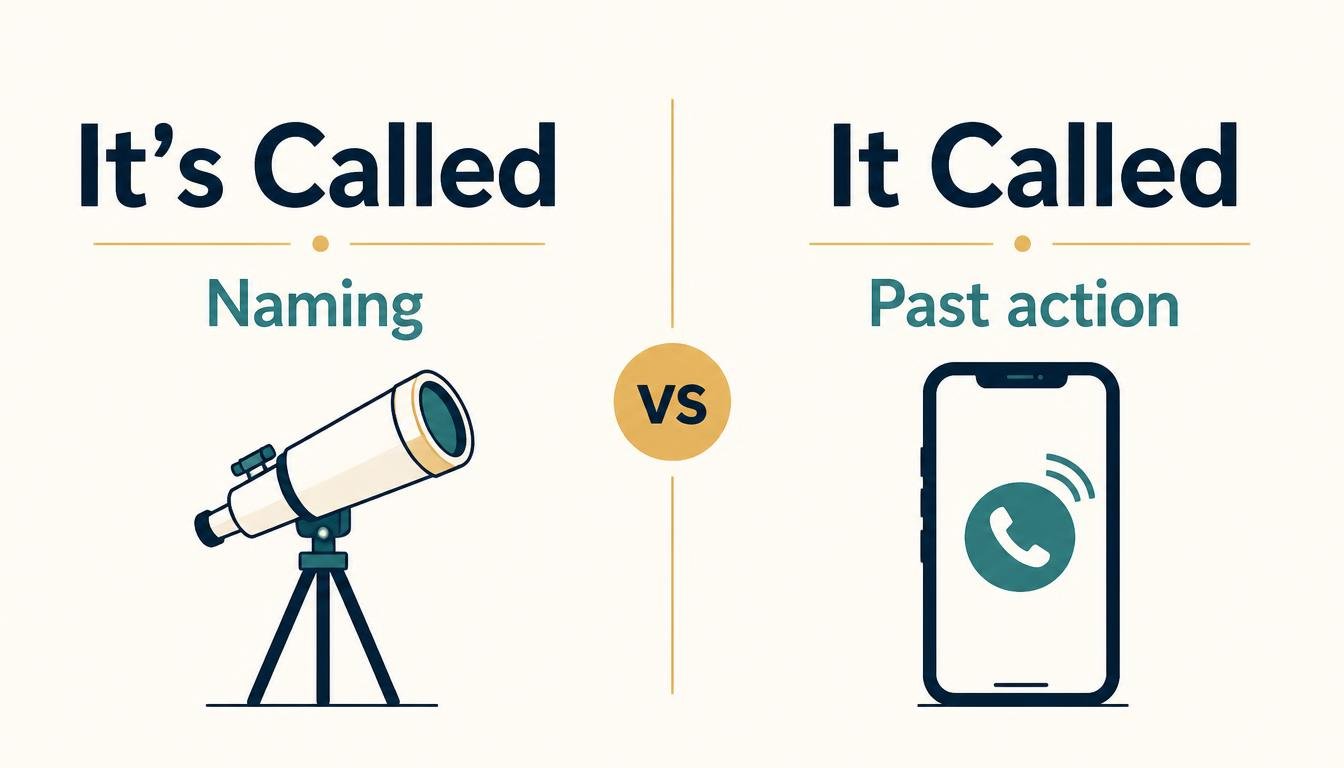

“It’s called” and “it called” look similar, but they have different grammatical structures and meanings. Choosing the right phrase depends on what you want to say.
“It’s called” usually means “it is called” and is used to identify or name something. “It called” uses the simple past tense of call to describe an action performed by the subject.
For example, you would say, “It’s called a telescope” when identifying an object. However, “It called me yesterday” describes something that made a call in the past.
The difference becomes easier to understand when you look at how each phrase works in a complete sentence. Let’s examine the meanings, examples, and common mistakes.
Quick Answer: It’s Called vs It Called
The main difference between “it’s called” and “it called” is their grammatical structure and intended meaning.
| Phrase | Meaning | Example |
|---|---|---|
| It’s called | It is named or identified | It’s called a telescope. |
| It called | The subject performed an action in the past | It called me yesterday. |
| It was called | Someone gave it a name or label in the past | It was called the Silver Star. |
| Its | Indicates possession or association | The telescope lost its cover. |
Use “it’s called” when you want to explain what something is named or known as. Use “it called” when the subject performed an action described by the verb called.
However, “it called” is not always incorrect or incomplete. It is a grammatically valid construction when used in the appropriate context.
What Does “It’s Called” Mean?
“It’s called” is a contraction of “it is called” when used to name or identify something. You can use it to introduce an object, explain a concept, identify a place, or tell someone the name of something.
For example:
- What is this kitchen tool? It’s called a spatula.
- The process of plants using sunlight to produce food is called photosynthesis.
- This type of computer program is called a compiler.
- The technique is called active listening.
- The film is called The Silent Sea.
In each example, the sentence identifies something by its name or tells the reader what it is known as.
How Does “It’s Called” Work in Grammar?
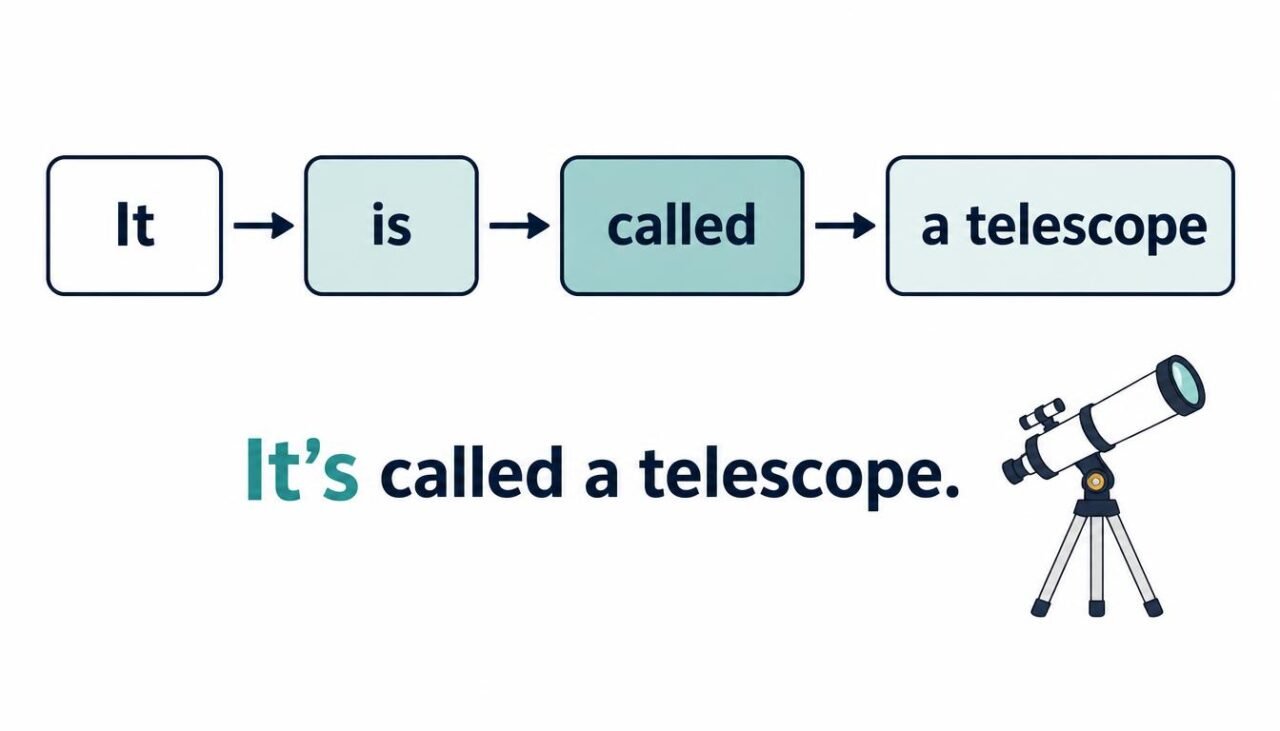
In the naming construction, “it’s called” uses the present simple passive voice.
The basic structure is:
Subject + is + past participle + name or description
For example:
- It is called a telescope.
- It is called artificial intelligence.
- It is called a solar eclipse.
In everyday conversation and general writing, you can shorten “it is” to “it’s”:
- It’s called a telescope.
- It’s called artificial intelligence.
- It’s called a solar eclipse.
Both forms are correct and communicate the same meaning in these examples.
The passive voice focuses on the thing being named rather than the person who gave it that name. You can learn more about this structure in the British Council’s guide to passive voice in English.
When Should You Use “It’s Called”?
Use “it’s called” when you want to:
- Identify an object, place, or concept.
- Explain the name of a process or method.
- Introduce a technical term.
- Tell someone the title of a book, film, or other work.
- Describe what something is commonly known as.
Imagine that someone points to an unfamiliar kitchen utensil and asks what it is.
You can answer, “It’s called a ladle.”
You are identifying the utensil, not describing an action it performed.
What Does “It Called” Mean?

“It called” uses the simple past tense of the verb call. In this construction, it is the subject, and called describes an action that happened in the past.
The meaning depends on the context. The verb call can refer to contacting someone by phone, making a sound, shouting, summoning someone, or performing another action associated with calling.
Consider these examples:
- The automated system called me yesterday.
- The alarm called the security team after detecting a problem.
- The bird called from a nearby tree.
- The software called another function during the process.
- The program called the external server twice.
Each example describes an action rather than simply identifying what something is named.
Oxford Learner’s Dictionaries lists both the naming meaning of call and its use for contacting someone by phone. See the dictionary entry for call for further examples.
When Is “It Called” Correct?
Use “it called” when the subject performed an action in the past.
Talking about a phone call
“The unknown number called twice, but it never left a message.”
Here, it called describes the action of making a phone call.
Talking about a sound
“The bird called from the branches before flying away.”
Here, called describes the sound the bird made.
Talking about technology
“The program called another function to complete the task.”
Here, called describes one part of a program invoking another function.
Talking about an earlier event
“The device called the emergency number automatically.”
Here, the device performed the action.
Notice that “it called” does not always require a direct object. For example, “It called out again” can be a complete sentence when the context makes the subject clear.
There is also an important detail: call can mean to give someone or something a name. For example, “The family called the puppy Max” describes a naming action in the past.
Therefore, the real distinction is not simply whether a sentence mentions a name or an action. You need to consider the grammatical structure and the intended meaning.
It’s Called vs It Called vs It Was Called
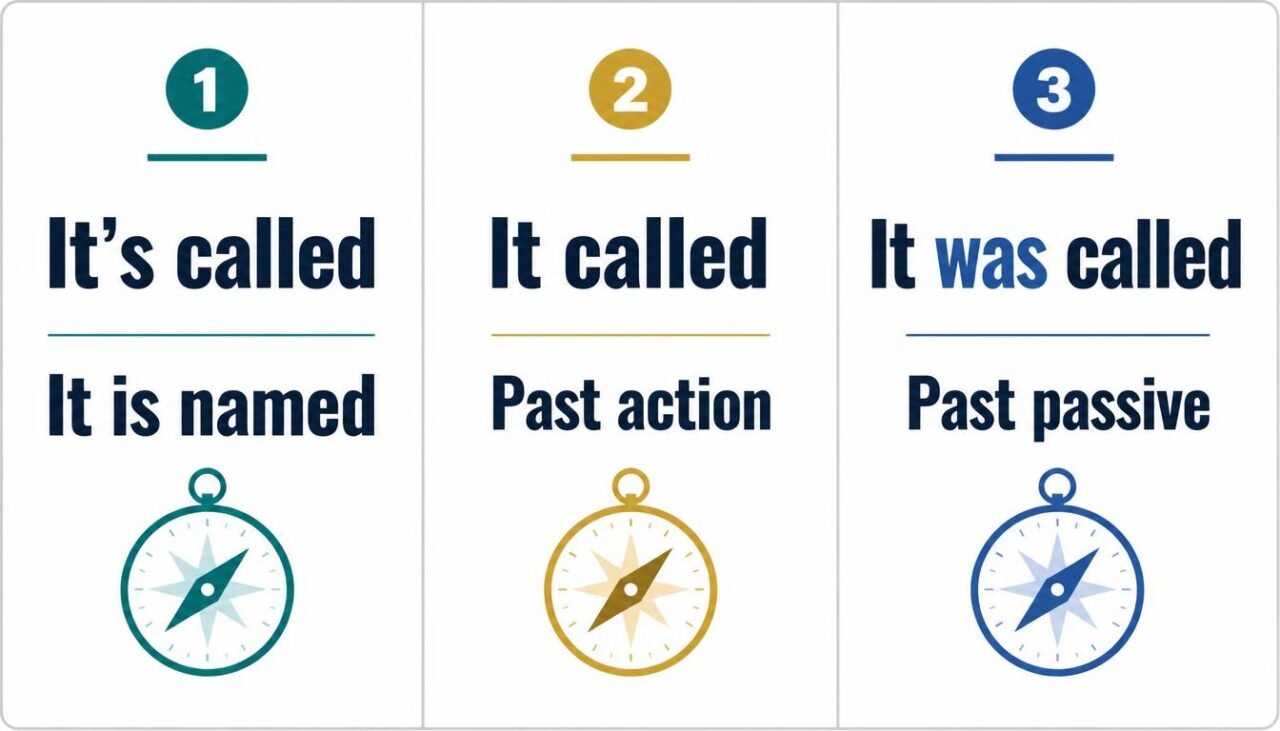
These three expressions are easy to confuse, but they serve different purposes.
| Sentence | Grammatical structure | Meaning |
|---|---|---|
| It’s called a compass. | Present passive | It is named a compass. |
| It called the office. | Simple past active | It contacted the office. |
| It was called a compass. | Simple past passive | Someone gave it that name in the past. |
The difference between active and passive voice is especially important here.
In “It called the office,” the subject performs the action. In “It was called a compass,” the subject receives the name or label.
Here are three examples that make the distinction clearer.
Present passive: “It’s called the Northern Lights.”
You are identifying a natural phenomenon by its name.
Simple past active: “It called the customer three times.”
You are describing an action that happened in the past.
Simple past passive: “It was called the Northern Lights in the guidebook.”
You are describing the name used for the phenomenon in the past.
Remember that “it was called” does not necessarily mean the name has changed. The sentence simply places the naming or labeling in the past.
What Is the Difference Between “It’s Called” and “Its Called”?
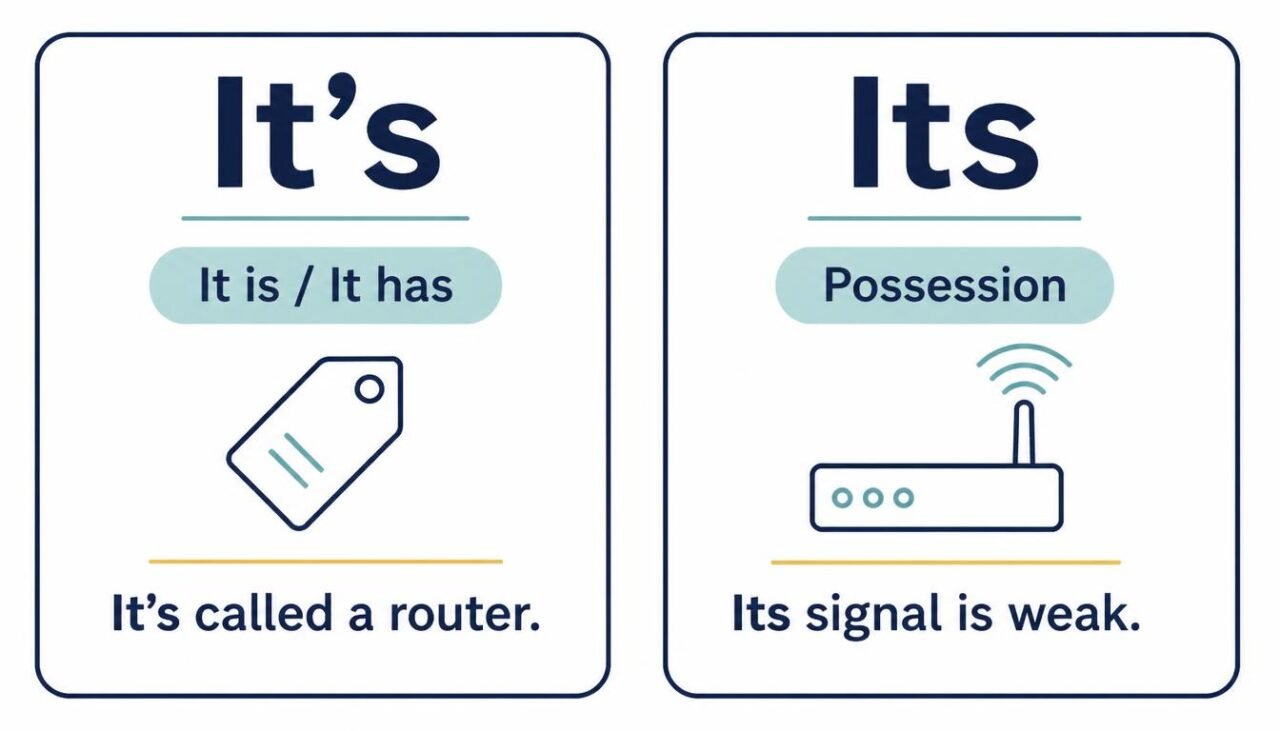
Another common source of confusion is the difference between “it’s” and “its.”
Although these words look similar, they have different grammatical functions.
It’s is a contraction of “it is” or “it has.”
Its is a possessive determiner that indicates something belongs to or is associated with something.
Consider these examples:
- It’s called a modem.
- It’s been working properly.
- The phone lost its signal.
- The company changed its name.
In the first example, “it’s” means “it is.” In the second, it means “it has.” In the last two examples, “its” indicates possession or association.
Therefore, when you want to identify something, write:
Correct: It’s called a router.
Incorrect for this meaning: Its called a router.
The second sentence does not express the intended meaning because the possessive form “its” cannot replace the contraction “it is.”
This distinction is the same in standard American and British English. For additional guidance, see Merriam-Webster’s explanation of when to use “it’s” versus “its”.
One useful test is to replace “it’s” with “it is” or “it has.” If one of those expanded forms preserves the intended meaning and sentence structure, the contraction is appropriate.
For example:
“It’s called a telescope.”
Expanding the contraction gives:
“It is called a telescope.”
The sentence still makes sense, so “it’s called” is correct for the naming meaning.
The same contraction can also appear in a different construction:
“It’s called me three times.”
Here, “it’s” can mean “it has,” so the sentence means that something has called the speaker three times. The context determines the meaning.
Common Mistakes to Avoid
Several mistakes can occur when choosing between these phrases. Understanding the grammar behind each one makes them easier to avoid.
1. Using “It Called” to Introduce a Name
Incorrect for the intended meaning:
“It called a microscope.”
Correct:
“It’s called a microscope.”
The first sentence does not naturally express that the object is named a microscope. The second clearly identifies it.
However, “it called” can be grammatical in another context. For example, “It called the office” describes a past action.
2. Assuming “It Called” Is Always Incorrect
A common misconception is that “it called” is incomplete because it lacks a helping verb.
That is not true.
For example, “It called me yesterday” is a complete sentence when the context identifies what it refers to. The simple past tense does not require a helping verb in this sentence.
3. Writing “Its Called” Instead of “It’s Called”
Incorrect:
“Its called renewable energy.”
Correct:
“It’s called renewable energy.”
The apostrophe indicates the contraction of “it is” in the naming construction.
4. Confusing “It Called” With “It Was Called”
Incorrect for the intended past-passive meaning:
“It called a mistake by the committee.”
Correct:
“It was called a mistake by the committee.”
The second sentence explains that someone gave it the label “a mistake.” The first does not express that passive meaning.
5. Using “How Is It Called?” to Ask for a Name
When asking someone for the name of an object, the natural standard-English question is:
“What is it called?”
You can also ask:
“What do you call it?”
“How is it called?” is generally nonstandard when asking for a name. In English, what is used to ask about identity or a name, while how normally asks about manner or method.
How to Remember the Correct Phrase
The easiest way to choose the right expression is to check what your sentence is trying to communicate.
Step 1: Are you naming or identifying something?
Use “it’s called.”
Example: “It’s called a dictionary.”
Step 2: Are you describing an action that happened in the past?
Use “it called” when called is the simple past verb.
Example: “It called the support team yesterday.”
Step 3: Are you describing a name given in the past?
Use “it was called.”
Example: “It was called the Green House before the renovation.”
Step 4: Are you showing possession?
Use “its.”
Example: “The house lost its original color.”
Finally, remember the expansion test for “it’s.” Replace the contraction with “it is” or, where the grammar calls for it, “it has.” If the expanded form preserves your intended meaning, the contraction is appropriate.
This test is useful, but you should always consider the full sentence. “It’s called a telescope” and “It’s called me three times” both use the apostrophe, but the contraction has a different meaning in each sentence.
Frequently Asked Questions
Is “It Called” Grammatically Correct?
Yes. “It called” is grammatically correct when called functions as the simple past verb.
For example, “It called me yesterday” describes an action in the past. However, when you want to identify something by name, “it’s called” is normally the appropriate expression.
Is “It’s Called” Correct English?
Yes. “It’s called” is standard English when it means “it is called” and is used to identify or name something.
For example, “It’s called a compass” tells the reader what the object is named.
Can I Use “It Is Called” Instead of “It’s Called”?
Yes. Both forms are correct when they express the same meaning.
“It’s called a telescope” and “It is called a telescope” both identify the object by name. The contracted form is common in everyday conversation, while the expanded form may sound more formal or emphatic.
What Is the Difference Between “Its” and “It’s”?
“It’s” is a contraction of “it is” or “it has,” while “its” indicates possession or association.
For example, “It’s called a router” identifies an object. “The router lost its signal” describes something associated with the router.
Is “What Is It Called?” Correct English?
Yes. “What is it called?” is the natural standard-English question when you want to know the name of something.
“What do you call it?” is another correct alternative.
Can “It’s Called” Refer to Something Named in the Past?
Yes. If something received its name in the past and is still known by that name, “it’s called” can remain correct.
For example, “It’s called the Old Bridge because it has stood here for centuries” is grammatically correct.
If you specifically want to describe the name used in the past, you can write, “It was called the Old Bridge.”
Conclusion
The difference between “it’s called” and “it called” comes down to grammatical structure and meaning. Use “it’s called” when you want to name or identify something. Use “it called” when the subject performed an action in the past, such as contacting someone or calling out.
Remember that “it was called” describes a past passive naming or labeling construction, while “its” indicates possession rather than acting as a contraction.
Whenever you are unsure, check the complete sentence instead of relying on how the words sound. If you are identifying something, “it’s called” will usually be the right choice. If you are describing an action, check whether “it called” expresses that action correctly.
Understanding these differences will help you avoid common grammar mistakes and write more naturally and accurately.
