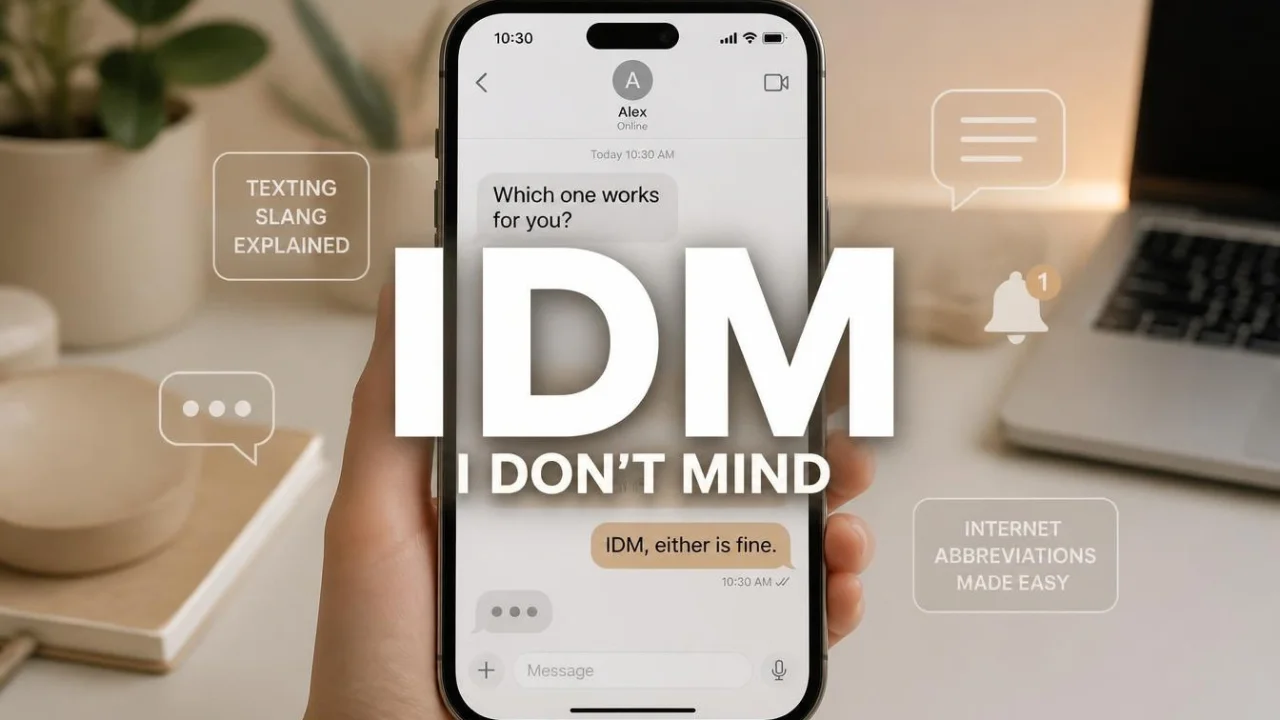

You get a text back, it just says “IDM.” No context to lean on.
IDM stands for “I Don’t Mind.” It’s a casual way of telling someone you’re okay with whatever they choose — no strong opinion either way.
Before you can even guess what it means, you’re already three “wait, does this mean…” theories deep.
That’s the short version. But IDM shows up in enough different situations, tones, and platforms that a one-line definition doesn’t tell you everything you need to know. This guide covers what it really communicates, how people use it in practice, when it’s the wrong choice, and how it’s different from the abbreviations people mix it up with.
What Does IDM Mean in Text?
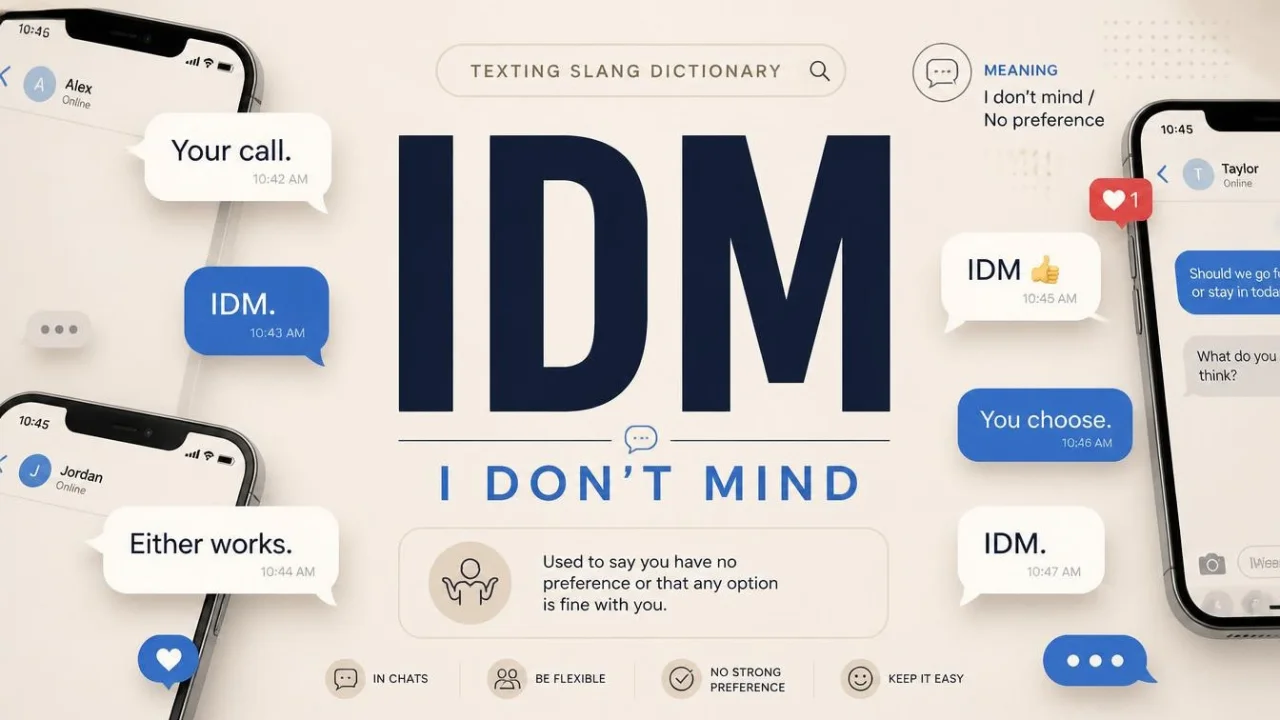
In texting, IDM means “I Don’t Mind.” It signals that you’re fine with either option, and you’re happy to let someone else make the call.
“Should we grab tacos tonight or just cook at home?” “idm, whatever’s easier for you”
That’s the whole function of the phrase. It removes friction from a decision. Instead of weighing in with a preference, the person is saying the outcome is fine either way.
It reads as neutral, and usually friendly. It’s not the same as being disengaged: it’s more that the specific choice isn’t something they feel strongly about.
IDM in Everyday Conversations: Tone, Context & Real Examples
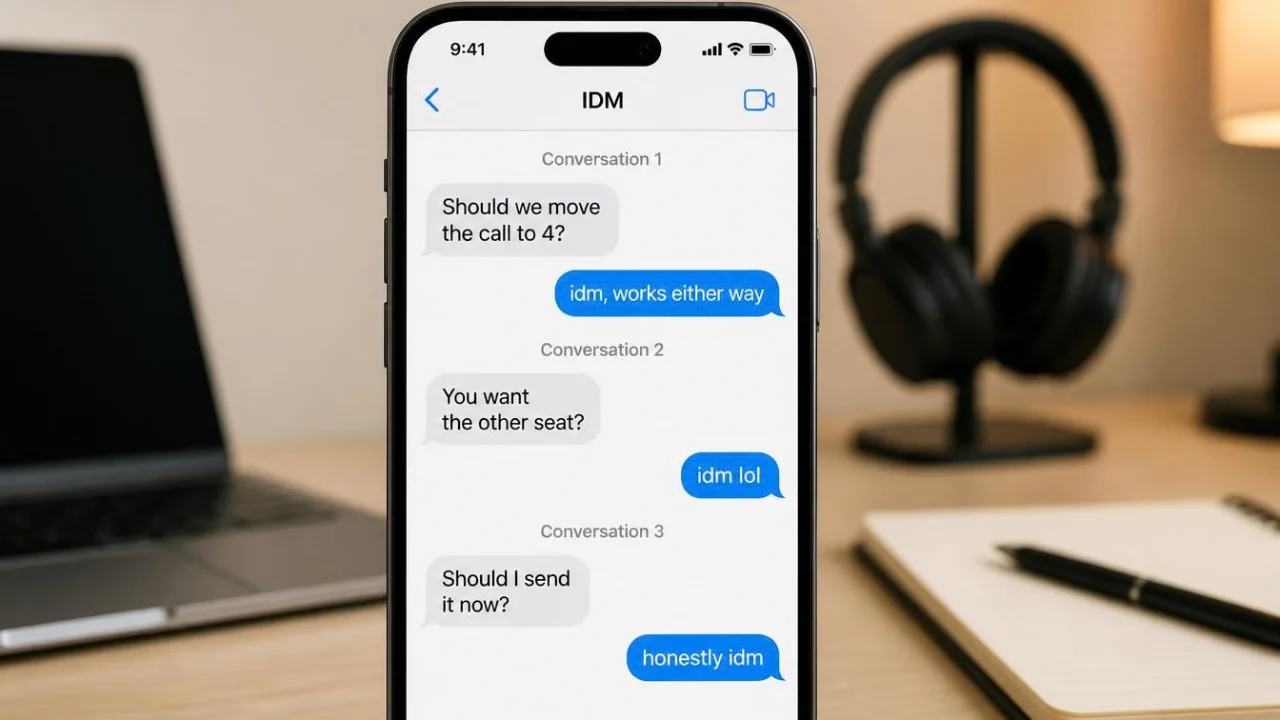
IDM tends to show up in one specific kind of moment: someone’s been asked to pick, and they’d rather not.
That happens constantly in everyday texting: deciding where to eat, what time to meet, whether to reschedule, which option someone should go with. IDM is the fast way to hand that decision back without sounding indecisive.
“should we push the call to 4?” “idm, works either way”
“you want the window seat?” “idm you can have it lol”
“do u think I should text him first or just wait it out” “tbh idm, either way works, go with your gut”
Tone-wise, it usually lands as relaxed and easygoing: closer to “either works for me” than a shrug.
It’s worth knowing IDM can occasionally read as a little low-effort, especially with no emoji and nothing else in the reply. A bare “idm.” when someone actually wanted your input can come across as mildly checked-out, even if that’s not the intent. Context usually clears that up.
Does IDM Mean the Same Thing on Every Platform?
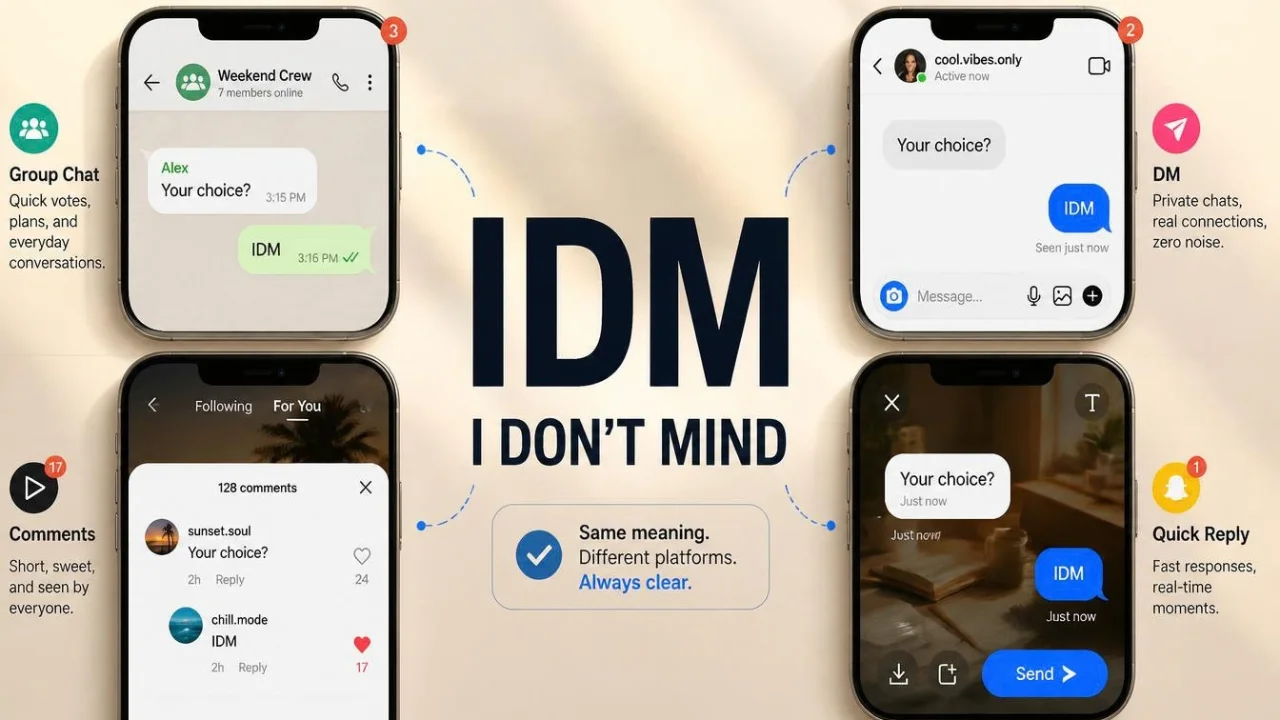
Yes. The meaning doesn’t shift depending on where you see it. Whether it shows up in a WhatsApp group chat, an Instagram DM, a TikTok comment, or a Snapchat reply, IDM is still “I Don’t Mind.”
What changes is where and how it tends to get used on each app:
| Platform | Where it shows up | Example |
|---|---|---|
| Group chats, planning threads | “movie night sat or sun?” → “idm either day works for me” | |
| DMs, comment replies | “should I go with the beach pic or the sunset one” → “idm honestly, they’re both solid” | |
| TikTok | Comment sections, “pick one” posts | “team A or team B?? 👀” → “idm honestly, both good picks” |
| Snapchat | Quick back-and-forth replies | “down to facetime later or nah” → “idm, whatever works for u” |
Other Meanings of IDM (Outside Texting)
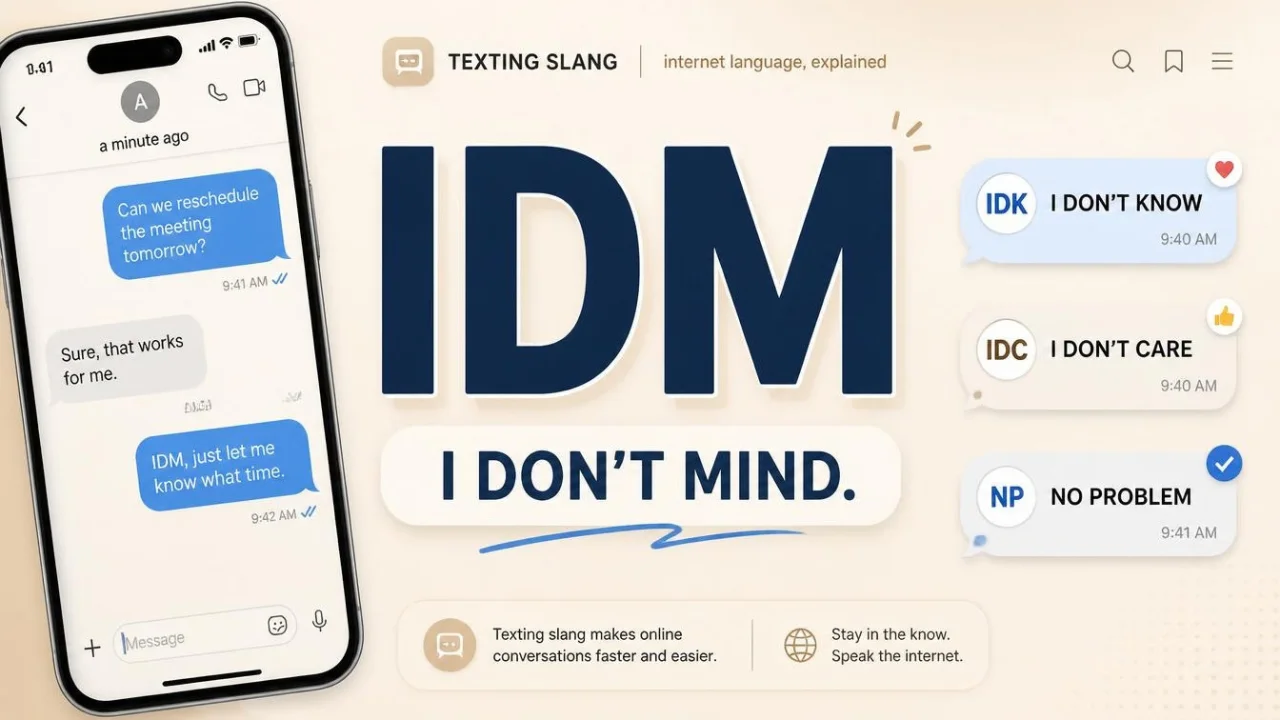
“I Don’t Mind” isn’t the only thing IDM stands for: it just happens to be the meaning almost everyone runs into while texting.
A few other contexts worth knowing, in case you’ve seen IDM somewhere that isn’t a chat:
| Meaning | Context |
|---|---|
| Intelligent Dance Music | A real electronic music genre. Shows up in music subreddits, Discord servers, or Spotify-adjacent conversations. |
| Identity Management | Common term in IT and cybersecurity, referring to how organizations manage user access. |
| Internet Download Manager | A well-known Windows tool for speeding up file downloads. Comes up in tech-support contexts. |
| Technical trading concept | Appears on stock/crypto charts, unrelated to texting slang: a completely separate concept from technical analysis. |
In everyday messaging, none of these are the intended meaning. If you’re mid-conversation about plans, IDM means “I don’t mind,” full stop.
Is IDM Formal or Informal? When to Avoid It
IDM is strictly casual. It belongs in texts, DMs, and comment sections, not in professional emails, client messages, or anything where tone needs to read as considered rather than quick.
It’s worth skipping in situations where the decision actually matters. If someone asks something like “are you okay with us canceling the trip” or “do you actually want to do this,” a bare “idm” can feel dismissive of a question that deserved more thought.
In those moments, spelling it out works better: “I’m honestly fine either way, whatever you’d prefer.” Same flexibility, without sounding like you didn’t want to engage.
How to Reply When Someone Says IDM
Since IDM usually hands the decision to you, a natural reply either takes that decision or acknowledges it:
- “cool, I’ll pick then”
- “alright, let’s do [option]”
- “haha okay, guess it’s on me”
- “appreciate you being flexible”
- “no worries, I got it”
There’s no need to overthink the reply. IDM is low-stakes by design, so the response usually matches that energy.
Words Similar to IDM (Related Slang)
A few abbreviations get confused with IDM because they look similar or show up in the same kinds of conversations.
| Term | Meaning | How it’s different from IDM |
|---|---|---|
| IDK | I Don’t Know | Not the same thing at all. IDM is about preference (you’re fine either way); IDK is about information (you genuinely don’t know the answer). |
| IDC | I Don’t Care | Closer in meaning, but flatter in tone. IDM leans toward “I’m happy with either”; IDC can come across as more dismissive. |
| NP | No Problem | Not about preference at all: it’s a response to being asked or thanked for something, not to being asked to choose. |
More Texting Slang Worth Knowing
IDM isn’t the only acronym that leaves people guessing. A few more worth bookmarking:
- YHYH — short for “yeah yeah,” a quick, emphatic way of agreeing with someone. See the full YHYH meaning guide.
- IMK — stands for “in my knowledge,” used when someone’s sharing an opinion rather than a confirmed fact. Check out the IMK meaning guide for real examples.
- IONK — a close cousin of IDK, meaning “I don’t know.” Here’s the breakdown: IONK meaning guide.
- IWKY — a playful (and slightly alarming) one that can mean either “I wanna kiss you” or “I will kill you,” depending entirely on the context. Figure out which one you’re dealing with: IWKY meaning guide.
Common Mistakes & Misunderstandings
A few recurring mix-ups worth clearing up:
- Confusing it with IDK. They look alike at a glance, but one is about not knowing, the other is about not minding.
- Reading it as rude. On its own, IDM is neutral-to-friendly. It only reads negatively when the context called for a more thoughtful answer and got a one-word brush-off instead.
- Assuming it always means disinterest. Most of the time it’s genuine flexibility, not a lack of care.
FAQs
Does IDM mean “I don’t mind”?
Yes: that’s the standard meaning in texting and social media chats.
Is IDM the same as IDC?
Not quite. Both express flexibility, but IDM tends to sound warmer, while IDC can come across as more indifferent.
Does IDM change meaning depending on whether a guy or a girl sends it?
No. The meaning doesn’t change based on who’s sending it.
Is it okay to use IDM at work?
In casual internal chats, usually fine. In emails or client-facing messages, spell it out as “I don’t have a preference” instead.
Does IDM have any meaning besides “I don’t mind”?
It does, just not in everyday chats. Outside of texting you’ll find it short for Intelligent Dance Music, Identity Management, or Internet Download Manager. Context makes the intended meaning clear.
Is IDM rude?
No, not on its own. It’s usually neutral to friendly. It can come across as a little dismissive if it’s the only reply to a question that needed more thought, but that’s about the context, not the phrase itself.
What’s the difference between IDM and IDK?
They’re not related. With IDM, you’re telling the other person you’ll go along with whichever option they pick, it’s a preference thing, not a knowledge thing. IDK means you genuinely don’t know the answer. Mixing them up changes what you’re actually telling the other person.
Final Words
IDM is a small phrase doing a simple job. It takes the pressure off a decision and hands it somewhere else, without making a big deal of it.
Once you can spot the tone behind it (genuine flexibility, not disinterest), it stops being confusing and just becomes one more piece of how people talk quickly online.
Got a text with a word that left you confused? MeaningInsider breaks it down for you the real meaning, examples from actual conversations, and the perfect reply, all in one spot.
