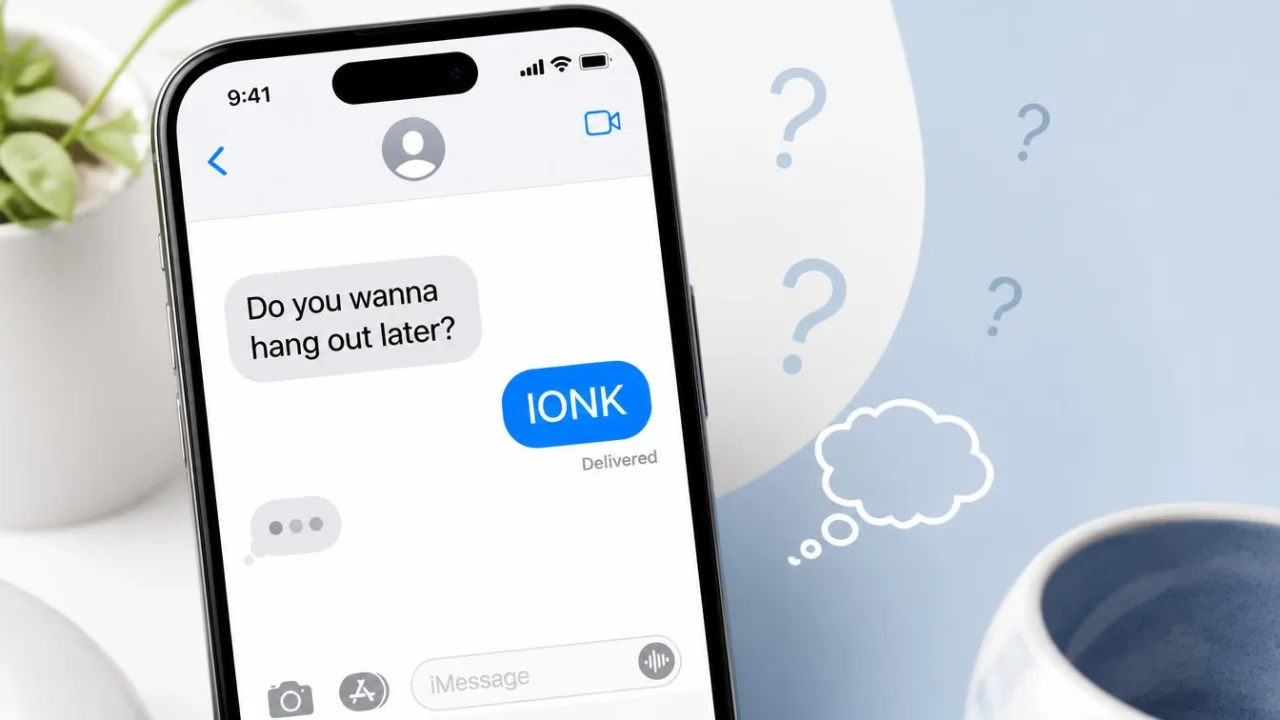

You ask someone a question, they type back “ionk,” and unless you already know the code, that reply looks like a typo. It isn’t.
IONK means “I don’t know.” It’s a casual, phonetic way of writing out that phrase the letters roughly follow how “I don’t know” sounds when someone says it fast and mumbled, the same logic behind writing “ion” for “I don’t.”
It’s become a common stand-in for the classic IDK, especially in group chats and comment sections where nobody’s stopping to type full sentences. Below is what it actually means, how it differs from similar-looking slang, where you’ll run into it, and how to handle it when it shows up in your own messages.
What Does “IONK” Mean?
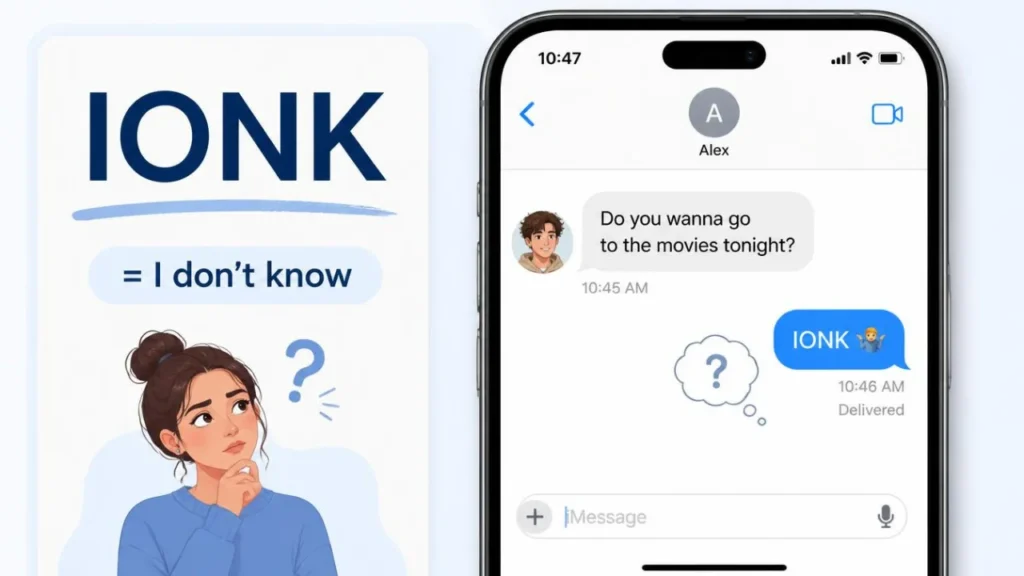
IONK is shorthand for “I don’t know.” That’s the meaning, full stop it doesn’t shift depending on who sends it or what app it shows up in.
The spelling comes from sound rather than spelling rules. Say “I don’t know” quickly and casually out loud, and it starts to collapse into something closer to “i-onk.” Texting slang has leaned into that pattern for a while now “ion” for “I don’t” works the same way and IONK is just that same shortcut extended one word further.
In practice, it almost always shows up lowercase, without punctuation, and often tacked onto other slang for extra emphasis: “ionk fr,” “ionk lol,” “ionk tbh.” It functions as a low-effort, blunt way to shrug at a question not rude, just efficient. If IDK is the standard reply, This abbreviation is its more relaxed, more spoken-sounding cousin.
“IONK” vs. “Ion” What’s the Difference?
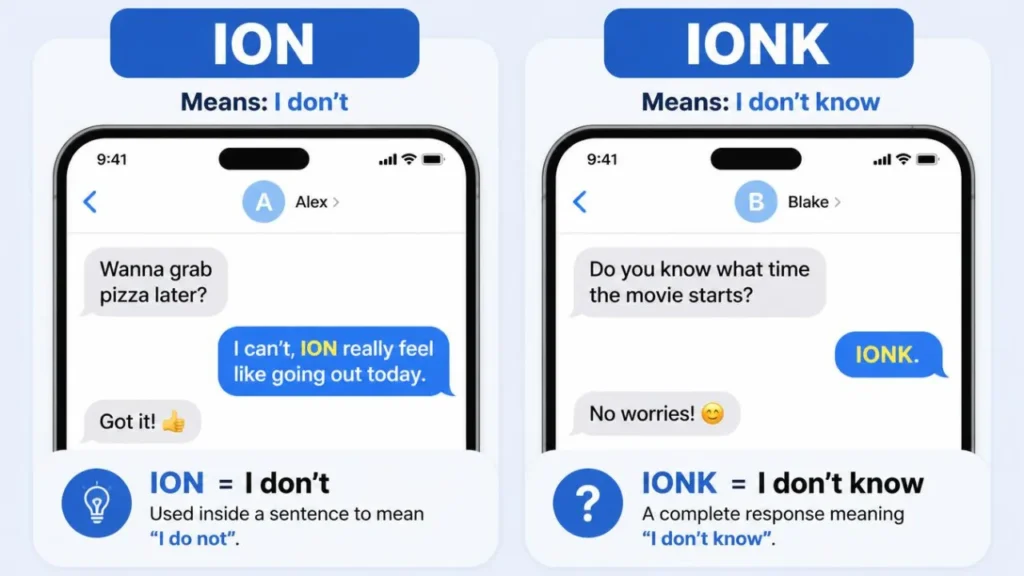
These two get mixed up constantly because they look like variations of the same thing, and they’re related just not identical.
“Ion” on its own usually means “I don’t,” as in “ion wanna go” or “ion think so.” It’s a standalone contraction that needs the rest of the sentence to make sense.
IONK goes one step further and bundles in “know,” so it works as a complete answer by itself. You don’t need to add anything after it “ionk” already says “I don’t know.”
So if a friend texts “ion feel like going out tonight,” they’re saying they don’t want to. If they text “ionk if I’m going tonight,” they’re saying they haven’t decided or don’t have the info yet. Same root, different job.
“IONK” in a Real Text Example
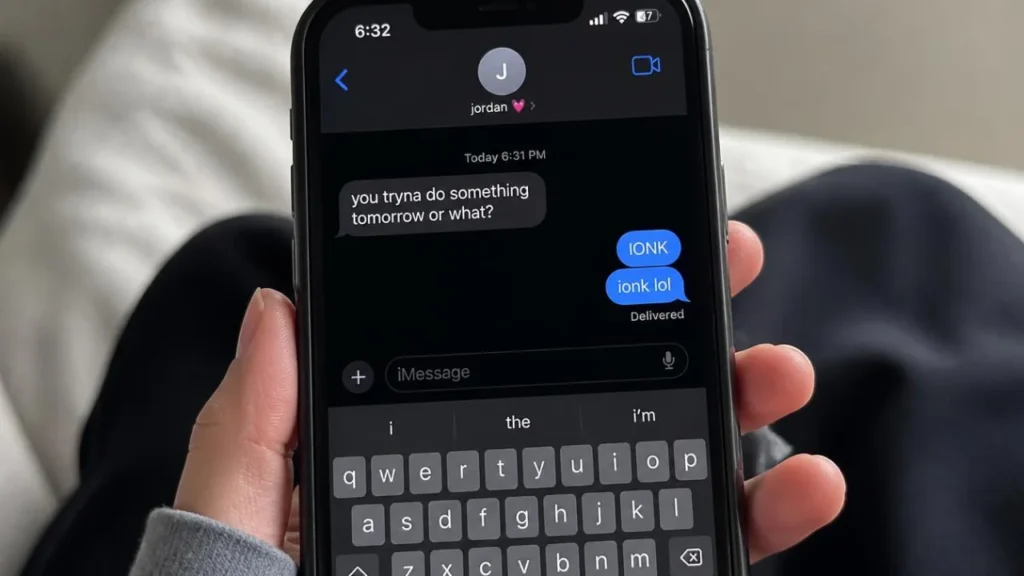
Seeing it in context makes the meaning click faster than any definition does.
Example 1
Friend: are we still doing the group project tonight
You: ionk, haven’t heard back from the teacher
Example 2
Friend: what’s the wifi password here
You: ionk lol ask the front desk
Example 3
Friend: what time does practice start tmrw
You: ionk fr, check the group chat
Notice it rarely shows up alone in a longer sentence it’s usually the whole reply, sometimes with a quick add-on (“lol,” “fr,” “tbh”) that softens or reinforces the tone.
Where You’ll See “IONK” Used
It shows up anywhere fast, informal replies are the norm. That includes regular text messages, Snapchat chats, TikTok comment sections, Instagram DMs, Discord servers, X replies, and group threads on WhatsApp or iMessage.
There’s nothing about the term that ties it to one specific app it’s not a Snapchat-only thing or a TikTok-only thing. It’s more accurate to say it belongs to a general style of texting: quick, casual, low-punctuation, common wherever people are typing fast and don’t feel like spelling everything out.
Does “IONK” Mean Something Different From a Girl or a Guy?
Short answer: no. The word itself means the same thing no matter who’s typing it.
A lot of people search this because getting “ionk” back from someone especially in a conversation that feels loaded, like being asked out or asked to make plans can feel like it’s hiding something. It usually isn’t. It just means the person genuinely hasn’t decided, doesn’t have the information, or isn’t ready to commit to an answer yet.
You: wanna hang out this weekend?
Her: ionk yet, depends on my schedule
That’s not a rejection. It’s closer to “ask me again later.” Any flirty, hesitant, or evasive read on it comes from the surrounding conversation and the emojis attached not from this word itself. Compare it to the same reply with a different tone:
You: wanna hang out this weekend?
Her: ionk 😏 maybe
The word hasn’t changed. The context around it has. That’s the part worth paying attention to, not the abbreviation.
How to Reply to “IONK”
Since IONK is basically a conversational shrug, the natural response usually does one of a few things:
- Ask a follow-up “when though, later this week?”
- Offer to check: “No worries, I’ll find out and get back to you.”
- Hand it back casually “either, let’s just figure it out later”
- Let it close the topic sometimes it’s fine to just move the conversation forward without pressing for more
There’s no fixed script here. The right response depends on whether you actually need an answer or the “ionk” is just filling space in a fast-moving chat.
Words Similar to “IONK” (Related Slang)
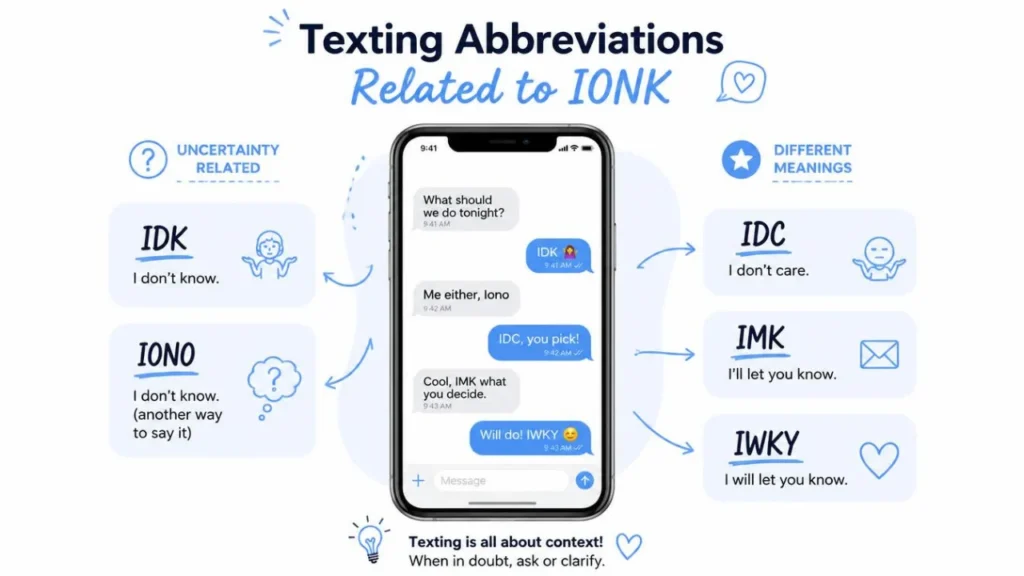
A few other terms sit in the same neighborhood, but they’re not interchangeable.
| Term | Meaning | How it differs from IONK |
| IDK | I don’t know | The standard, most widely recognized version. IONK is the more phonetic, casual variant of the same thing |
| IMK | I mean, kinda | IMK expresses a qualified or uncertain opinion, while IONK directly means “I don’t know” |
| Iono | I don’t know | Another slurred spelling of the same phrase, functionally close to IONK |
| IDC | I don’t care | Not the same sentiment. This signals apathy, not uncertainty. Don’t swap it in for IONK |
| IWKY | I wish you knew | IWKY expresses a personal or emotional statement, while IONK simply indicates that someone doesn’t know something |
| IDEK | I don’t even know | Stronger version of “I don’t know,” often used when someone is more confused or overwhelmed |
| JSP | Just Playing / Just Saying / Je Sais Pas | Can mean “I don’t know” in French contexts (Je Sais Pas), but also used for joking or soft opinions |
| NMMS | No mames / No manches | Spanish-influenced reaction slang, often used for surprise rather than pure uncertainty |
The distinction that actually matters is IONK/IDK/iono (all uncertainty) versus IDC (indifference), IMK (a qualified opinion), and IWKY (a personal statement). Mixing those up changes the tone of what you’re saying. “I don’t know” invites more conversation; “I don’t care” tends to shut it down.
When Not to Use “IONK”
It is fine for friends, group chats, and casual social platforms. It’s not built for anywhere formality matters work emails, school assignments, job applications, or customer support conversations.
If you’re texting a friend, “ionk, ask Jake” works fine. In a work Slack message, the same idea reads better as “I don’t have that information yet let me check.” Same meaning, different register.
Common Mistakes and Misunderstandings About “IONK”
A few misconceptions come up often enough to be worth clearing up directly:
- Confusing it with “ion” alone. As covered above, “ion” means “I don’t,” while IONK specifically means “I don’t know.” Missing the “know” part changes what’s being said.
- Assuming it’s dismissive or rude. On its own, IONK is neutral. Whether it reads as blunt, friendly, or careless depends entirely on tone, punctuation, and what’s around it not the abbreviation itself.
- Treating it as a coded or hidden message. It isn’t. There’s no secret meaning layered underneath “I don’t know.”
- The “I Only Now Know” claim. A small number of sources online define IONK as “I Only Now Know,” used to express a sudden realization. This isn’t supported by how the term actually shows up across chats, TikTok comments, and mainstream slang usage “I don’t know” is the meaning that’s consistently confirmed across real examples and usage. If you see the alternate definition somewhere, treat it with skepticism rather than as an established second meaning.
Where Did “IONK” Come From?
There’s no single documented moment or creator behind this term no verified date, platform, or origin story exists in reliable sources. What can be said with confidence is that it fits a broader, well-established pattern in texting slang: phonetic spellings that mimic how phrases actually sound when spoken quickly and casually. “Ion” for “I don’t” follows the same logic, and IONK extends it.
It’s also visible in the kind of content that tends to spread slang like this TikTok comment sections and videos where people explain unfamiliar terms to confused viewers are part of how a word like this reaches people outside the group that started using it. Beyond that general pattern, though, there isn’t a reliable timeline to point to.
Final Words
IONK isn’t complicated once you see it in a sentence it’s just “I don’t know,” dressed down for fast typing. The only real skill is reading the context around it, since that’s what tells you whether someone’s genuinely unsure, brushing off the question, or leaving room for a different answer later.
FAQs
Is IONK the same as IDK?
Yes. Both mean “I don’t know.” it is just a more phonetic, casual-sounding spelling of the same idea.
Can IONK mean something else?
Rarely, and not reliably. A few sources define it as “I Only Now Know,” but that isn’t backed up by how the term is actually used in real chats and content “I don’t know” is the meaning you can count on.
What does IONK mean on Instagram or Snapchat?
Same thing it means everywhere else “I don’t know.” The meaning doesn’t change from platform to platform.
What does “ions” mean in slang?
There isn’t a reliably documented, distinct slang meaning for “ions” as its own term separate from “ion” or “ionk.”
Someone Texted You a Word You Don’t Understand?
MeaningInsider Gives You the Real Meaning, Real Examples, and How to Reply All in One Place.
