


You’ve just seen “ADIH” under a photo or in a message, and you can’t tell whether it’s a joke or a cry for help.
ADIH stands for “Another Day In Hell.” It’s a casual way of complaining about a rough day or a situation you’re stuck in, most often a job you don’t like.
Nobody sending it is literally in hell. It’s an exaggeration, and the tone can range from a real vent to a dry joke.
What Does ADIH Mean in Text?
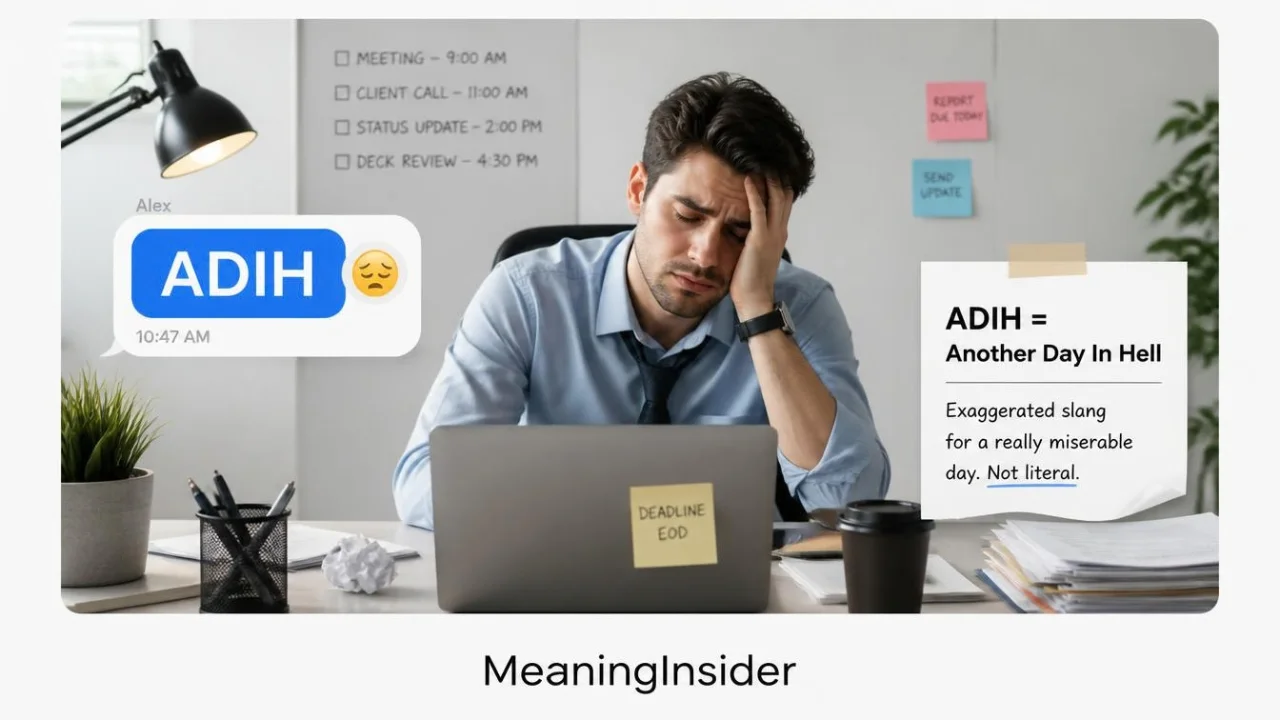
Each letter stands for one word: Another Day In Hell. People type it instead of the full phrase when they want to say that things are unpleasant, again.
The “hell” part is hyperbole. English has long used the word for anything miserable or punishing, and dictionaries list expressions like “war is hell” and “give someone hell.” ADIH works the same way.
Slang dictionaries classify ADIH as texting and online chat shorthand. Slang.net describes it as a way to complain about unfortunate circumstances, most commonly a job you hate. It isn’t new, either. Slang.net’s entry was last updated in October 2013, and AcronymsAndSlang also has a 2013 entry.
The Tone and Intent Behind ADIH

The same four letters can carry quite different intentions, so it helps to know the common ones. Slang.net documents the first two below. The rest are readings of how a phrase like this naturally works, and they’re offered as interpretation, not as dictionary findings. The conversations are invented for illustration.
A genuine vent about work
This is the textbook use: the sender is fed up and the message is a real complaint.
Jo: how’s the new job going
Sam: adih honestly. 3 meetings that could’ve been emails and my manager moved the deadline AGAIN
Jo: brutal. drinks friday?
Sarcasm on a good moment
Slang.net notes that people sometimes pair ADIH with a photo of their vacation. Here the phrase says the opposite of the picture, and the contrast is the joke.
Priya: [photo of a beach at sunset]
Priya: adih 🙄
Dev: i genuinely hate you
The message is closer to “look how good my day is,” delivered with a straight face.
Deadpan resignation
Sometimes there’s no big feeling, just a shrug. The day is the same as yesterday and the sender is announcing it flatly.
Maya: monday. adih
Luca: same
Maya: at least it’s only 9am
Bonding with people in the same boat
In a group chat or between coworkers, ADIH can work as a quick signal that you’re all dealing with the same thing. This one is interpretation, but it fits how a shared complaint tends to work: sending it assumes the other person already knows what you mean.
Hamza: [photo of a full inbox] adih
Sara: lol welcome to my week
Hamza: 4 more days of this
Exaggerating a small annoyance
Because “hell” is so over the top, ADIH is also easy to use on trivial problems, on purpose. The mismatch between the phrase and the problem is where the humor comes from.
Zain: wifi’s down, my charger’s dead and the bus is late. adih
Ayesha: the holy trinity of mondays
A quiet bid for sympathy
Occasionally the light wording hides something heavier. A person who rarely complains sends ADIH on its own, and the offhand tone is covering for how the day actually went.
Nina: adih
Tom: you good? that’s not like you
Nina: just a really rough few days. can i call you later?
The follow-up question is what surfaces it: the first message was small, but the second shows it wasn’t.
How to tell which one you’re reading
The letters themselves won’t tell you, but the context usually does. Check these:
- What came before it. If you’d just asked about their day or job, it’s probably a real vent. After a cheerful photo or message, it’s probably sarcasm.
- Whether there are details. A specific complaint reads as sincere. A bare “adih 😌” next to something nice reads as a joke.
- How this person normally texts. If they joke in every message, read it as a joke. If they’re usually upbeat and this is out of character, take it more seriously.
- Your relationship. With a close friend you can usually guess. With someone you don’t know well, it’s safer not to guess.
ADIH on Social Media: Captions, Stories and Statuses

No source ties ADIH to a particular app, but the same logic that works in a text works in a caption, because a post is just a message sent to a wider audience.
A few ways it could naturally appear:
- An Instagram caption on a desk photo. The picture shows a laptop and cold coffee, and the caption does the rest: “monday, 8:47am. adih ☕”
- A story over a photo of the office. A shot of the building or your cubicle with a short “adih” on top.
- A WhatsApp or Snapchat status. A quick work-day photo with the acronym as a one-word status, usually for friends who already get the tone.
- A post on X. One line, such as “alarm at 5, deadline at 9, adih,” works the same way as it would in a text.
- A comment under someone else’s post. Replying “adih” to a friend’s office photo says “I feel this” without writing a sentence.
On a public post, your boss, relatives and strangers can see it too, and none of them has the context a friend has. A photo or emoji helps show whether you’re venting or joking.
How to Reply When Someone Texts You ADIH
The right reply depends on what the sender meant, so it helps to match it to the intents above.
| If it looks like… | A good reply is… | Example |
|---|---|---|
| A real vent | Short and warm, with an open door | “ugh, sorry. what happened?” |
| Sarcasm | Play along | “i hate you. send more photos” |
| Deadpan resignation | A matching shrug | “same. hang in there” |
| Bonding | Join in | “ha, my week’s no better” |
| An exaggerated annoyance | Tease them gently | “the holy trinity of mondays” |
| A possible bid for sympathy | Check in directly | “you good?” |
If you can’t tell which one it is, “rough one?” works for almost all of them.
Mistakes to Avoid With ADIH
- Reading “hell” literally. Responding to a throwaway ADIH with full alarm can feel like an overreaction.
- Assuming the day was bad. Because ADIH can be sarcastic, a cheerful photo with ADIH on it doesn’t mean the person is struggling.
- Missing the quiet one. The opposite mistake matters as much. A bare ADIH from someone who never complains deserves a second look.
- Sending it into a serious situation. It’s a light phrase, and it can sound dismissive if the other person is dealing with something real.
- Using it with the wrong audience. It’s casual and includes the word “hell,” so it suits friends better than a boss or a first message to someone new.
- Mixing it up with ADIP. The two have opposite wording.
Where Did ADIH Come From?
Nobody has documented who first used ADIH, or where. No dictionary names a coinage, a platform or a community behind it.
What can be said is where it sits: NetLingo files it under online jargon, the family of text-message shorthand. The rest is reasoning, not history. Abbreviations like this usually shorten a phrase people keep repeating, and “another day in…” is a stock opening.
Similar Slang and Terms Like ADIH
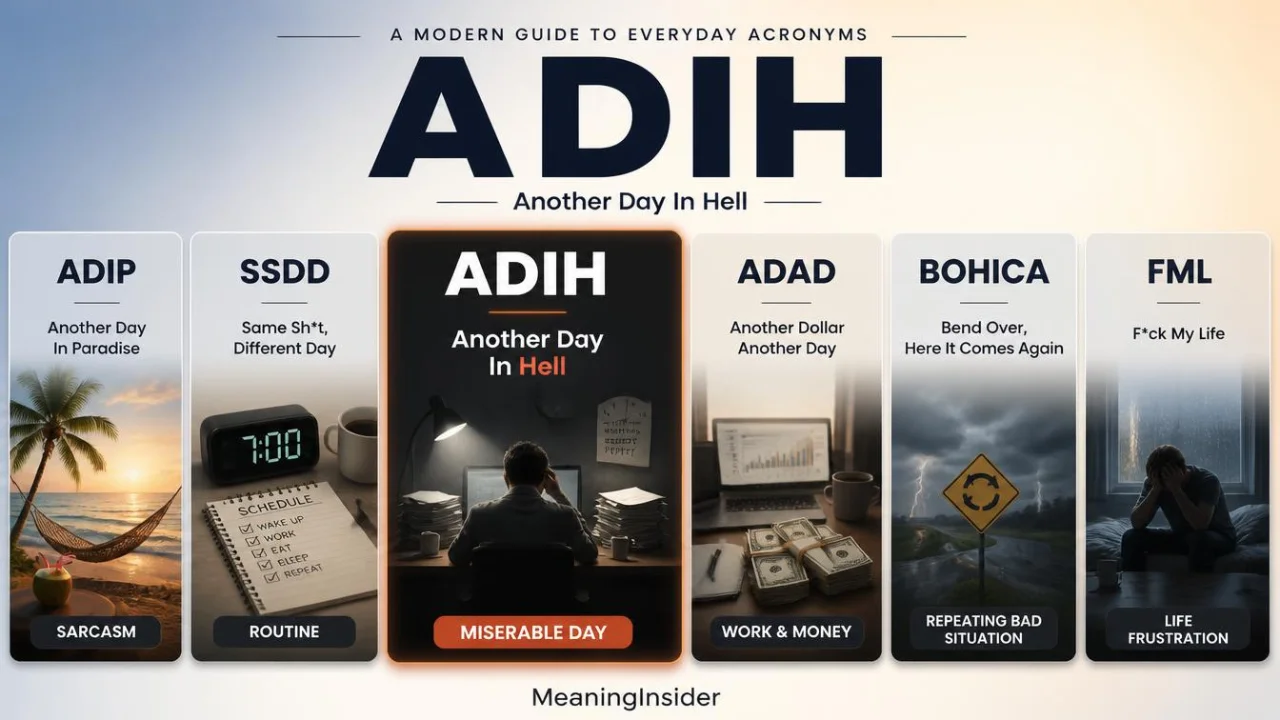
Several other abbreviations cover the same ground, mostly differing in what they point at: the day, the routine, the person, or the whole situation.
| Term | Stands for | How it differs from ADIH |
|---|---|---|
| ADIP | Another Day In Paradise | The opposite wording |
| SSDD | Same Sh** Different Day | Points at monotony rather than misery |
| ADAD | Another Day Another Dollar | Centers on work and getting paid |
| BOHICA | Bend Over, Here It Comes Again | Crude; about a bad situation about to repeat |
| FML | F*** My Life | Cruder and heavier; about the person’s whole life, not just today |
| PMO | Pisses Me Off (also “Put Me On”) | Aimed at a specific irritation, not the day |
| FYRTRD | Disputed | Several competing explanations, no settled meaning |
ADIP is the easiest one to confuse with ADIH. A folklore archive at USC recorded the spoken phrase “another day in paradise” as a sarcastic remark from tired coworkers. It’s a single record, but it’s enough reason not to assume ADIP is cheerful.
PMO is aimed at one specific irritation, like a delayed flight, rather than the overall slog. Our PMO guide also covers its other meaning, “Put Me On.”
FYRTRD is tied by many online sources to work, burnout or retirement, though they disagree on what it stands for. Our guide walks through the different explanations.
Other Meanings of ADIH
Outside texting and chat, the same letters belong to unrelated fields:
| Meaning | Where it appears |
|---|---|
| Anti-TB (antituberculosis) drug-induced hepatotoxicity | Medical papers, where it refers to liver damage linked to tuberculosis drugs |
| Acute drug-induced hepatitis | A clinical trial listing |
| Abu Dhabi Investment House | A UAE investment company, listed in an investor database |
Context settles it. If a friend texts it about their week, it’s the slang meaning. If you’re reading a medical paper or a company profile, it’s one of the others.
Final Words
ADIH can be a real complaint, a running joke or a sarcastic flex on a good day. The letters matter less than who sent them and what’s going on around the message. If you’re not sure how to take it, just ask.
FAQs
What does ADIH mean from a guy?
The meaning is the same whoever sends it. What changes is the tone, which depends on the person and your relationship with them. Nothing in the dictionaries suggests a different meaning based on gender.
Is ADIH a swear word?
Not exactly. ADIH isn’t a word itself, and “hell” is a mild one.
Is ADIH okay to use at work or with people you don’t know well?
It’s safer with friends than in formal messages or with someone you’ve just met.
Is ADIH social media slang or a texting abbreviation?
It’s texting and online chat shorthand. It shows up in captions the same way it shows up in texts, but no reliable source ties it to a particular platform.
Is ADIH still used today?
There’s no usage data to say how common it is now. What can be said is that slang dictionaries have listed it since at least 2013.
Should ADIH be capitalized?
Either works. Capitals look like an acronym, and lowercase fits the loose style of casual texting. The meaning is the same.
Someone Texted You a Word You Don’t Understand?
MeaningInsider Gives You the Real Meaning, Real Examples, and How to Reply All in One Place.
