
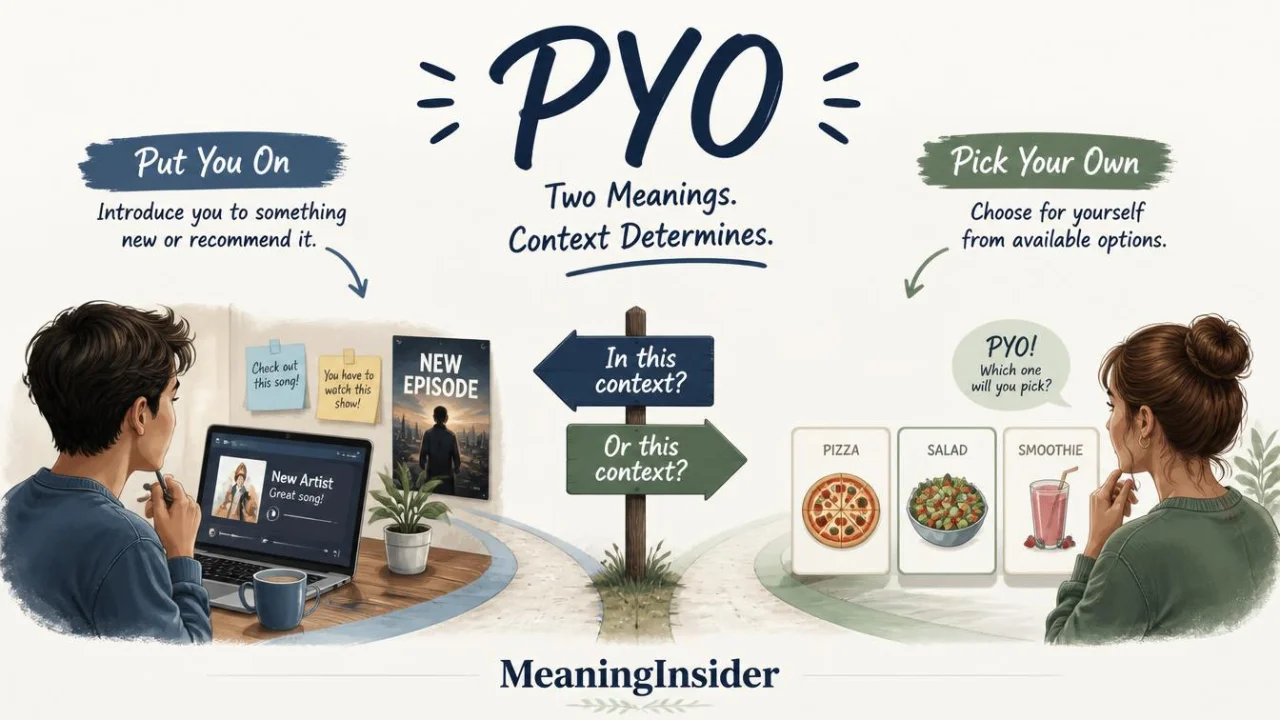

If someone just sent you “PYO” and you’re staring at it like it’s a typo, you’re not missing some obvious reference. It’s genuinely a term with more than one meaning, and context is doing most of the work.
In casual texting, PYO usually means “Put You On” as in, someone’s about to introduce you to something they think is worth your attention. A song, a show, a restaurant, an app, even a person. Less often, you’ll see PYO used for “Pick Your Own,” where the person is handing a decision back to you instead of making it themselves. Both are real. One shows up a lot more than the other.
What Does PYO Mean?
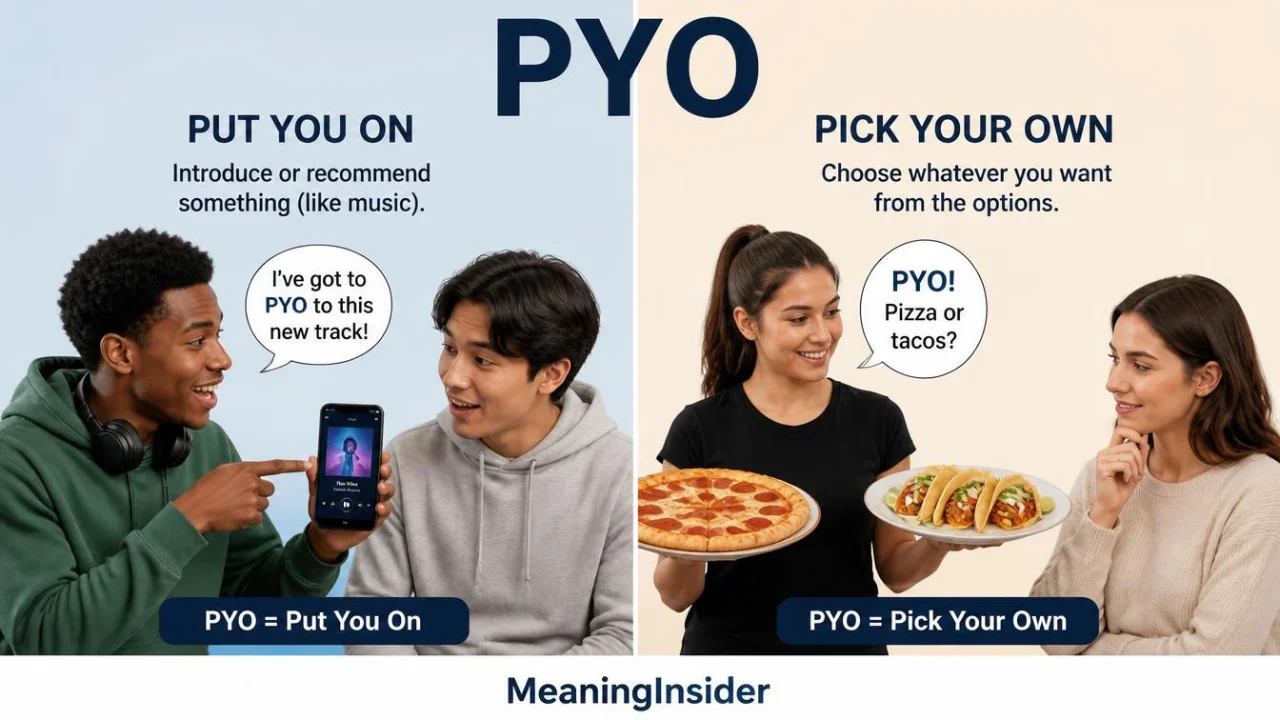
“Put You On” (the common meaning)
This is the one you’ll run into most. “Put you on” is an established phrase in music and recommendation culture. It means introducing someone to something they didn’t already know about. Shortened to three letters, it becomes PYO.
You’ll almost always see it paired with “lemme” or “let me”:
“You’ve never heard this album? Lemme PYO.”
That’s shorthand for “let me put you on,” meaning let me show you this thing I think you’ll like. It carries a small social charge to it too: the person saying it is usually a little proud to be the one sharing it first.
“Pick Your Own” (the less common meaning)
The second meaning is more literal. Here, PYO just means the other person gets to choose, food, plans, a movie, whatever’s on the table, instead of you deciding for them.
“Pizza or tacos tonight?”
“PYO, I’m easy either way.”
This use isn’t rare exactly, but it’s noticeably less common than the “put you on” sense in ordinary texting. If you see PYO with no other context, “put you on” is the safer first guess, though the surrounding message will usually tell you which one it is within a sentence or two.
Why People Shorten It to PYO
Neither “put you on” nor “pick your own” is a long phrase to begin with, so the shortening isn’t really about saving effort. It’s more about tone. Three letters feel quicker and more casual than typing the full phrase out, and in fast-moving group chats or comment sections, that casualness is part of the point. Spelling the phrase out in full can actually read as more formal or deliberate than the moment calls for.
PYO and PMO
Related to this is PMO, which flips the direction: “Put Me On.” Where PYO is offering a recommendation, PMO is asking for one.
“PMO to some new music, I’m bored of my playlist.”
They’re not interchangeable. PYO gives, PMO requests. But seeing one makes the other easier to recognize when it shows up.
PYO on Different Platforms
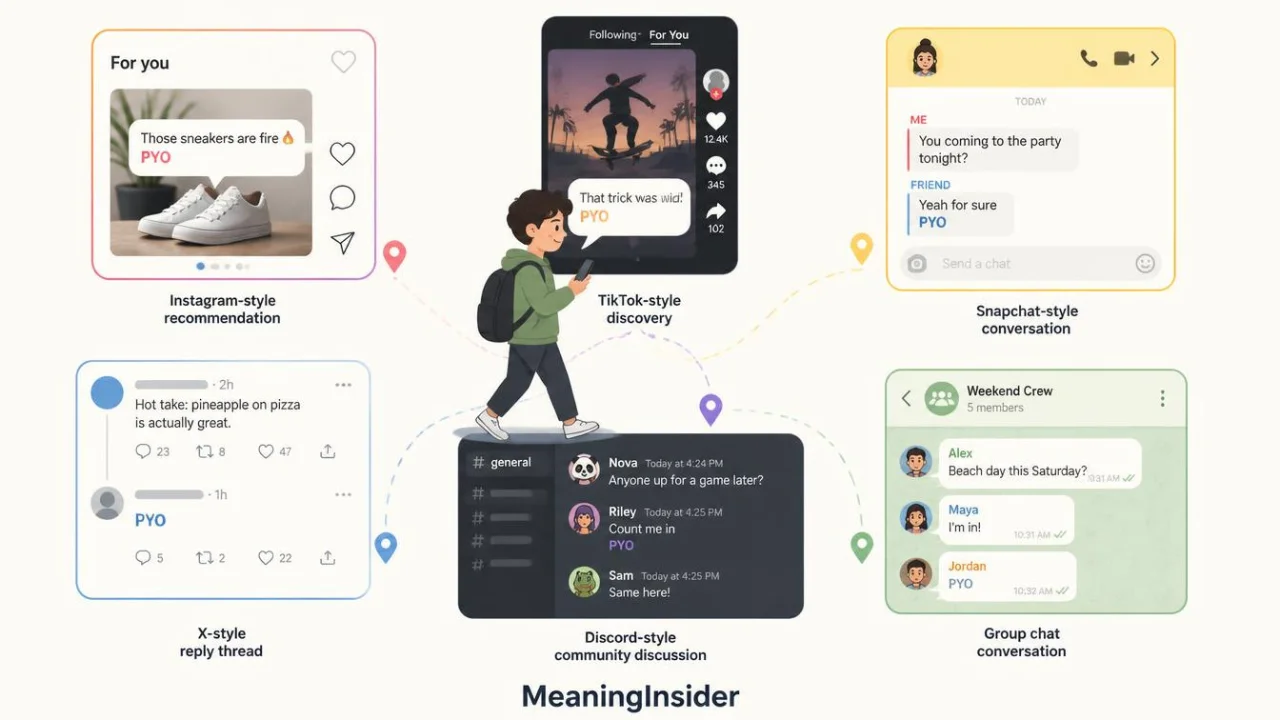
Instagram and TikTok
“Put you on” shows up naturally here since both platforms are built around recommendation culture:
- TikTok comments/captions: “this sound is about to PYO to something good”
- Instagram DMs: sharing a find directly with a friend, often with a screenshot or link attached
The platform doesn’t change the meaning. It just gives the phrase more room to show up, since discovery is the whole point of both apps.
Snapchat, X (Twitter), Discord, and Group Chats
Same meaning carries over here too:
- Snapchat: used in captions or chat the same way as texting
- X/Twitter: shows up in reply threads when someone’s recommending an account, thread, or post
- Discord: common in channels built around music, games, or shared interests
- Group chats: the most common place you’ll see it overall, simply because that’s where recommendations naturally get shared
One thing worth flagging: if you’ve seen a claim that PYO means something different, or negative, specifically on Snapchat, that doesn’t hold up outside of a single unreliable source. Treat it as a myth, not a platform rule. The meaning stays consistent everywhere. What changes is only how often you’ll run into it.
PYO in a Real Text Example
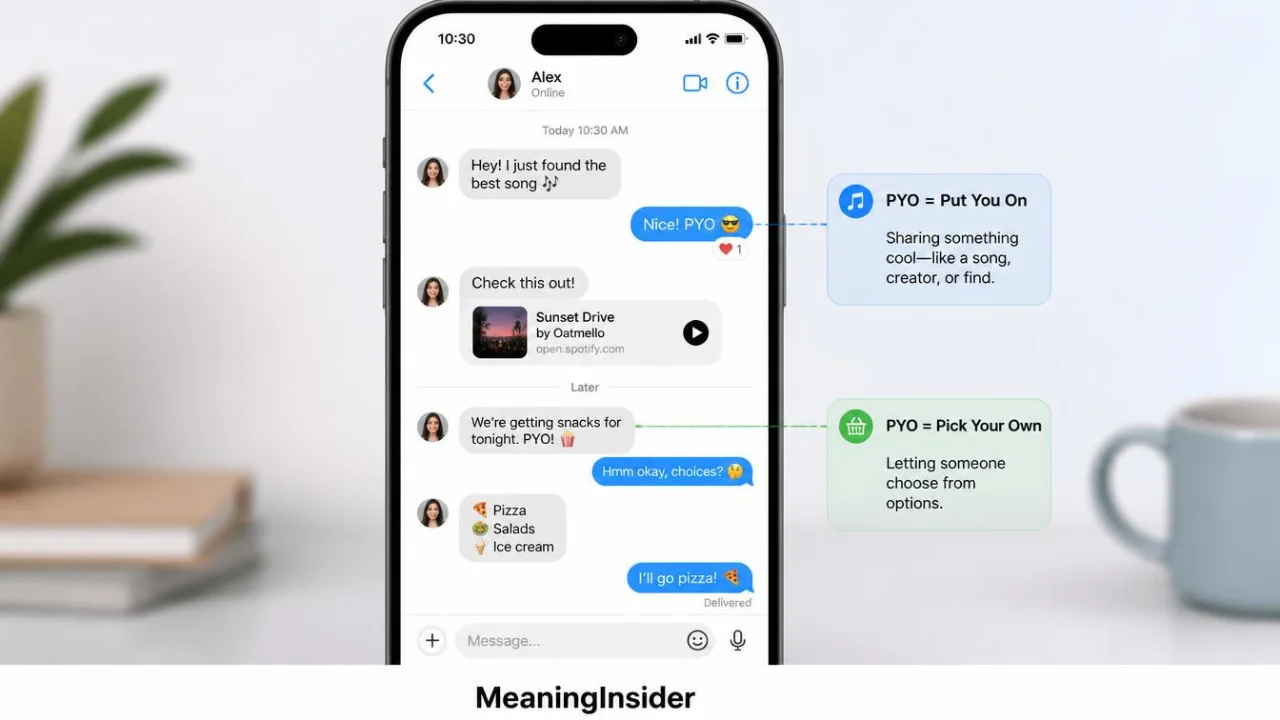
Here’s what the two meanings actually look like side by side.
“Put you on” sense:
jade: HY you need to hear this song rn
jade: lemme pyo, trust me
sam: send it
Another one:
marcus: bro I finally tried that ramen spot you mentioned
marcus: ngl you pyo’d me to something good for once 😭
“Pick your own” sense (less common, but real):
group chat: where’s everyone tryna eat sat
dani: pyo I really don’t care lol, anywhere’s fine
How to Reply to PYO
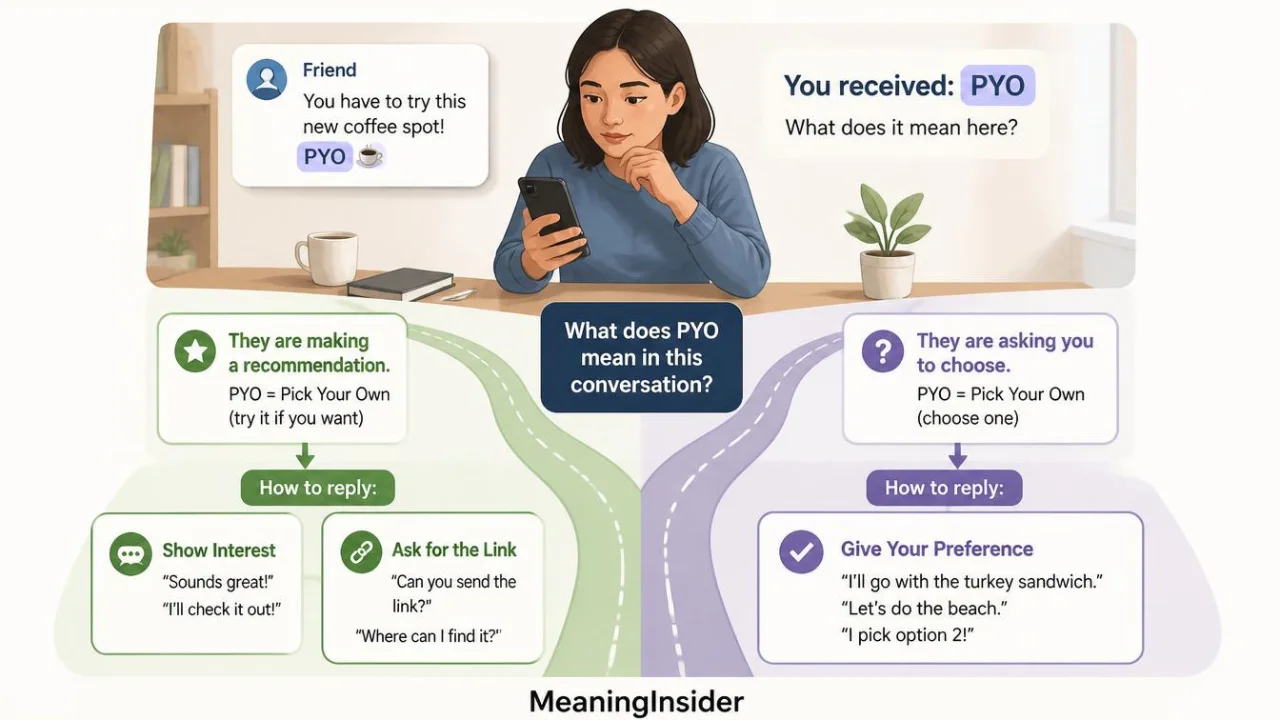
How you reply really depends on which version of PYO you just got, so it’s worth pausing for a second to figure out which one it is before you respond.
If They’re Recommending Something (“Put You On”)
The point of this message is that someone’s excited to share something, so the best replies acknowledge that rather than just moving past it.
- If you’re interested: “say less,” “send it,” or simply “okay, I’m listening.”
- If you check it out later: circle back and tell them what you thought, that’s genuinely the best reply, since it closes the loop and shows you actually took the recommendation seriously
- If you’re not that interested: a simple “maybe later” is fine, but flat-out ignoring it can come across as dismissive of something they clearly cared about sharing
If They’re Asking You to Choose (“Pick Your Own”)
Here the message is really just a question wearing a shortcut. The person genuinely wants your input, so the most useful reply is a direct answer.
- If you have a preference: just say it plainly, “let’s do tacos” beats sending PYO back, which only restarts the same back-and-forth
- If you truly don’t care either way: say that clearly instead, something like “either’s fine, you pick” moves things forward, whereas replying with PYO again just bounces the decision back without resolving anything
- If you need more information first: it’s completely fine to ask, “what are the options?” is a normal response when the choices haven’t actually been listed yet
The short version: PYO as a recommendation deserves a reaction, while PYO as a question deserves an actual answer.
Words Similar to PYO
| Term | Meaning | How it’s different |
| PMO | Put Me On | Requests a recommendation instead of offering one, the reverse direction of PYO |
| BYO | Bring Your Own | Asks someone to supply something themselves; visually close to PYO, but unrelated in meaning |
| WYA | Where You At | Same casual three-letter format as PYO, but asks for location, not a recommendation or choice |
| PYT | Pretty Young Thing | Shares two letters with PYO and appears in similar casual contexts, but describes a person’s appearance, not an action |
| PYP | Pick Your Poison | Same intent as PYO’s “pick your own” sense, just a more playful, idiomatic way of offering a choice |
| LMK | Let Me Know | Often used right alongside PYO in the “pick your own” sense, since both hand a decision to the other person |
PYO in Medical and Veterinary Contexts
This one has nothing to do with texting, but it’s worth knowing since the letters overlap.
The “Pyo-” Prefix (Pus)
“Pyo-” is a real prefix from Greek, meaning pus. It shows up in medical terms like pyogenic (pus-producing) and pyoderma (a skin infection involving pus). If you’ve seen “PYO” used in a clinical or health-related sentence, this is almost certainly why, not the slang meaning at all.
Pyometra (Veterinary Use)
The specific term you’ll most likely run into is pyometra, a uterine infection that can affect unspayed female dogs and cats. It’s a genuine, sometimes serious veterinary condition, and it’s a completely separate use of the letters PYO from anything discussed above.
Common Mistakes People Make with PYO
- Assuming there’s only one meaning. PYO can mean “put you on” or “pick your own,” and missing which one applies is the most common mix-up. The fix is simple: read the sentence around it, not just the abbreviation.
- Confusing it with BYO. The two look almost identical at a glance, but they mean opposite things, one is offering, the other is a request.
- Overthinking capitalization. PYO, Pyo, and pyo all mean exactly the same thing. Capitalization is just a style choice, not a signal about tone or meaning.
- Assuming everyone will understand it. PYO isn’t as universally recognized as terms like “lol” or “brb.” If you’re texting someone who might not know it, spelling out “put you on” avoids a confused reply.
Final Thoughts
PYO isn’t complicated once you know there are two meanings in play. It just asks you to pay attention to context for a second longer than a term like “lol” would. Most of the time, someone’s about to show you something. Every so often, they’re just handing you the choice.
FAQs
Does PYO mean “Put You On” or “Pick Your Own”?
Both are real, but “Put You On” is the far more common meaning in everyday texting. “Pick Your Own” shows up too, just less often.
What does “lemme PYO” mean?
It means “let me put you on,” the person is about to introduce or recommend something to you.
Does PYO mean pus?
Not on its own in texting, but the prefix “pyo-” does mean pus in medical terms, which is where you’d see it used that way, in words like pyogenic or in the veterinary condition pyometra.
Is PYO used the same way on Snapchat, Instagram, and TikTok?
Yes, the meaning stays the same across platforms. What changes is just how often you’ll run into it, since recommendation-heavy spaces like TikTok comments use it more.
Does capitalization change what PYO means?
No. PYO, Pyo, and pyo are all read the same way, capitalization is just a style choice, not a meaning signal.
Someone Texted You a Word You Don’t Understand?
MeaningInsider Gives You the Real Meaning, Real Examples, and How to Reply All in One Place.
