
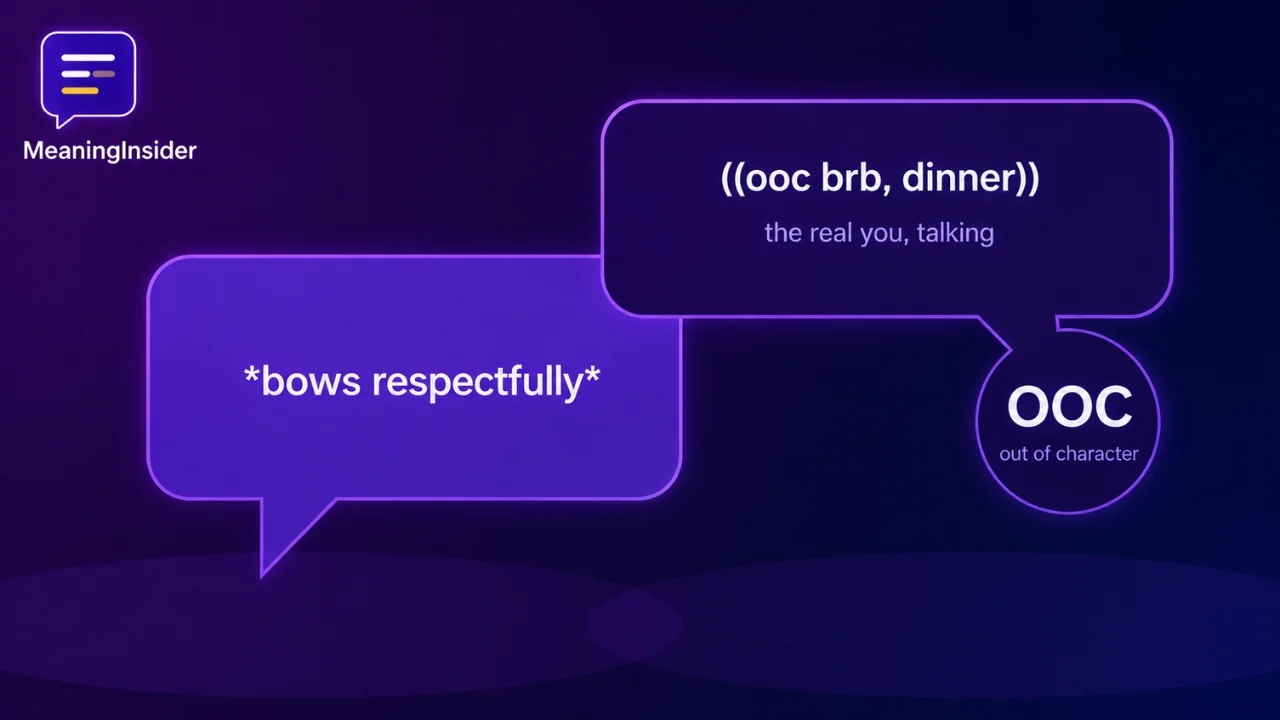

OOC most commonly means “out of character.” You’ll see it in roleplay chats, fanfiction comments, and increasingly in conversations with AI chatbots, always signaling that whoever’s typing has stepped out of a fictional role to speak as themselves.
That’s the main one, but it’s not the only one. OOC can also mean “out of context” (a quote or clip shown without the full picture) or “out of control” (used loosely to describe someone acting wild or unmanageable). Which meaning applies almost always comes down to where you’re reading it. A gaming or fandom thread is nearly always “out of character.” A heated Twitter reply calling out a quote is almost certainly “out of context.” A parent texting their kid about staying out too late is probably “out of control.”
OOC at a Glance
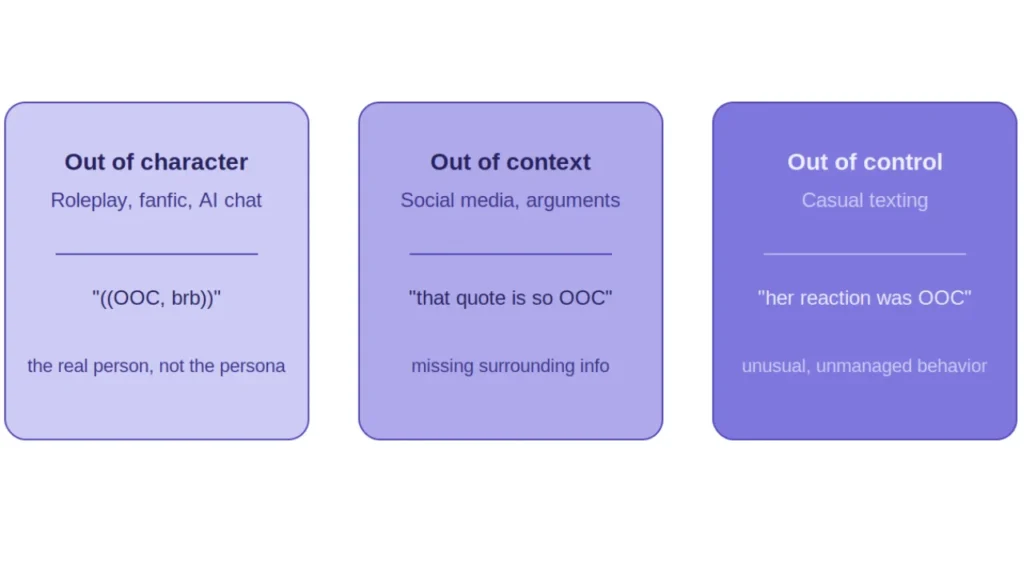
| Meaning | Where You’ll See It | Example |
| Out of character | Roleplay, fanfic, AI chat | “((OOC, brb))” |
| Out of context | Social media, arguments | “that quote is so OOC” |
| Out of control | Casual texting about someone’s behavior | “her reaction was OOC” |
OOC in Different Contexts
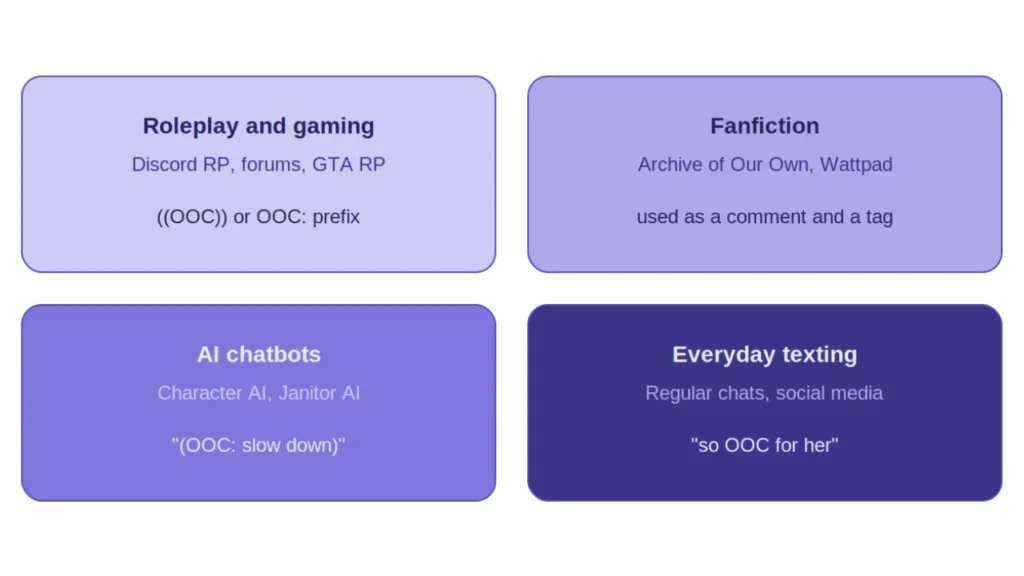
Rather than changing meaning from platform to platform, OOC shifts depending on the kind of space you’re in. Here’s how it plays out:
Roleplay and gaming spaces. In Discord RP servers, forum roleplay, and GTA RP communities, OOC marks the moment a player steps away from their character to talk as a real person. It usually gets wrapped in double parentheses, a prefix like “OOC:”, or slashes, so nobody mistakes it for something happening in the story. On a lot of GTA RP servers this isn’t just etiquette either. Mixing in-character and out-of-character talk without marking it can actually get you in trouble with server rules.
Fanfiction. On sites like Archive of Our Own and Wattpad, OOC is both a comment people leave and an actual tag. It flags a character acting in a way that doesn’t match how they’re written in canon, a normally guarded character suddenly oversharing, for example. Writers tag their own work as OOC when it’s intentional, and readers use the tag to filter for or against it.
AI chatbots. This is a newer use worth knowing. On apps like Character AI and Janitor AI, people type something like “(OOC: slow down the pacing)” to give the bot a direction without that instruction becoming part of the story itself. The AI is expected to treat it as a note from the user, not dialogue from the character.
Everyday texting. Outside of fandom and gaming, OOC gets used more loosely about real people. Calling something someone did “so OOC” just means it didn’t match how they normally act.
Where Did OOC Come From?
OOC is closely tied to early online roleplay and fanfiction communities, where people needed a quick, reliable way to separate “this is my character talking” from “this is actually me talking.” Beyond that general connection, there isn’t a clearly documented first use or exact starting point, so it’s worth being upfront that the precise origin isn’t settled.
OOC in a Real Chat Example
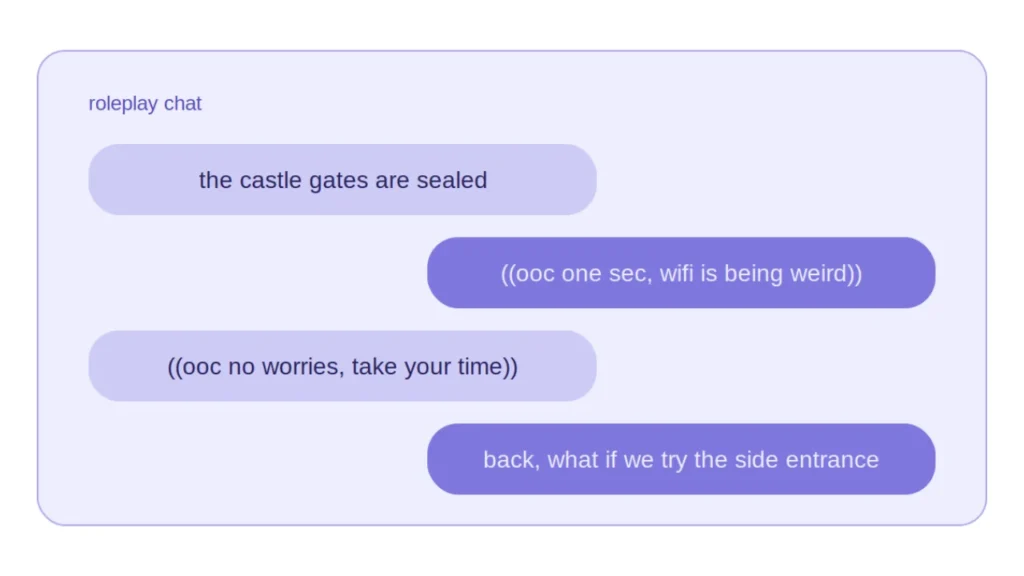
Here’s what it looks like inside a roleplay session, where someone needs to step out for a second:
Jules: the castle gates are sealed, we need another plan
Mika: ((ooc one sec, my wifi is being weird))
Jules: ((ooc no worries, take your time))
Mika: back, sorry about that. okay so what if we try the side entrance
And here’s how it shows up in a regular text exchange, no roleplay involved:
Sam: did you see how quiet Priya was at lunch today
Dana: yeah that was so ooc for her, she’s usually the loudest one in the group
Sam: hope she’s okay
Getting Back In Character
If OOC is the signal for stepping out, BIC (“back in character”) is the one for stepping back in. Someone might type “((OOC, brb))” to step away, then simply “BIC” when they return to let everyone know the story can pick back up. This pairing is mostly a roleplay and gaming convention. You won’t typically see someone text “BIC” after a normal conversation, since that half of the pair really only makes sense once you’re already inside a roleplay scene.
Words Similar to OOC
A few terms travel alongside OOC in the same spaces:
- IC (in character): the opposite of OOC, meaning a message comes from the character being played, not the real person.
- BIC (back in character): signals a return to the story after an OOC break.
- Metagaming: when a player has their character act on information the player only knows because of something said OOC. It’s generally considered bad etiquette in roleplay communities, since it breaks the separation OOC is meant to protect.
Terms like OOC weren’t the only shorthand that grew out of early forum and roleplay culture. Another one from the same era is B7, which started as a quick way to say “banned.”
Common Mistakes People Make Using OOC
A few things about this one can be confusing:
- Forgetting to mark it. If an OOC comment isn’t bracketed or labeled somehow, it can genuinely confuse other players or readers about what’s part of the story and what isn’t.
- Using it as a vague complaint. “This is so OOC” without saying what specifically feels off isn’t very useful. OOC callouts land better when they explain the actual inconsistency.
- Assuming everyone knows it. Outside fandom or gaming circles, OOC isn’t universally understood. Dropping it into a message to someone unfamiliar with the term can just create confusion instead of clarity.
Final Words
OOC is one of those acronyms that bends to whatever room you’re in. Whether it’s roleplay, fanfiction, an AI chat, or a regular group text, the letters remain the same their meaning simply changes with the context.
Once you know to check the context first, you won’t second-guess which one you’re looking at.
OOC isn’t the only texting shortcut that changes meaning depending on context. If you’ve run into a similar mix-up, IWKY follows the same pattern.
FAQs
What is OOC short for?
Most commonly, “out of character.” It can also stand for “out of context” or “out of control” depending on the setting.
What does OOC mean in GTA RP?
The same thing it means elsewhere: out of character. Many GTA RP servers restrict OOC talk to specific channels, and mixing it with in-character dialogue without marking it is often treated as a rule violation.
What does OOC mean at work or in a business context?
Outside of internet slang, OOC has several unrelated expansions used in business and technical fields. There isn’t one dominant meaning here, so it’s worth reading based on the specific context rather than assuming a fixed definition.
What’s the difference between OOC and IC?
IC means a character is speaking. OOC means the real person behind the character is speaking. The two are meant to stay clearly separated so nobody mixes up what’s part of the story and what isn’t.
Someone Texted You a Word You Don’t Understand?
MeaningInsider Gives You the Real Meaning, Real Examples, and How to Reply All in One Place.
