

Have you seen someone comment “GPI” after their friends shared pictures from a party, dinner, or trip? The three letters might look like another random internet abbreviation, but they have a specific meaning in Spanish-language online conversations.
GPI stands for “Gracias Por Invitar,” a Spanish phrase that means “Thanks for inviting me.” People often use it sarcastically when they discover that their friends went somewhere without inviting them. It is a playful way of saying, “Thanks for leaving me out!”
However, GPI is not always sarcastic. The meaning and tone depend on the situation and the relationship between the people communicating. Here’s how to understand it in messages, social media comments, and everyday conversations.
What Does GPI Mean in Text?
GPI means Gracias Por Invitar in Spanish. It is an informal texting abbreviation formed from the first letters of the three words.
Although its direct English translation is “Thanks for inviting me,” people frequently use it to point out that they were not included in a particular plan or event.
For example:
Friend: “We all went out for dinner last night. It was amazing!”
You: “GPI 😂”
Here, you are not genuinely thanking your friends for an invitation. You are jokingly reminding them that they went out without you.
What Does “Gracias Por Invitar” Mean in English?
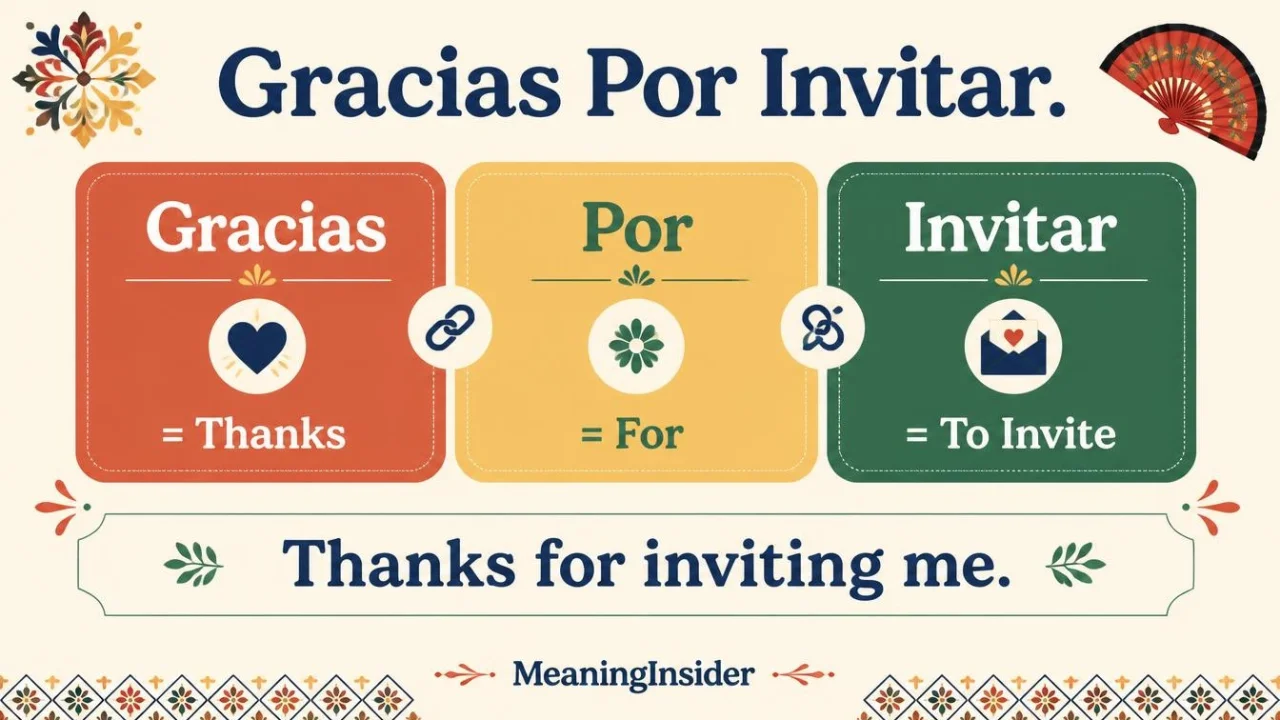
The Spanish phrase has three parts:
| Spanish word | English meaning |
|---|---|
| Gracias | Thanks |
| Por | For |
| Invitar | To invite |
Together, Gracias Por Invitar means “Thanks for inviting me” or, more naturally in everyday English, “Thanks for the invite.”
The word “me” is understood from the context rather than appearing as a separate word in the phrase.
When someone types GPI, they shorten the entire expression into three letters, making it easier to use in quick messages and social media comments.
Why Is GPI Often Used Sarcastically?
The interesting part of GPI is that its literal meaning and intended message are not always the same.
Someone might write “Thanks for inviting me” even though nobody actually invited them. Instead of directly asking why they were left out, they use GPI to make a playful complaint.
When friends want to know what someone is doing or whether they are free to join an outing, they may ask using WYO meaning (“What you on?”).
Consider these two situations.
When GPI Is Used Literally
GPI can express genuine appreciation when someone actually invites you somewhere.
For example:
Friend: “We’re having a birthday party on Saturday. You should come!”
You: “GPI! I’ll definitely be there.”
In this situation, the sender is expressing thanks for the invitation. There is no hidden complaint or sarcastic meaning.
When GPI Is Used Sarcastically
This is the usage commonly described in Spanish-language social media explanations.
Imagine your friends went to a restaurant, enjoyed dinner, and posted pictures without telling you about their plans.
You discover their photos and comment:
“GPI guys 😂”
Your message is closer to:
- Thanks for leaving me out.
- Looks like everyone had fun without me.
- Why didn’t you invite me?
- Next time, remember to include me.
It is a way to call attention to a missed invitation without necessarily starting an argument.
The expression can be humorous between close friends, although it may also communicate genuine disappointment when someone feels deliberately excluded.
Where Does GPI Come From? Understanding Its Spanish Background
GPI comes from the Spanish phrase Gracias Por Invitar. It belongs to informal digital communication, where people shorten longer expressions to make messages quicker to type.
The expression is documented in Mexican Spanish-language usage. A 2022 dictionary published with the involvement of the Universidad Autónoma de Coahuila records gpi as a colloquial expression used on social networks such as Facebook and WhatsApp, particularly as an ironic response when friends attend a party or gathering without inviting the person commenting.
Spanish-language publications such as NMás and TreceBits also explain its use in social media conversations.
You can read more about this usage in the University of Coahuila’s dictionary of expressions and this Spanish-language explanation from NMás.
One distinction is worth keeping in mind: these sources document the phrase and its colloquial use, but they do not establish who first created GPI or the exact date it entered online communication.
How Is GPI Used in Text Messages and on Social Media?
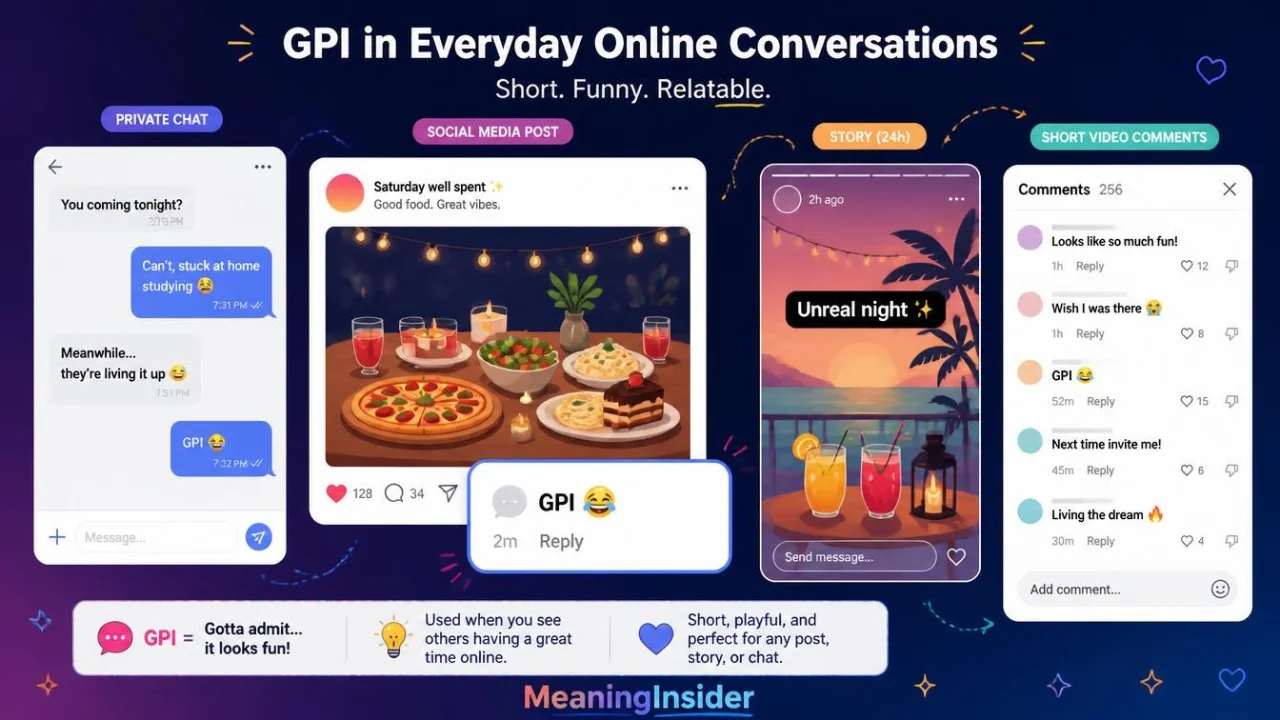
GPI is not exclusive to one social media platform. Its basic meaning remains the same whether someone uses it in a private message, a group chat, or a comment on a shared photo.
Friends may also start these casual online interactions with greetings like WSG meaning (“What’s good?”), which is commonly used to open a conversation.
The situation in which you encounter it usually matters more than the platform itself.
GPI in Private Messages and Group Chats
In private conversations, GPI often appears when friends discuss plans, outings, parties, or other activities.
For example:
Person 1: “We’re going bowling tonight.”
Person 2: “GPI y’all 😂”
The second person is playfully pointing out that they were not included in the plans.
It can also appear in an existing group chat when someone discovers that a few members have arranged something separately.
When friends discuss what to do next or make plans for an outing, they may use WTM meaning (“What’s the move?”) to ask about the plan.
GPI in Social Media Comments, Stories, and Posts
On platforms like Instagram, Facebook, TikTok, and X, someone might use GPI after seeing pictures, videos, or updates from an event they were not invited to.
For example:
- Instagram: Your friends post a restaurant story, and you reply with “GPI.”
- Facebook: Someone uploads birthday party pictures, and you comment “GPI guys!”
- TikTok: Your friends share a video from their weekend trip, and you leave a sarcastic GPI comment.
- WhatsApp: A friend shares pictures from a gathering, and you respond with GPI in the conversation.
You do not need to change the meaning for each platform. The abbreviation expresses the same idea: “Thanks for inviting me,” often with an ironic tone.
GPI Meaning in Real Conversations: Examples and Explanations
Seeing GPI in a complete conversation makes its intended meaning much easier to understand. Here are a few situations showing how people might use it.
When Friends Go Out Without Inviting You
Alex: “Went out for dinner with the boys last night.”
Jake: “GPI bro 😂”
Meaning: Jake is jokingly complaining that Alex went out without inviting him.
When Someone Shares Party or Travel Photos
Mia: “Best birthday party ever! Had so much fun.”
Sarah: “GPI 😭”
Meaning: Sarah is sarcastically saying, “Thanks for inviting me,” because she was not included in the party.
Another example:
Ryan: “Weekend trip was crazy. Already planning the next one.”
Daniel: “GPI next time 😂”
Meaning: Daniel wants to be included in the next trip and is joking about missing this one.
When You Actually Receive an Invitation
Emma: “We’re going to the cinema tomorrow. Want to join us?”
Olivia: “GPI! What time are we leaving?”
Meaning: Olivia is genuinely thanking Emma for the invitation.
These examples demonstrate why you should not assume that every use of GPI is sarcastic. The surrounding conversation makes the intended meaning clearer.
Is GPI Rude, Funny, Flirty, or Offensive?
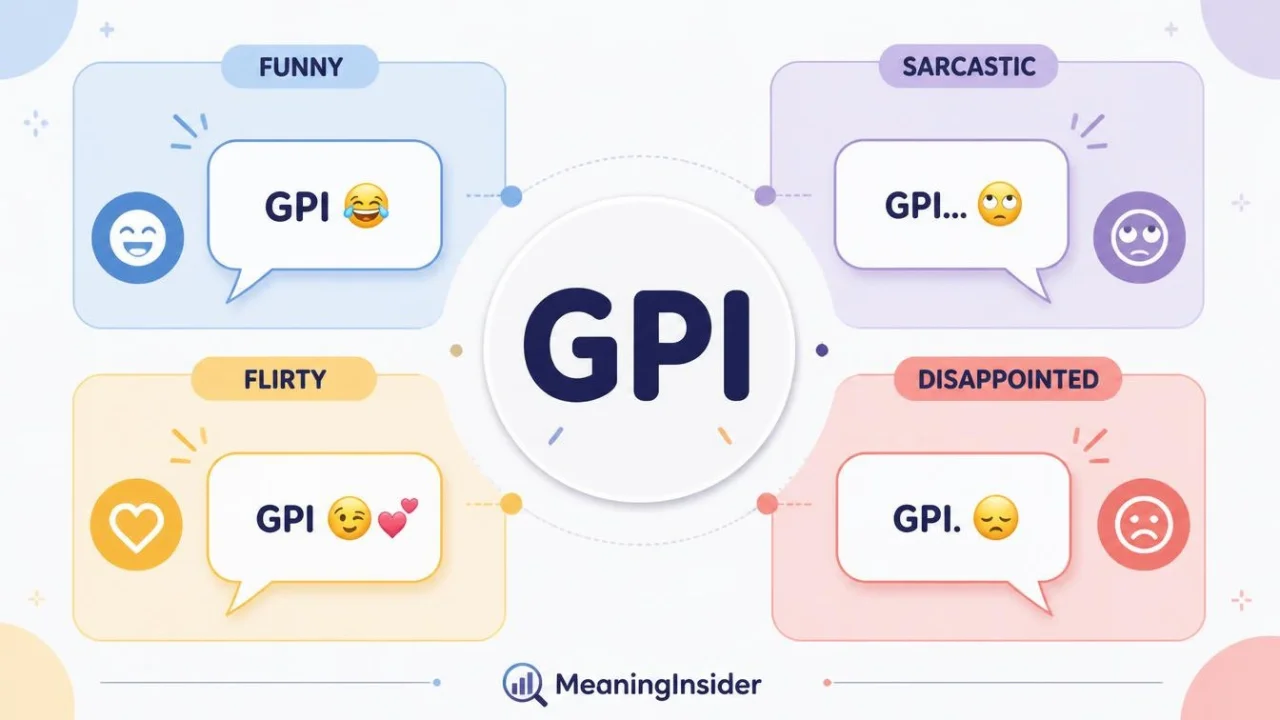
GPI is not inherently rude or offensive. It is generally a playful expression, particularly when friends use it to point out that they were left out of an activity.
However, its tone can change depending on the situation.
| Tone | How GPI may come across |
|---|---|
| Funny | A lighthearted joke between friends |
| Sarcastic | A playful complaint about not receiving an invitation |
| Disappointed | Someone genuinely feels excluded |
| Passive-aggressive | Someone indirectly expresses frustration |
| Friendly | A casual way of asking to be included next time |
Is GPI flirty?
Not by itself. Someone might use it while talking to a romantic partner or a person they like, but the abbreviation does not have an established romantic meaning.
For example, if your partner goes out with friends without inviting you, responding with “GPI 😂” could simply be a teasing complaint.
Pay attention to the surrounding messages, emojis, and your relationship with the sender before deciding whether the comment is serious or playful.
How to Reply When Someone Says GPI?
The best response depends on why the other person used GPI. Sometimes they are just joking, while other times they genuinely wanted to be included.
Here are a few ways to respond.
Funny and Playful Replies
When a close friend uses GPI jokingly, you can keep the conversation light:
- “Next time pakka 😂”
- “You were missed, bro!”
- “Don’t worry, your invitation is coming.”
- “We saved you a seat!”
Friendly and Apologetic Replies
When someone genuinely feels left out, a more thoughtful response makes sense:
- “Sorry, we should have invited you.”
- “Next time you’re definitely coming.”
- “We didn’t mean to leave you out.”
- “Let’s plan something together next weekend.”
What to Say When You Are Unsure
Not every message makes the sender’s intention clear. Rather than guessing, you can ask:
- “Haha, are you saying we should have invited you?”
- “Wait, are you joking or actually upset?”
- “What do you mean by GPI here?”
A little clarification is better than misunderstanding someone’s feelings.
Does GPI Have Other Meanings Outside Texting?
Yes. The same three letters are used in several professional and academic fields. These meanings are unrelated to the Spanish texting expression.
Here are some verified examples:
| Context | GPI meaning | Explanation |
|---|---|---|
| Economics | Genuine Progress Indicator | A measure designed to assess sustainable economic well-being beyond economic activity alone |
| Education | Gender Parity Index | A ratio comparing female and male values for an educational indicator |
| Cell biology | Glycosylphosphatidylinositol | A type of molecule that anchors certain proteins to cell membranes |
| Genetics and biomedicine | Glucose-6-phosphate isomerase | An enzyme involved in the process of glycolysis |
For example, the Maryland Department of Natural Resources describes the Genuine Progress Indicator as a way to assess economic, environmental, and social well-being rather than relying only on conventional economic measures.
Similarly, the UNESCO Institute for Statistics defines the Gender Parity Index as a ratio of female to male values for a given educational indicator.
In cell biology, glycosylphosphatidylinositol refers to molecules that anchor certain proteins to cell membranes, as explained in the National Library of Medicine’s MeSH terminology. MedlinePlus also identifies GPI as the gene for glucose-6-phosphate isomerase, an enzyme involved in glucose metabolism.
These definitions are relevant when GPI appears in scientific, educational, or economic material. They are not alternative slang meanings that you should automatically apply to a casual text message.
GPI vs. FOMO: What’s the Difference?
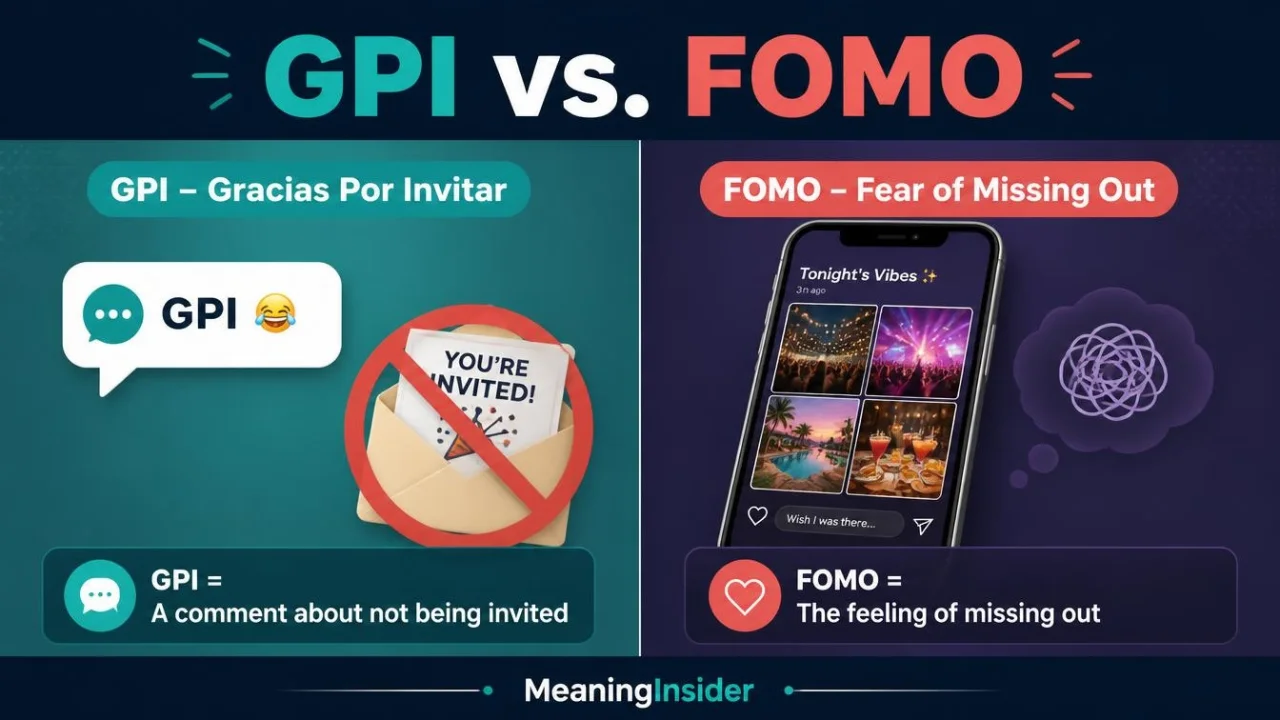
GPI and FOMO can appear in similar social situations, especially when someone sees friends enjoying an activity they missed. However, the two expressions communicate different things.
| Term | Full form | What it communicates |
|---|---|---|
| GPI | Gracias Por Invitar | A sarcastic or playful comment about not being invited |
| FOMO | Fear of Missing Out | Worry or anxiety about missing an exciting experience |
For example:
GPI: Your friends went to a concert without inviting you, so you comment, “GPI 😂.”
FOMO: You see everyone’s concert pictures and feel like you missed an experience you would have enjoyed.
The difference is simple: GPI is something you say to point out a missed invitation, while FOMO describes the feeling of missing out on something.
Frequently Asked Questions About GPI
What does GPI mean in text messages?
GPI stands for Gracias Por Invitar, a Spanish phrase meaning “Thanks for inviting me.” It is often used sarcastically when someone discovers that friends attended an event without inviting them.
What does GPI stand for in Spanish?
GPI stands for Gracias Por Invitar. Gracias means thanks, Por means for, and Invitar means to invite.
Is GPI always sarcastic?
No. GPI can express genuine gratitude when someone receives an invitation. However, it is commonly used ironically when someone was left out of a gathering or activity.
What does GPI mean on WhatsApp and TikTok?
On WhatsApp and TikTok, GPI can mean Gracias Por Invitar. Someone might use it in a message or comment after seeing friends share pictures or videos from an event they were not invited to.
Is GPI rude or offensive?
Not inherently. It is generally playful or sarcastic, although it can express real disappointment when someone feels excluded. Its tone depends on the conversation.
How should I reply when someone says GPI?
You can respond with “Next time you’re invited!” or “Sorry, we should have told you.” A funny reply works for playful conversations, while an apology is more appropriate when someone genuinely feels left out.
Does GPI have other meanings?
Yes. Outside texting, GPI can stand for Genuine Progress Indicator, Gender Parity Index, Glycosylphosphatidylinositol, and glucose-6-phosphate isomerase. The intended meaning depends on the subject being discussed.
Final Words
GPI is short for Gracias Por Invitar, which translates to “Thanks for inviting me.” In social media conversations, it is often a playful or sarcastic way of pointing out that someone went somewhere without inviting you.
The easiest way to understand it is to look at the situation. A friend sharing party pictures, a group planning a trip, or someone posting about a dinner can all provide the context needed to interpret GPI correctly.
And remember, the literal translation is not always the message behind it.
