
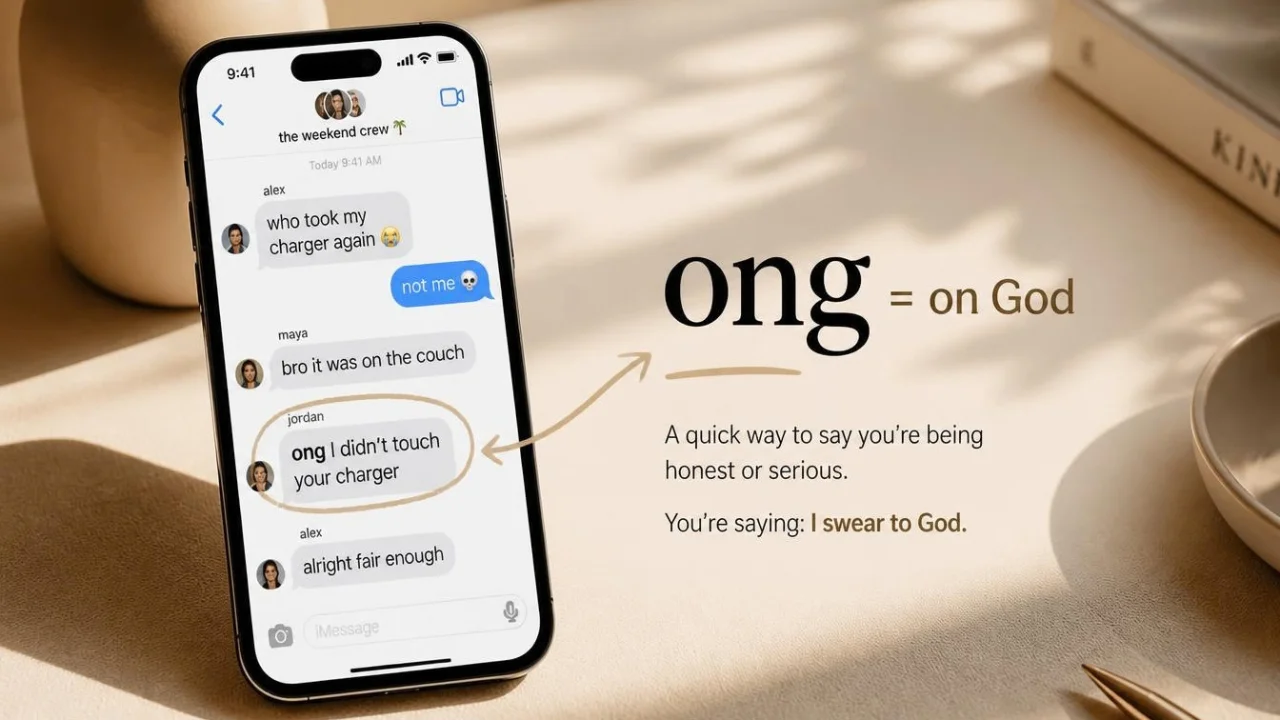

Someone drops “ong” into a group chat with no punctuation and no explanation, and everyone else seems to understand it instantly. If you’ve stopped to wonder whether it was a typo, you’re in good company.
ONG stands for “on God.” It’s slang for “I swear,” used to say something is true or that you really mean it.
That’s the short version. The longer one is more interesting: ONG can also work as a strong “same,” as a raised-eyebrow question, or as a joke.
It also gets mistaken for a typo of OMG fairly often. This guide covers what it means, how to read it in context, where it came from, how to reply, and how it compares to similar slang.
What Does ONG Mean in Text?

ONG is an initialism for “on God,” a phrase people said out loud long before it was shortened for texting. In practice it works like “I swear to God” or “for real.” The sender is putting their word behind what they just said.
It’s often described as a way to express honesty, strong belief or strong feeling, similar to “I swear to God” or “as God is my witness.” That comparison shows how much weight the phrase can carry.
When someone types ong, they’re not adding new information. They’re telling you how seriously to take the information already there.
That’s why it turns up in messages like “ong I didn’t touch your charger” or “that pizza was unreal ong.” A plain statement can read as flat in text, and ong gives it some emphasis without another sentence of explanation.
You’ll see it written as ong, Ong or ONG. All three mean the same thing, and lowercase is common in casual chat.
How People Actually Use ONG
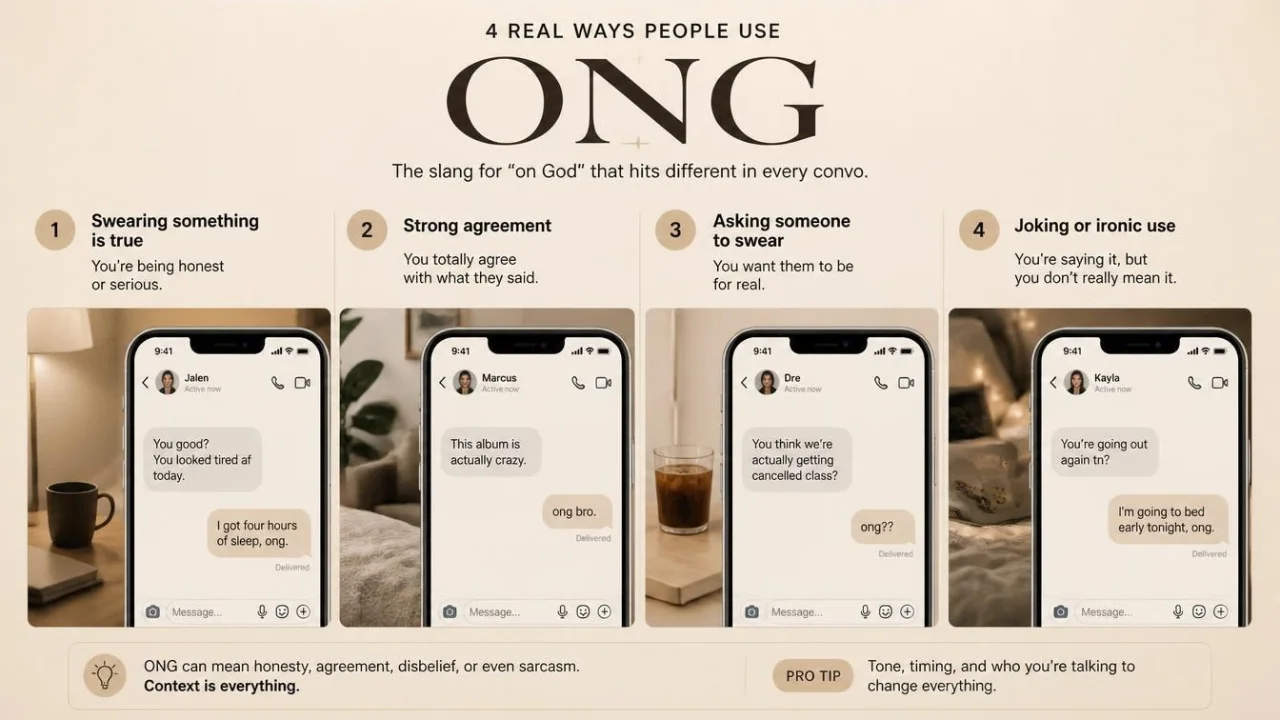
The core meaning stays the same, but what the sender is doing with it can shift. The surrounding message usually tells you which use you’re looking at.
Swearing something is true
This is the classic use: someone makes a claim and backs it with ong. It often follows something that sounds exaggerated, unlikely or slightly suspicious.
“I got four hours of sleep, ong.” “I told you, I didn’t read your messages, ong.”
The message is basically “believe me, I’m not making this up.” It can go at the start or the end of a sentence, or stand on its own as a reply.
Agreeing strongly or reacting
In this sense, ong is used to agree with something, similar to “I swear to God” or “I put that on God.” Here, ong isn’t proving a fact. It’s showing that you feel what someone else just said.
If a friend complains that their teacher gave a surprise quiz and you reply “ong bro,” you’re saying “that is completely true” or “I’m on your side.”
The AI-style shorthand for this is something like “facts,” but ong carries a more personal, emphatic feel.
“Ong?” and “say ong”: asking someone to swear
Ong doesn’t have to be a statement. With a question mark, it becomes a challenge: “you’re serious? Swear to it.” A related phrase, “say ong,” works the same way: it’s a request for someone to swear that what they said is true.
These uses aren’t formally standardized, so think of them as how people commonly say the term rather than a strict rule. But the pattern is easy to spot in real conversation.
Someone tells you something surprising. You reply “ong??” They reply “ong,” and that’s usually the end of the debate.
Joking or ironic use
Like a lot of internet slang, ong can be played for laughs. After big meme pages started overusing the phrase around 2018, people began using it ironically, including meme captions like “Oh? On God?” as mock skepticism.
Today you might see ong attached to a claim nobody could possibly believe: a caption saying “I’m going to bed early tonight, ong” posted at 1:47 a.m. The sincerity is exaggerated on purpose, and the joke depends on the contrast.
Tone and context are the giveaway. If the claim is absurd and the delivery is deadpan, it’s probably a bit.
Is ONG a Typo for OMG?
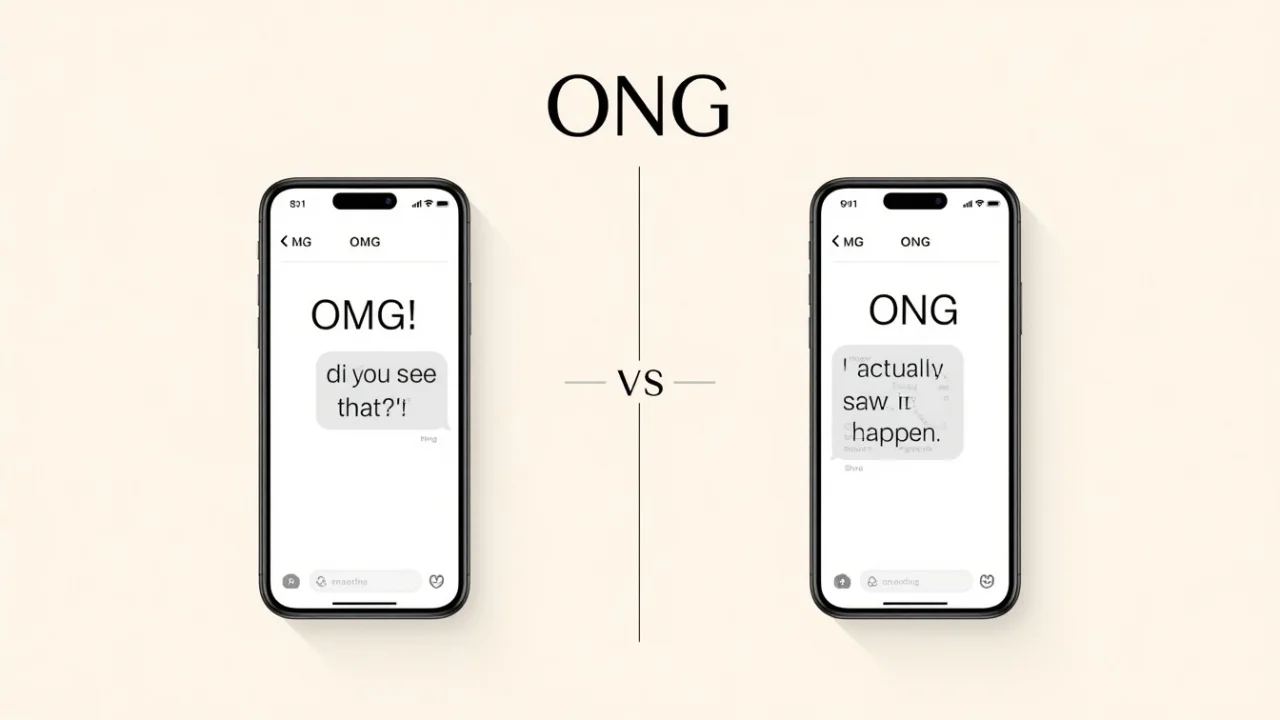
Sometimes, yes. ONG is a common typo of OMG (“oh my God”), and it’s easy to see why. N and M sit right next to each other on a standard keyboard, and one slipped finger changes the whole message.
The two mean different things. OMG is a reaction, usually surprise or shock. ONG is an assurance: it vouches for something.
To tell them apart, check what the message is doing:
- Reacting to news (“omg did you see that??”) is an OMG.
- Backing up a claim or agreeing (“ong I actually saw it happen”) is on God.
- A one-off “ong” that doesn’t fit the sentence might just be a slip. If the sender usually writes omg correctly, that’s a clue too.
Most of the time, ONG really is “on God.” But if a message makes more sense as an exclamation of surprise, a typo is a fair guess.
Where You’ll See ONG: Texts, TikTok, Snapchat and More
The meaning of ONG doesn’t change by app. It’s the same “on God” whether it appears in a text message, a TikTok comment, a Snapchat chat, an Instagram DM, a WhatsApp group, a Discord server or a post on X (formerly Twitter).
What changes is the format. In comments and captions, ong tends to be a quick reaction or emphasis.
In DMs and group chats, it’s more often a promise, a defense or an agreement. On a platform like Snapchat, where messages are quick and casual, it fits naturally as a short add-on.
That’s about as far as the research supports. There’s no evidence that the term means something different on TikTok than on Snapchat, so if you’re asking “what does ong mean on Snapchat,” the answer is the same: on God.
Where Did “ONG” Come From?
The phrase came before the abbreviation. “On God” is a spoken oath, and many explainers link it to African American Vernacular English (AAVE).
But no single origin point or first speaker has been established, and it’s better to say it’s commonly associated with AAVE than to name a specific community or moment.
The online timeline is easier to document. “On God” first showed up in slang references around December 2008, though it wasn’t widely used online until 2014, when large accounts on Twitter began using it. The shortened “ong” started appearing as its own slang entry by August 2018.
ONG has been used since at least the later 2010s and was probably around earlier. By the early 2020s, the term was becoming more prevalent and was associated with Gen Z internet users.
“On God” also became a popular song title in hip-hop from the late 2010s onward, with artists including Kanye West, Juice WRLD and Gucci Mane. That shows the phrase was part of the culture, but it doesn’t prove those songs spread the slang.
A caution on dates: these are when the term was documented, not necessarily when someone first said it. Slang usually lives in speech long before anyone records it.
ONG in Real Chat Examples
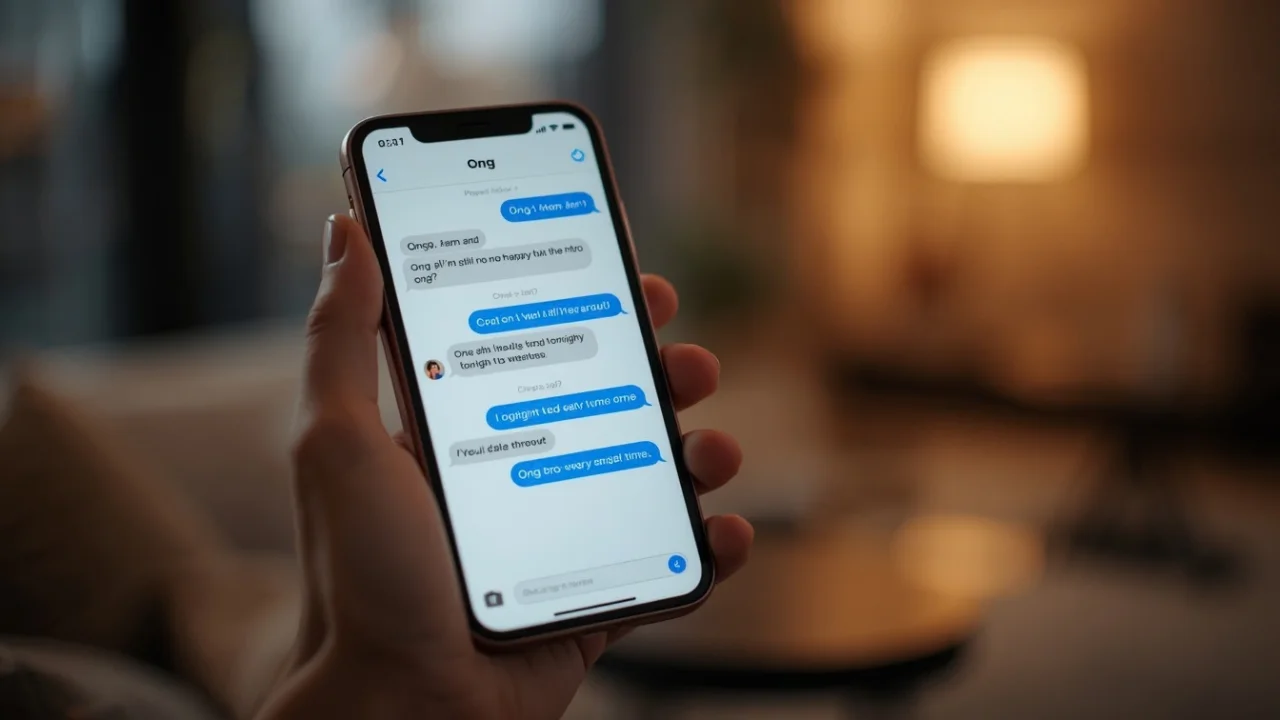
Here’s how ong shows up in different situations.
A sworn claim
maya: wait you actually finished the whole essay last night??
jo: ong. 4am and I’m still not happy with the intro 😭
Emphasis in the middle of a message
that final boss was so hard ong I almost threw my controller
The “ong?” challenge
dev: my cousin got front row tickets for free
sam: ong??
dev: ong. she won them in a raffle
Strong agreement
priya: why is the group project always due the same week as everything else
lena: ong bro every single time
Joking use
caption: i’m going to bed early tonight ong
posted at 1:47 a.m.
Stacked with other slang
ong fr that was the best concert I’ve ever been to
Notice that ong never changes what’s being said. It adds a sworn, emphatic or teasing edge to it.
How to Reply When Someone Says ONG
ONG doesn’t demand a special response. You can just keep the conversation going. But if you want to answer in kind, the best reply depends on what the sender was doing.
- They swore a claim is true. Believe them (“okay, I believe you”), react (“no way,” “that’s wild”), or push back playfully (“you sure?” or “cap”).
- They agreed with you. Match their energy: “right??”, “frfr”, “facts.”
- If they asked “ong?” Answer it straight (“ong”) or add extra weight (“yes, I promise”).
- If they’re clearly joking. Go along with the bit. When the claim is too ridiculous to be real, something like “sure you will 😂” works well.
When you can’t quite tell how serious someone’s being, the rest of their message is usually the clue. Otherwise, a brief, relaxed reply covers most situations.
ONG vs. FR, NGL, No Cap and Similar Slang
Several slang terms signal honesty or emphasis, but each has a slightly different job.
| Term | Stands for | What it does |
|---|---|---|
| ONG | On God | Swears something is true or strongly agrees; carries the feel of an oath |
| FR / fr fr | For real | Confirms or emphasizes; plainer than ONG |
| NGL | Not gonna lie | Introduces an honest opinion or admission |
| No cap | (no abbreviation) | “No lie”: you’re not exaggerating |
| ISTG | I swear to God | Very close to ONG, just spelled out differently |
| Deadass | (no abbreviation) | “Seriously”; often used to question or confirm something |
The main difference is tone. FR simply says “this is real.” ONG borrows the weight of an oath, which is why it can feel stronger. NGL is more about confessing an opinion than proving a fact.
People also combine these words for extra effect. Pairings like “ong fr” or “no cap ong” push the sincerity even further.
Other Meanings of ONG
In casual texting, ONG almost always means “on God.” Outside slang, though, the same three letters have unrelated meanings:
- As an NGO abbreviation. Several languages — Spanish, French, Italian, Portuguese and Romanian among them — use ONG as the shorthand for “non-governmental organization.” That’s the answer if you’ve been searching “ong meaning in Spanish”: it points to groups like nonprofits and relief organizations, not slang.
- As a surname. Ong also exists as a family name, most commonly a Chinese one.
- As an airport code. In aviation, ONG identifies Mornington Island Airport in Australia.
The setting usually makes the intended meaning obvious. If a headline about humanitarian work mentions an ONG, it’s talking about an organization — not the same “ong” your friend just texted you.
Is ONG Rude, Religious or Okay to Use?
ONG isn’t a swear word or an offensive term. It’s an oath phrase, and in casual use most people treat it as simple emphasis.
Because it does reference God, some people may prefer not to say it for religious or personal reasons. If you’re texting someone you don’t know well, that’s a fair thing to keep in mind.
As for formality, ONG belongs in relaxed settings: texts with friends, comments, group chats. It doesn’t suit work emails, school assignments or anything professional. If you need the same effect in a formal message, “honestly,” “I promise” or “seriously” will do the job.
Like most slang, it lands best when used sparingly. Put ong on every sentence and it stops meaning anything.
Is ONG Gen Z Slang?
Mostly, in the sense that the abbreviation is closely associated with Gen Z internet users. But the underlying phrase “on God” is older than the generation, so it’s more accurate to say Gen Z popularized the shorthand than that they invented the expression.
It also isn’t limited to one age group. Anyone who spends time in group chats or comment sections may pick it up. It’s still in circulation, though there’s no reliable data on exactly how widely it’s used today.
For parents who’ve spotted it in a teen’s texts: it’s a harmless expression of sincerity, not code for anything. When a teen texts “ong I finished my homework,” they’re just insisting it actually happened.
FAQs
What does ONG mean from a girl or a guy?
Nothing different. ONG means “on God” no matter who sends it. Any flirty, playful or serious tone comes from the rest of the message, not the sender.
Is ONG the same as OMG?
No, though they’re easy to mix up. OMG is a reaction to surprising news, while ONG is used to swear something is true or to agree strongly. A stray “ong” that doesn’t fit the sentence is sometimes just a typo of OMG.
What does “ong fr” mean?
It stacks two emphasis phrases: “on God” and “for real.” People combine them to make a statement sound as sincere as possible.
Does capitalization change what ONG means?
No. ong, Ong and ONG all mean the same thing.
Is ONG rude or offensive to use?
Not typically. It’s an oath phrase used for emphasis, not a swear word. Some people may still avoid it for religious or personal reasons, so it’s worth reading the room with someone you don’t know well.
Does ONG mean something different in Spanish or French?
Yes, outside of texting slang. In several languages, including Spanish and French, ONG is a standard abbreviation for a non-governmental organization, unrelated to the “on God” meaning used in English chats.
Final Words
ONG is a small word doing one big job: it tells you how much the sender means what they’re saying. Once you can tell whether it’s a promise, a “same,” a challenge or a joke, and remember it might occasionally be an OMG typo, you’ll rarely misread it.
Spotted another confusing term while you were here? Our YHU meaning guide is a good next read.
