


If you’ve seen “SFS” pop up in an Instagram caption, a Snapchat message, or a comment section and had no idea what it meant, you’re not the only one googling it right now.
SFS most commonly stands for “Shoutout For Shoutout.” It’s a social media arrangement where two users agree to promote each other’s accounts, usually to pick up new followers, views, or engagement, without paying for ads.
That’s the short answer. But SFS doesn’t always mean exactly that, and which meaning applies depends heavily on the platform and the sentence it’s sitting in. This guide walks through the different meanings, how the term shows up on Instagram, Snapchat, TikTok, and elsewhere, where it likely came from, and how to actually reply when someone sends it to you. By the end, you’ll be able to recognize the term in almost any situation, instead of just memorizing one definition and hoping it fits.
What Does SFS Mean?

SFS = Shoutout For Shoutout.
In practice, it’s a trade: you promote someone’s profile to your followers, and they do the same for you. Usually this happens through a Story repost, a tagged post, or a shared mention: the idea is that both accounts get exposed to a new audience without either person spending money on promotion.
You’ll see it phrased as a question or an offer:
- “SFS? I’ll post your page if you post mine.”
- “Doing SFS today, DM me.”
It reads almost like a handshake deal: quick, informal, and mutual. That mutuality is really the core of what separates SFS from a regular shoutout. A shoutout can go one way, but SFS implies both sides are expected to hold up their end.
That said, “Shoutout For Shoutout” isn’t the only thing those three letters can mean. The exact meaning shifts depending on where you’re seeing it and who’s using it: that’s what the next section covers.
Other Meanings of SFS

Because SFS is really just an abbreviation, different corners of the internet have bent it toward slightly different uses. The three worth knowing:
Snap For Snap: On Snapchat specifically, SFS sometimes means trading snaps back and forth, often to keep a streak alive or bump up a snap score, rather than promoting an account.
Spam For Spam: An agreement to mutually like or comment on each other’s posts. This version carries a slightly different connotation than a shoutout exchange: it’s engagement for the sake of engagement, and it’s generally viewed as lower-effort than an actual shoutout.
Sorry For Spam: This one has nothing to do with promotion at all. People use it after sending a burst of back-to-back messages, essentially apologizing for flooding someone’s notifications.
None of these are wrong meanings, just different ones. If someone texts “sfs” after sending you fifteen messages in a row, they’re clearly not asking for a shoutout. The words sitting around SFS almost always tell you which version you’re dealing with.
Why Do People Use SFS?
The appeal is pretty practical: SFS is free. Instead of paying for promotion, two accounts with similar-sized or similar-interest audiences agree to expose each other to their followers.
It tends to work best for smaller or newer accounts trying to get initial traction, for example a fashion page doing SFS with another fashion page, or a meme account trading with another meme account. The logic is simple: shared audiences are more likely to actually stick around and engage, rather than just following and disappearing.
It also helps explain why SFS keeps showing up in captions and DMs even now. It costs nothing, takes a few minutes to arrange, and doesn’t require either person to have any existing budget or following. For a brand-new account with zero reach, that low barrier is often the whole appeal.
SFS Meaning on Different Platforms

The core idea, mutual promotion, stays consistent, but which specific meaning of SFS you’ll run into changes depending on the app.
On Instagram, SFS almost always means Shoutout For Shoutout. It typically plays out through Stories: one user tags the other’s account, encourages their followers to check it out, and the favor gets returned. You’ll see it in captions like “DM for SFS” or “doing SFS all day,” most often from creators, small businesses, and influencers looking to grow.
Snapchat
Snapchat is where things get genuinely ambiguous. SFS here can mean either Shoutout For Shoutout (promoting each other’s accounts) or Snap For Snap (trading snaps, often tied to streaks). Neither meaning is more “correct” than the other on this platform: you really do need the rest of the conversation to tell which one someone means.
TikTok
SFS shows up less often on TikTok than on Instagram, but it hasn’t disappeared. It’s usually found in comment sections rather than captions, and it still points to the same basic idea: two accounts promoting or supporting each other.
WhatsApp and X (Twitter)
There’s no single dominant meaning on WhatsApp. In a group chat, SFS is just as likely to mean Sorry For Spam as it is a promotional request, depending entirely on what was said right before it. On X, usage tends to mirror Instagram and TikTok: mostly a promotional ask between accounts.
Where Did SFS Come From?

SFS is generally associated with the broader “shoutout culture” that grew up around Instagram as creators, meme pages, and small accounts looked for ways to gain visibility without spending on ads. Cross-promotion, essentially you post me and I post you, became a simple, no-cost alternative to paid growth tactics, and the exchange eventually got shortened to the three letters people type today.
The exact timeline and first use aren’t something that can be pinned down with confidence, so it’s worth treating this as general background rather than a precise history. What is clear is that the practice spread from Instagram outward to Snapchat, TikTok, and other platforms as shoutout-based growth became a normal part of online creator culture.
SFS in a Real Chat Example
Here’s what the exchange tends to look like in practice. Note that not every example means the exact same thing:
Asking for a shoutout swap:
“hey love ur page!! wanna do sfs?”
“sure, send me ur username 😊”
A casual, joking use among friends:
“u forgot to sfs my new page 😭”
“omg my bad, posting it rn”
Someone checking which meaning is meant:
“sfs?”
“snap for snap or shoutout? lol”
That last one matters more than it looks. Asking “which kind?” is genuinely common, especially on Snapchat, precisely because the term isn’t locked to one meaning.
How to Reply When Someone Sends SFS
Your reply really just depends on what you actually want to do.
If you’re in:
- “sure, send your page!”
- “yeah let’s do it 😊”
If you’re not sure what they mean:
- “what kind of sfs: shoutout or snap?”
- “wym by that lol”
If you’d rather not:
- “thanks but I’ll pass for now”
- “not doing sfs right now, sorry!”
There’s nothing awkward about asking someone to clarify. Given how many things SFS can technically mean, it’s a completely normal question rather than a sign you’re out of the loop.
Words Similar to SFS (Related Slang)
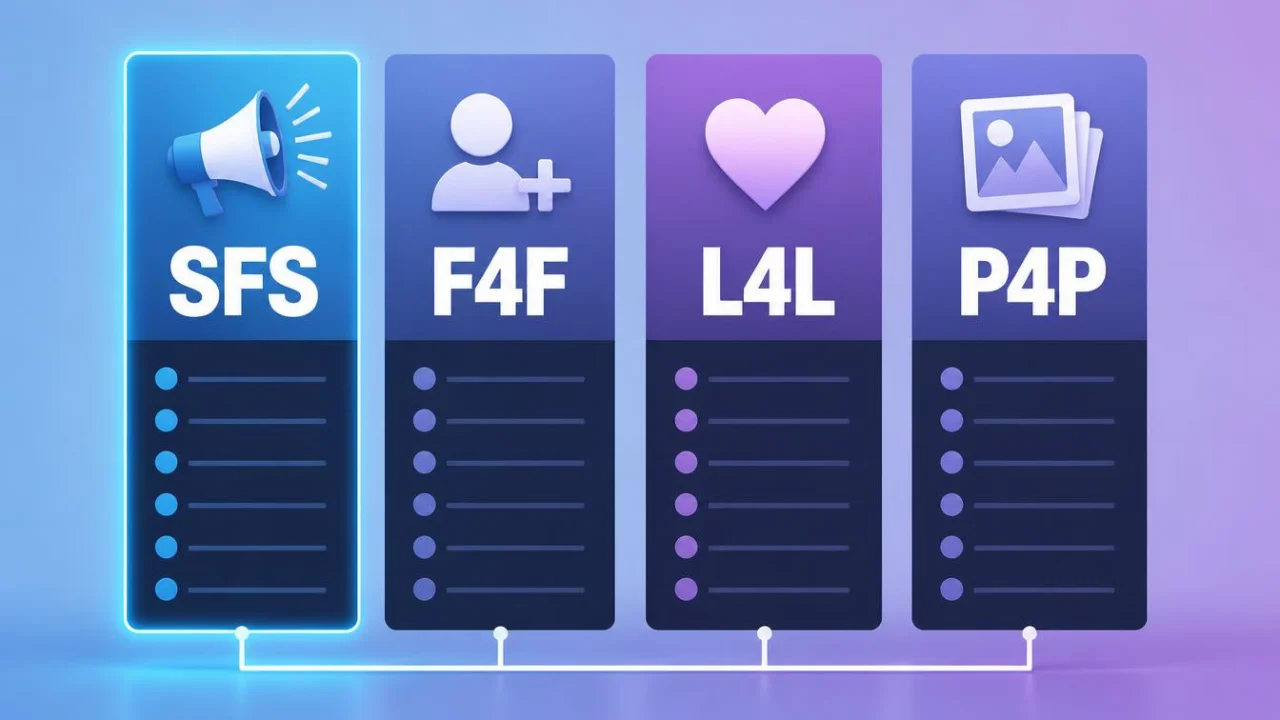
| Term | Meaning | What’s Being Exchanged |
|---|---|---|
| SFS | Shoutout For Shoutout | Promotion / visibility |
| F4F | Follow For Follow | Following each other |
| L4L | Like For Like | Likes on posts |
| P4P | Post For Post | Shared content |
The distinction that trips people up most is SFS vs. F4F. SFS is about promoting or shouting out an account to your audience; F4F is narrowly about the follow itself. You can follow someone without shouting them out, and you can shout someone out without necessarily following them. They’re related concepts, but not interchangeable ones.
Common Mistakes People Make With SFS
- Assuming it means the same thing everywhere. What’s a shoutout exchange on Instagram might be a snap exchange on Snapchat: the platform changes the likely meaning.
- Confusing it with similar-looking abbreviations. SFS gets mixed up with things like FFS or SFW simply because they’re both three letters starting with S/F, but they’re unrelated terms with unrelated meanings.
- Using it somewhere formal. SFS is informal social media shorthand. It doesn’t translate to a professional email, a school assignment, or a business message where the recipient may not recognize it at all.
- Reading it as a demand rather than a request. SFS is meant to be a mutual, voluntary trade, not an obligation. If someone doesn’t reply or declines, it isn’t a broken promise, just a pass on the exchange.
Is SFS Still Used?
Yes: SFS hasn’t disappeared, though it’s not used quite the same way it once was. It’s still common among smaller creators and newer accounts looking for low-cost ways to grow, even as some bigger influencers have shifted toward more formal collaborations instead of straightforward shoutout swaps. It’s less of a dominant growth strategy than it may have once been, but it’s still a normal part of how smaller accounts network with each other.
If you’ve run into another confusing abbreviation lately, PYO is one more term worth checking out.
FAQs
What is SFS on Instagram?
On Instagram, SFS almost always means Shoutout For Shoutout: two users promoting each other’s accounts, typically through Stories or tagged posts.
What does SFS mean in text on WhatsApp?
There’s no single fixed meaning on WhatsApp. It could mean Shoutout For Shoutout or Sorry For Spam, depending on what the rest of the conversation is about.
What does SFS mean in text, used jokingly?
Friends sometimes use it playfully, like teasing someone for forgetting to post a shoutout (“no sfs for you 😂”), without it being a literal request.
What does SFS mean on Urban Dictionary?
Crowd-sourced slang sites generally reflect the same core meanings covered here: shoutout or snap exchanges, since that’s how the term is actually used online.
What does SFS mean from a girl or from a guy?
There’s no gender-based difference in meaning. Whoever sends it, SFS is asking about the same thing: a shoutout or snap exchange.
Does SFS have a business or retail meaning?
Not a standard one. When it shows up around a business or retail account, it’s typically the same shoutout-exchange practice, just applied to a brand’s social page rather than a personal one.
What does “DM for SFS” mean?
It’s an invitation to message the poster privately to arrange a shoutout exchange: a common caption on Instagram and TikTok when someone’s actively looking for SFS partners.
Final Words
So, what does SFS mean in text, at the end of the day? Mostly a shoutout exchange, though not always. SFS is shorthand that bends to whatever trade two people have actually agreed to, whether that’s a shoutout, a snap, or just an apology for blowing up someone’s phone. The fastest way to know which one you’re looking at is simple: check the platform, and check the sentence around it.
For more breakdowns like this one, Meaning Insider covers dozens of other text and social media slang terms in the same everyday, no-guesswork style.
