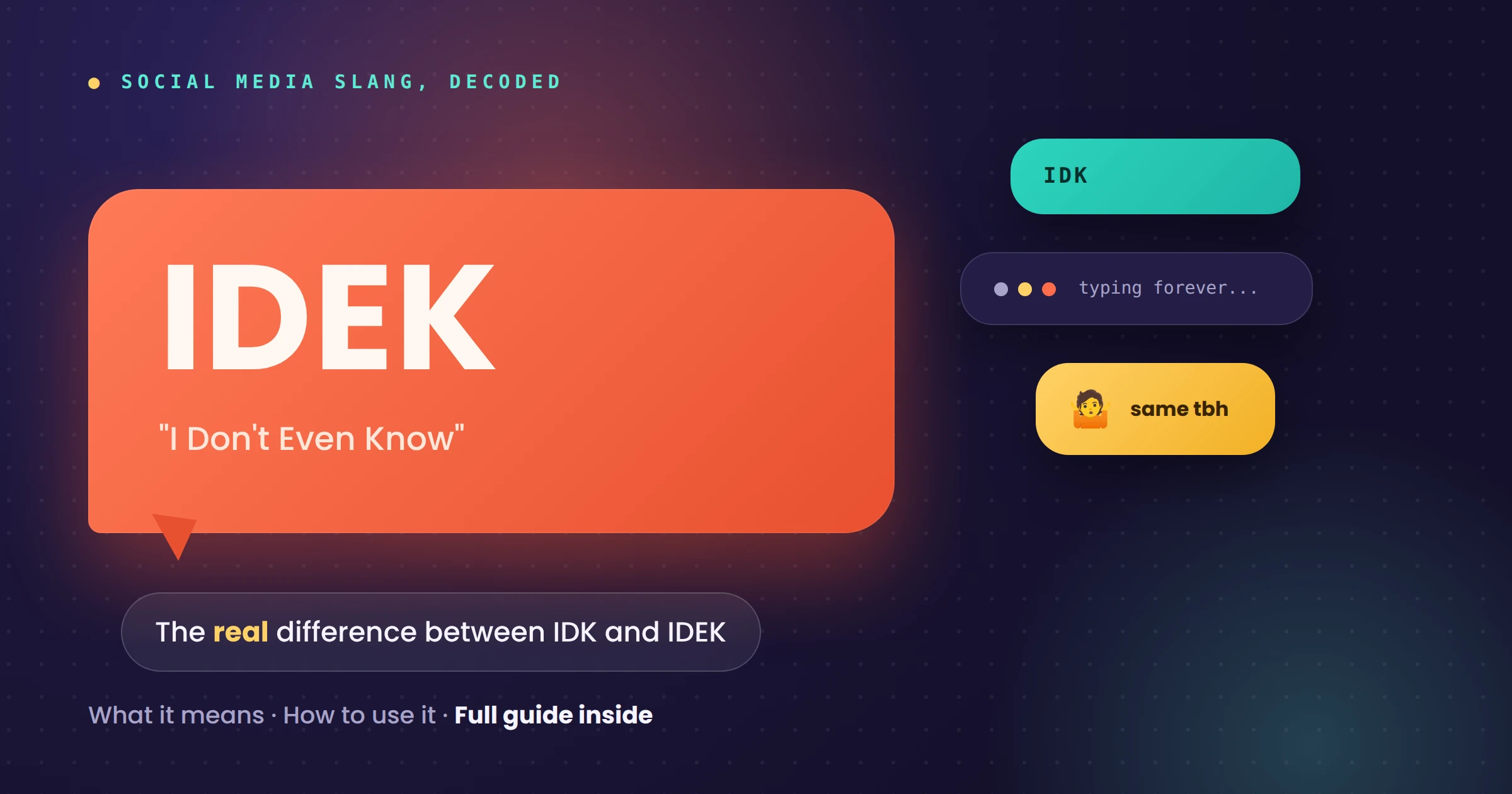

Someone drops “idek” as their entire reply, and it’s hard to tell right away whether they’re confused, annoyed, or just brushing the question off.
IDEK is short for “I Don’t Even Know.” It’s a notch stronger than plain old “IDK” — that extra “even” isn’t just decoration, it’s the part carrying the meaning. It tells you the person isn’t only missing a fact; they’re actually thrown off, confused, or a bit overwhelmed by whatever’s being asked.
That one small word is really the whole story, and it’s worth unpacking properly, because it changes how the term should be read and how it should be used.
What Does IDEK Mean?
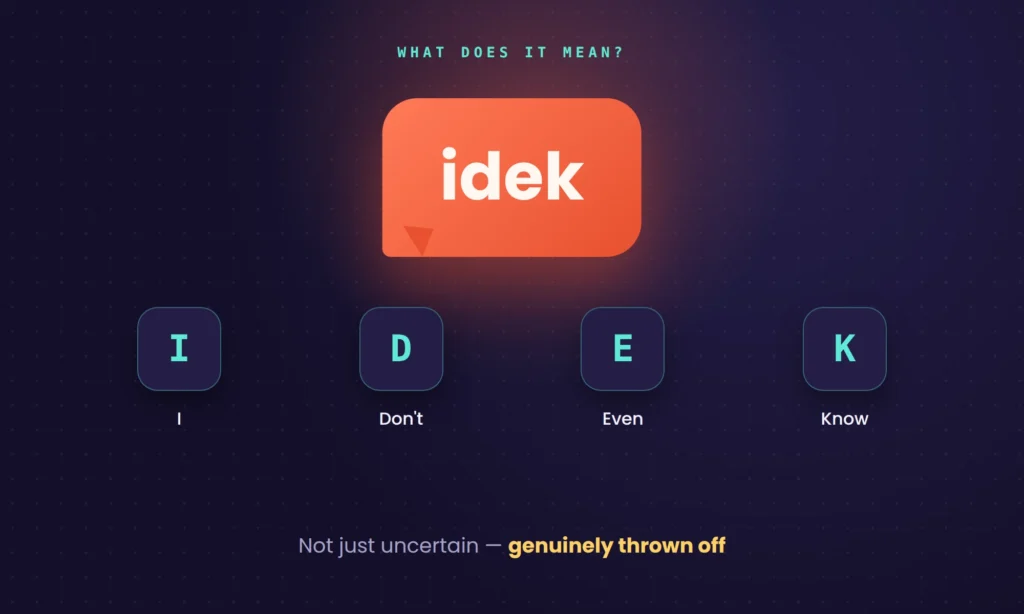
IDEK is texting shorthand for “I Don’t Even Know.” It covers similar ground to a simple “I don’t know,” but with more feeling behind it. Depending on the conversation, it can be doing any of the following:
- Signaling real confusion about what just happened
- Carrying mild disbelief or surprise about a situation
- Showing you’re a little overwhelmed by a question, not just short on facts
- Softly admitting something is hard to explain, rather than simply unknown
These aren’t rigid, separate boxes. In real conversations they blend together — a single reply like this might be mostly confusion with a touch of exasperation, and the reader is generally expected to pick up which is which from tone and context.
IDEK vs. IDK: What’s the Real Difference?
This is probably the question people have most often about the term, so it deserves a direct answer instead of staying implied.
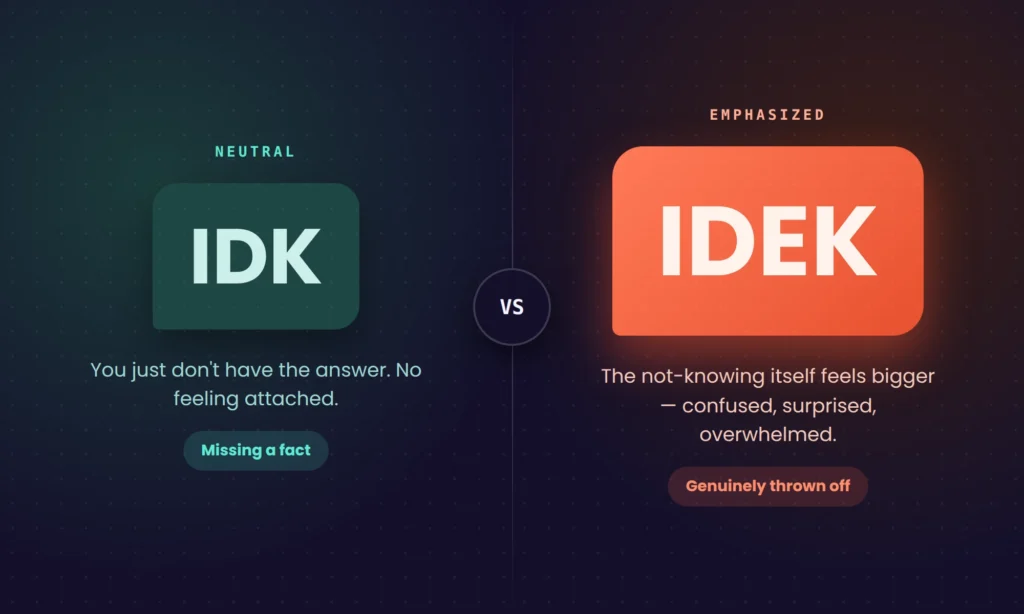
IDK is plain and neutral. It states you don’t have the information, nothing more. Someone asks what time a show starts, you genuinely don’t know, you type IDK. No emotional weight attached.
IDEK carries more. It’s the option people reach for when the not-knowing itself feels bigger than a missing fact — when you’re confused about why something happened, not just unaware of a detail.
| IDK | IDEK | |
|---|---|---|
| Meaning | I don’t know | I don’t even know |
| Tone | Neutral, factual | Emphasized, emotional |
| Typical use | Missing a piece of information | Confusion, disbelief, feeling overwhelmed |
Same question, answered two ways:
“Why did they cancel the trip?” — “IDK, they just said something came up.” — “IDEK, it doesn’t even make sense, they were so excited yesterday.”
The second reply isn’t just uncertain — it’s confused by the situation itself. That gap is the real difference between the two terms.
Where Did IDEK Come From?
There’s no confirmed inventor, date, or specific app where it first appeared, and that’s true of most texting shorthand like it. What can be said with more confidence is that it follows a recognizable pattern seen elsewhere in texting slang: an existing short phrase gets the word “even” dropped into it for emphasis. “IDC” (I Don’t Care) becomes “IDEC” (I Don’t Even Care) through that exact same move, and this term goes through the same process starting from IDK.
Beyond that pattern, any claim about which platform it “started” on, or when it first caught on, isn’t something that can be pinned down reliably — so it’s better left unsaid than dressed up as history.
IDEK in a Real Text Example
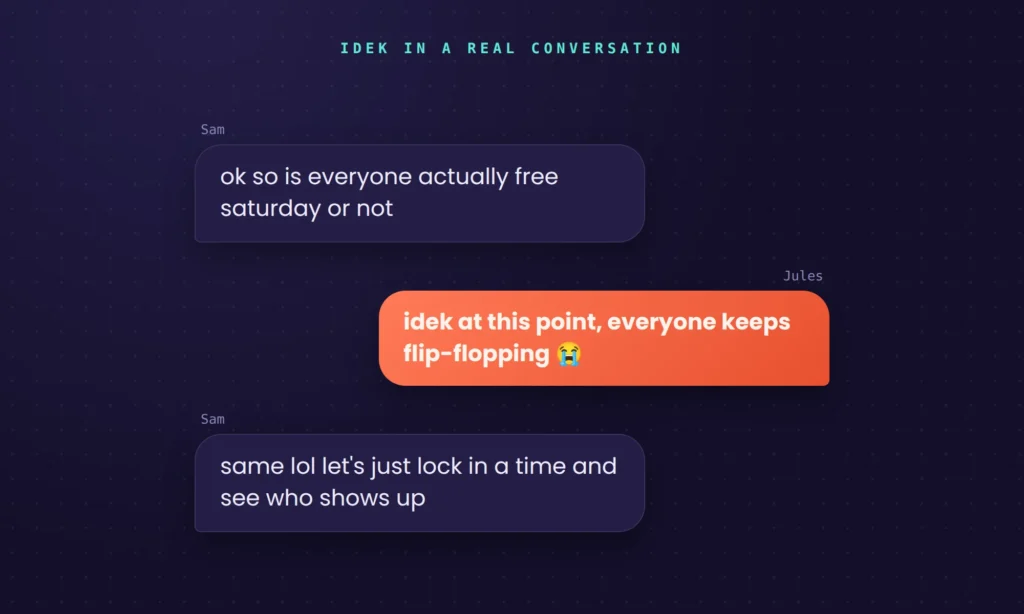
Group chat, trying to settle on plans:
Sam: ok so is everyone actually free saturday or not Jules: idek at this point, everyone keeps flip-flopping Sam: same lol let’s just lock in a time and see who shows up
Reacting to something confusing:
“wait, he just left in the middle of the date??” “IDEK 😭 she said he got a call and never came back”
Notice how the tone shifts across these two — both carry real confusion or shock rather than a neutral shrug, which is exactly what separates this term from a plain “I don’t know.”
Tone & Context: How IDEK Can Land Different Ways
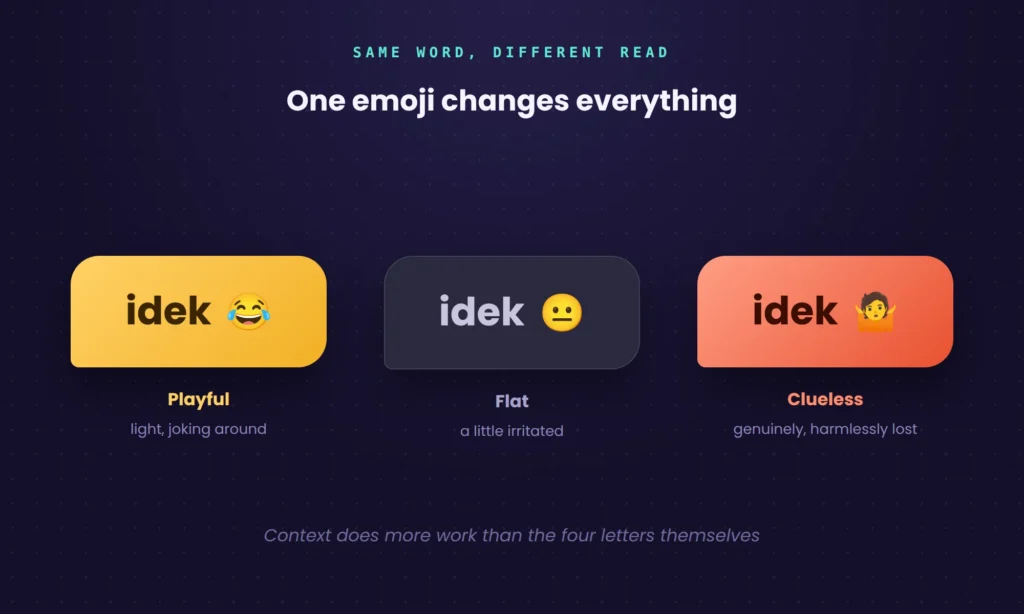
It isn’t automatically rude, but it isn’t automatically harmless either — a lot rides on who’s saying it, and why.
Coming from a close friend mid-vent about something baffling, it reads as honest. They trust you enough to admit they’re lost, and there’s nothing dismissive in that.
Coming from someone who asked a genuine question and got a bare one-word answer with nothing else attached, it can read as checked-out — particularly early on with someone you don’t know that well yet.
In a heavier moment, it can land badly. If someone asks “what’s wrong?” and that’s the whole reply, it can feel like the conversation is being shut down rather than met, even when that’s not the intent behind it.
The emoji riding alongside it shifts things too: pair it with a laughing face and it reads light and playful, swap in a flat face and it sounds a little irritated, or a shrug and it reads as genuinely, harmlessly clueless. Strip all of that away, and a bare, standalone reply can come across colder than it was ever meant to.
As a rough guide: it’s fine in casual texting, group chats, and comments. It’s worth skipping in professional messages, formal emails, or moments when someone actually needs a real answer or genuine support — a one-word reply in those spots tends to undersell how much you actually care.
Common Mistakes People Make With IDEK
Treating it as a stand-in for IDK. They’re close cousins, not twins — reaching for it when you mean plain, unemotional uncertainty can make something ordinary sound more dramatic than it is.
Piling on too much slang at once. Stacking several abbreviations back to back might land fine with a close friend, but it forces anyone else to decode all of them at once, which slows a conversation down instead of speeding it up.
Leaning on it as a default. If it’s the answer to almost everything, people stop reading it as “I’m genuinely unsure” and start reading it as “I’m not really here for this conversation.”
How to Reply When Someone Says IDEK
The right reply really depends on which flavor of it you’re getting.
- Genuinely confused: “wait really? that’s so weird” or “let’s figure it out together”
- Sounding overwhelmed: “no worries, we don’t have to decide right now”
- Just a casual shrug: keep the conversation moving — “okay I’ll just pick then”
- Possibly avoiding something serious: it’s worth a gentle follow-up rather than dropping it, since a flat answer like this can be a soft way of not wanting to get into things just yet.
Still confused by another popular abbreviation? Check out our guide to CYC meaning in text to see how the same short term can have different meanings depending on the conversation.
Words Similar to IDEK (Related Slang)
| Term | Meaning | How it differs |
|---|---|---|
| IDK | I Don’t Know | Neutral, no added emotion |
| IDC | I Don’t Care | About indifference, not confusion |
| IDEC | I Don’t Even Care | Same “even” emphasis as IDEK, applied to not caring instead of not knowing |
| IDRK | I Don’t Really Know | Softer than IDK — a guess might exist, just not a confident one |
| IDFK | I Don’t F***ing Know | The more frustrated, heated version |
| IKR | I Know, Right? | Not about uncertainty — it’s agreement, easy to confuse visually but functionally unrelated |
Final Words
It’s really IDK with genuine feeling attached — confusion, surprise, or a bit of overwhelm, depending on where it shows up. The letters stay the same; the context around them carries the rest.
FAQs
Is IDEK rude? Not by default. It depends on the moment — casual and fine among friends, but it can read as dismissive if someone’s asking about something that actually matters and that’s all they get back.
Does IDEK mean something different on TikTok, Snapchat, or Instagram? No. The meaning holds steady wherever it shows up — it’s just common across all of them rather than tied to any one app.
Does IDEK mean something different from a girl versus a guy? Not really — there’s no meaningful gap tied to gender. Tone comes down to the relationship and the specific conversation far more than who’s typing it.
What does “IDEK ATP” mean? “I Don’t Even Know At This Point.” ATP already stands on its own as “at this point,” so this is simply the two combined for extra emphasis.
What does “IDEK FR” mean? “I Don’t Even Know, For Real” — used to underline that the confusion is genuine, not a throwaway line.
What’s the difference between IDEK and IDRK? IDRK (“I Don’t Really Know”) sounds softer and more polite. This term usually carries more actual confusion or emotion.
What does IDEC mean? “I Don’t Even Care.” Built the same way, just applied to indifference instead of confusion.
What does IDCF mean? “I Don’t Care Face.” It’s an older, less common term at this point — you’re more likely to spot it in older internet slang than in how people write today.
What does DDC mean in texting? There’s no single agreed meaning — it’s used differently depending on the group or context, so it’s best to read it off the specific conversation rather than assume a fixed definition.
What does IDEK mean on Urban Dictionary? Community entries there line up with the core meaning covered here, with some variation in tone or emphasis depending on who wrote the submission.
If you’re looking for more slang meanings and texting abbreviations, explore MeaningInsider to discover other terms you may have seen in chats or on social media.
