
You’re mid-conversation, you’ve just answered a question about your day, and before you hit send you tack on two extra words: wbu. It barely registers as a decision it’s just what you type.
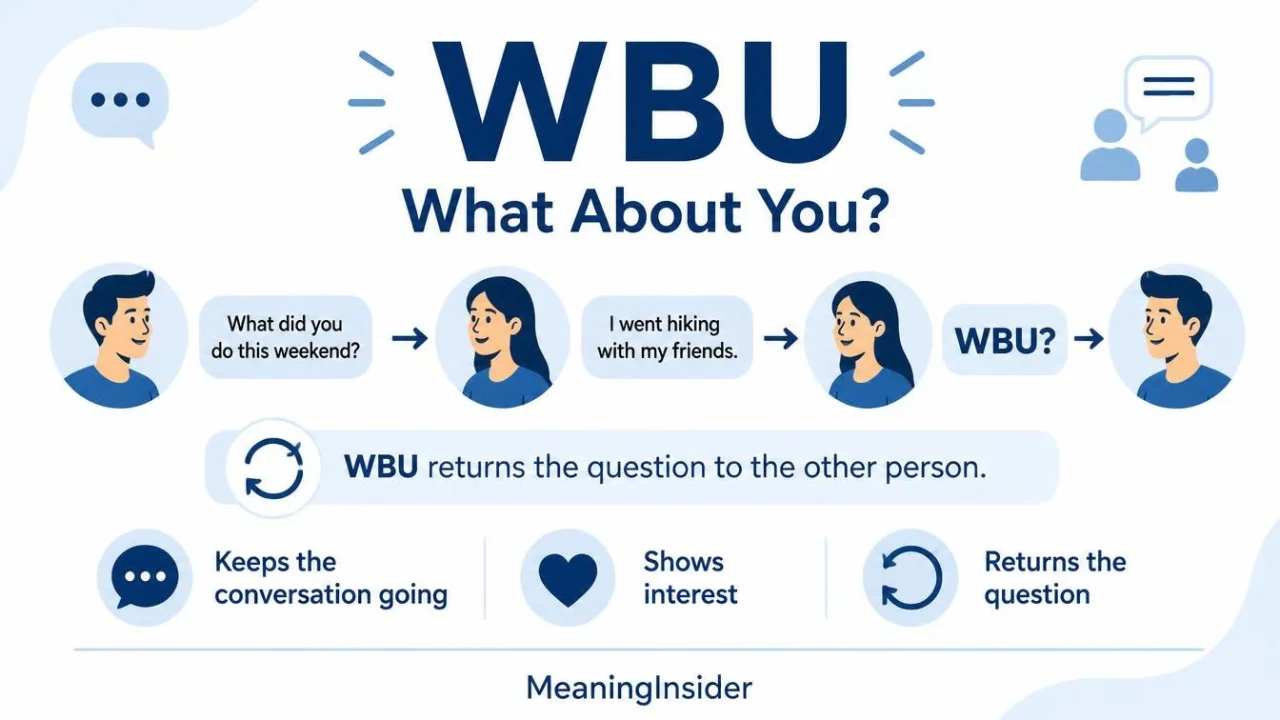
WBU stands for “What About You?”It’s a quick way to return a question after answering one yourself, giving the other person a chance to share too.”
That much is simple. What’s more useful to actually understand is how the same three letters can read as genuinely curious in one message and completely automatic in another, when it’s fine to use and when it isn’t, and how it’s different from lookalikes like HBU, WBY, and WB. That’s what the rest of this covers.
Who Uses WBU and Where It Shows Up
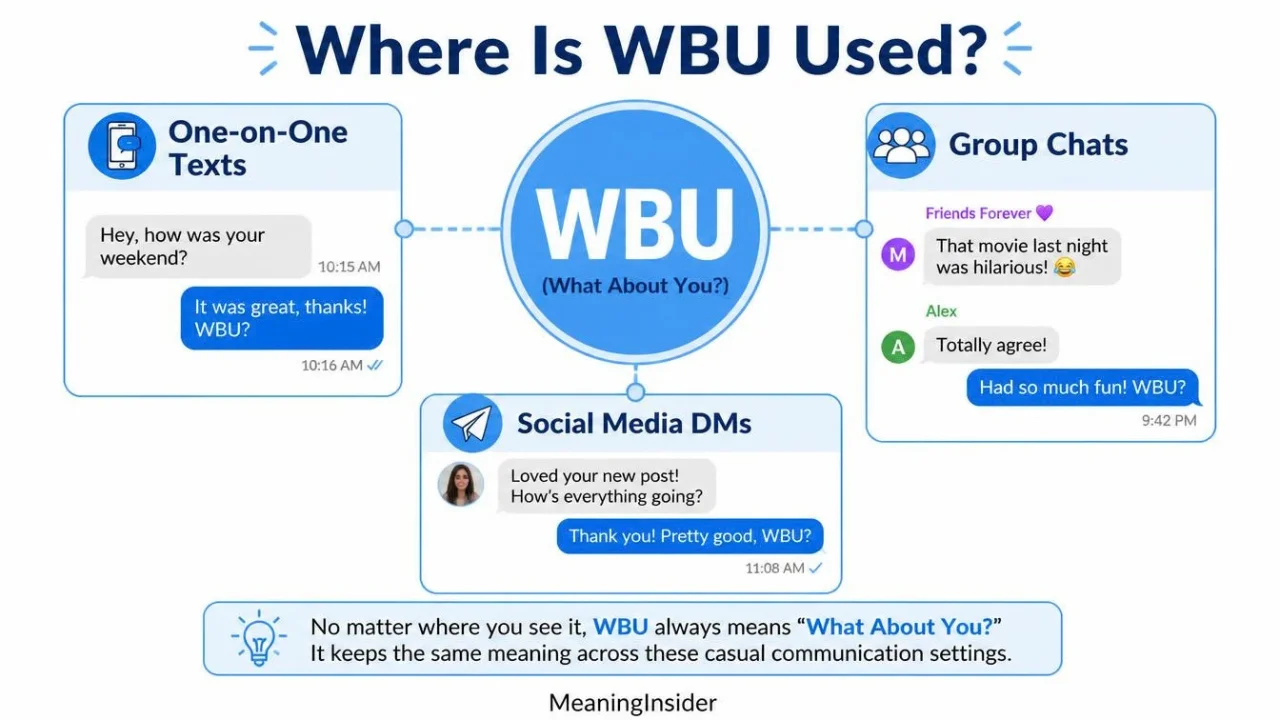
WBU lives almost entirely in casual, informal messaging, alongside a whole family of similar short greetings and check-ins like WSG. It’s most common among younger texters teens and Gen Z in particular who grew up typing on phones rather than learning texting as a new skill later in life, but it isn’t locked to one age group. Anyone having a relaxed, back-and-forth conversation online can use it without it standing out.
WBU in One-on-One Texts
This is where WBU shows up most naturally. Someone shares an update, a mood, or an answer, and adds WBU to keep the exchange even. It’s especially common at the start of a conversation when two people are catching up:
Friend: just got out of class, wbu?
You: still at work lol
WBU in Group Chats
In a group setting, It can do something slightly different it can single one person out after a general question has already gone around. If everyone’s weighed in except one person, adding “wbu” directs the question specifically at them without retyping it:
Friend 1: I’m down for Friday
Friend 2: same
Friend 1: wbu though?
WBU in Social Media Comments and DMs
You’ll also see WBU in Instagram DMs, Snapchat chats, and TikTok comment replies usually following a story reply or a comment on someone’s post. It’s worth being straightforward about something most explanations of this term dance around: It doesn’t actually mean something different on each platform. The format changes a DM reads differently than a comment thread but the word is doing the exact same job everywhere it shows up.
WBU’s Tone and Intent
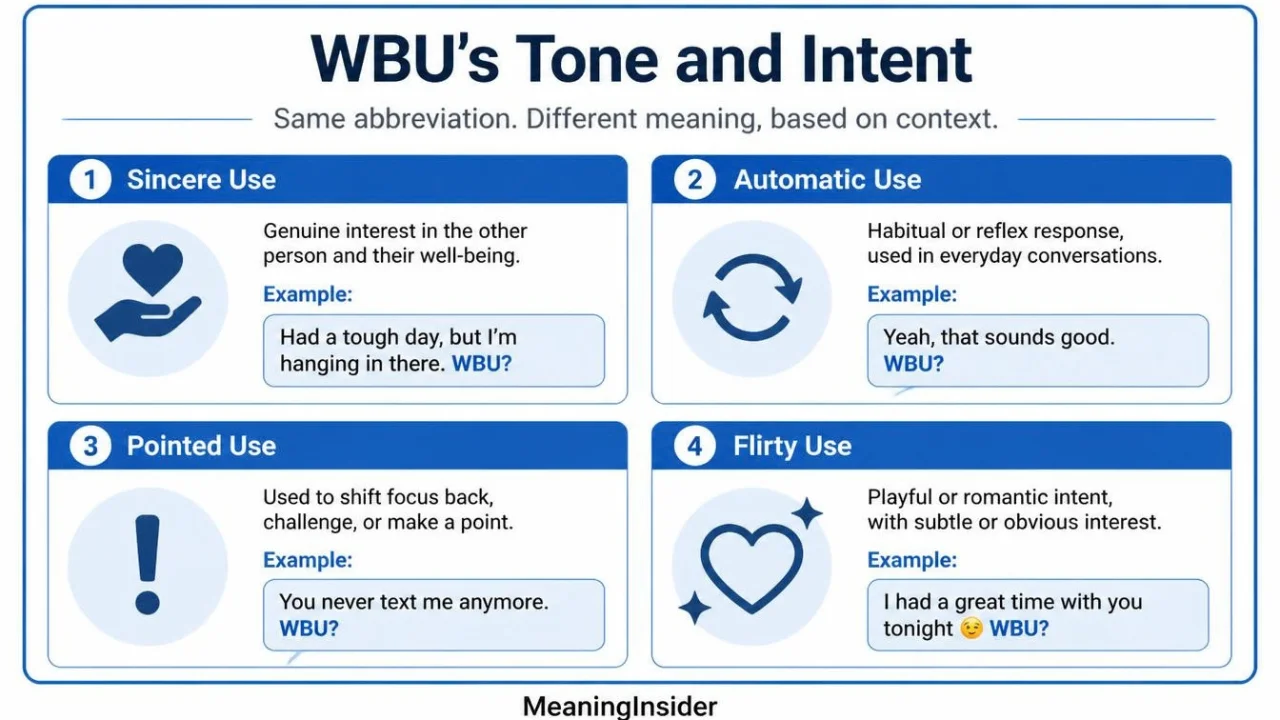
Here’s the part that actually matters more than the definition: WBU’s meaning stays fixed, but its weight changes completely depending on where it lands in a conversation.
Sincere, Everyday Use
Most of the time, WBU is exactly what it looks like a low-effort, genuine way of keeping a conversation two-sided. It shows up after someone answers a mood check-in, shares their plans, or describes their day, and it signals that their update mattered enough to ask back.
Habitual or Automatic Use
Not every WBU carries real curiosity behind it. When it gets tacked onto the end of nearly every message on autopilot, it starts functioning more like a verbal tic than an actual question. The clearest way to tell the difference isn’t the word itself it’s what happens next. If someone asks “wbu” and then never responds to your answer, the question was closer to reflex than genuine interest.
Pointed or Callout Use
Less commonly, WBU gets used with a bit of an edge. If one person has been doing all the answering three questions in, nothing asked back adding “wbu” can be a way of pointing that imbalance out, sometimes gently, sometimes not:
“You’ve asked me like three questions and told me nothing about yourself. WBU???”
The extra punctuation and the sudden appearance of the question after a one-sided stretch is what shifts the tone here, not the abbreviation itself.
Can WBU Sound Flirty?
Yes but the flirtiness never comes from the letters WBU. It depends entirely on the surrounding context: an emoji, a suggestive opening, or the existing chemistry between the two people texting. “I’m free tonight, wbu 👀” reads very differently from “just doing homework, wbu,” even though the abbreviation is identical in both.
WBU in a Real Chat Example
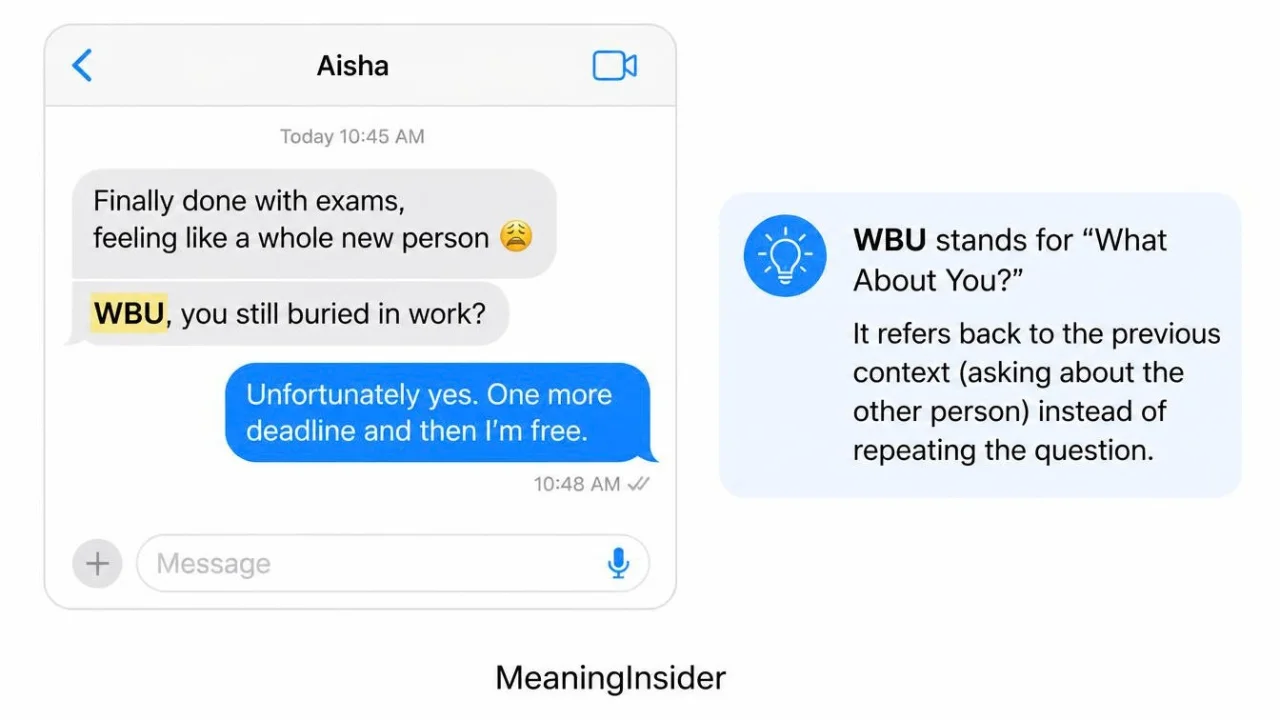
Seeing it in context usually clarifies more than any definition can:
Friend: finally done with exams, feeling like a whole new person 😩 wbu, you still buried in work?
You: unfortunately yes. one more deadline and then I’m free
Notice that WBU isn’t repeating “how are you” it’s borrowing the entire context of the previous message (finishing exams, feeling relieved) and asking whether the other person is in a similar spot. That’s the mechanic at the core of the term: it never restates the question, it just points back at whatever was already said.
How to Reply to WBU
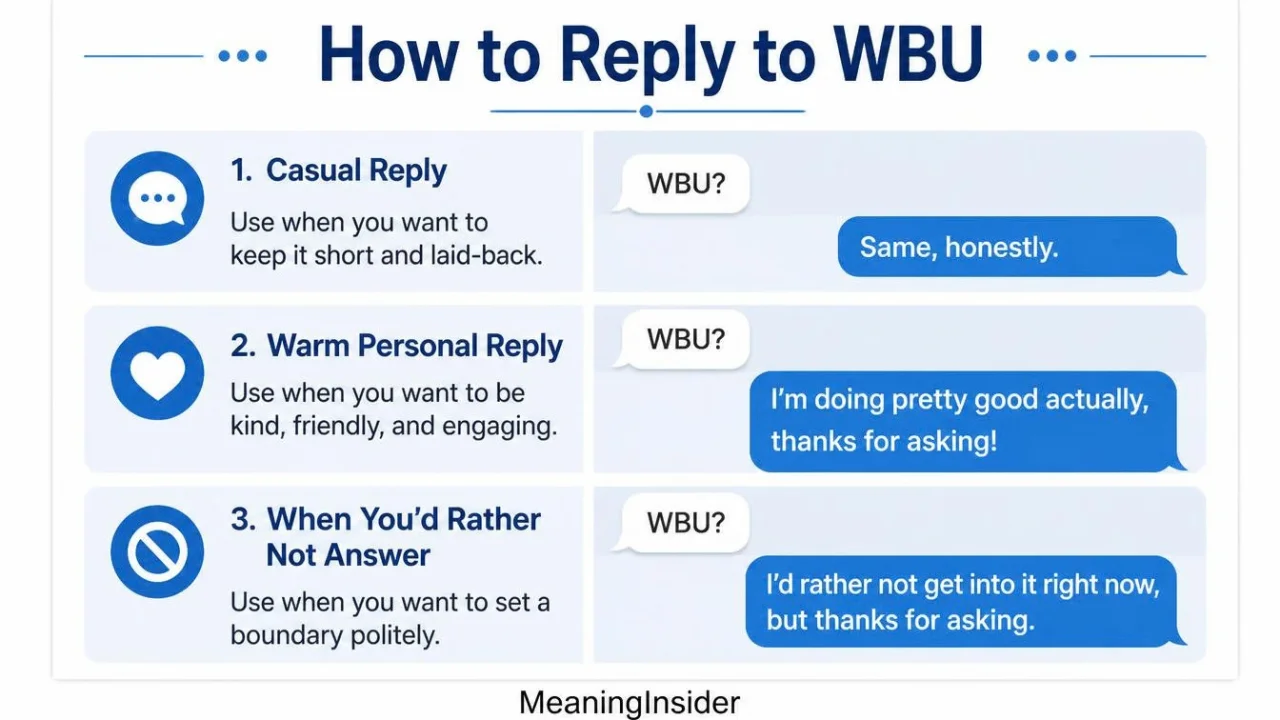
There’s no fixed script the right reply depends entirely on what the other person shared and how much you want to say back.
Casual or Quick Replies
When the exchange is light, matching that energy works fine:
- “same, honestly”
- “not much, just chilling”
Warmer, More Personal Replies
If someone shared something that deserves more than a one-liner, a slightly fuller answer reads as more engaged:
- “I’m doing pretty good actually, thanks for asking! just been busy with work”
- “missed talking to you too, things have been decent, how about your week?”
When You’d Rather Not Answer
WBU doesn’t obligate a detailed answer. If you’d rather not get into it, a short, polite deflection is completely reasonable:
- “I’d rather not get into it right now, but thanks for asking”
Words Similar to WBU (Related Slang)
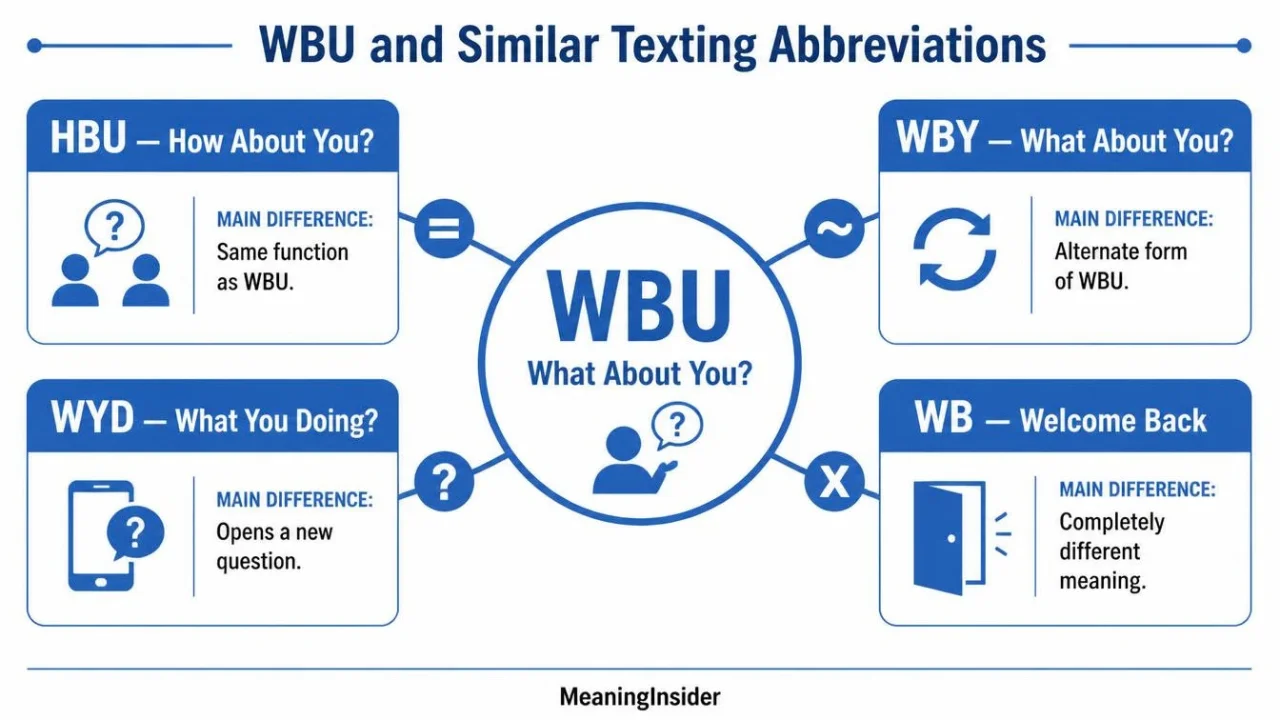
A handful of abbreviations get confused with WBU or used interchangeably with it but they’re not all identical.
WBU vs. HBU
These two are functionally the same thing. WBU is built from “what about you,” while HBU is built from “how about you” different phrasing, same job. “Good here, wbu?” and “good here, hbu?” mean exactly the same thing in practice.
WBU vs. WBY
WBY is a less common alternate shorthand for the same phrase, “what about you.” If you’re wondering which is correct to use, WBU is by far the more widely recognized version WBY shows up occasionally but isn’t the standard.
WBU vs. WYD
This is where a real difference exists. WYD (“what you doing”) usually opens a conversation, asking what someone’s up to right now. WBU usually closes a loop it comes after someone has already answered something and hands the question back.
| WBU | WYD | |
| Full form | What About You | What You Doing |
| Typical role | Returns a question already asked | Opens a new question |
| Example | “I’m good, wbu?” | “wyd tonight?” |
WBU vs. WB
These look similar in a quick glance but mean completely different things. WB is unrelated to WBU it commonly means “welcome back,” and shows up often in gaming chats and group conversations when someone returns after being away. Mixing the two up is an easy mistake when typing fast, since only one letter separates them.
Is WBU Formal or Informal?
Informal, without exception in any real sense. WBU fits texting, DMs, and casual group chats comfortably, but it doesn’t belong in professional or formal writing a work email, a client message, academic writing.In those contexts, you can spell it out as “What about you?” in full reads as more polished and doesn’t risk coming across as careless.
Common Mistakes and Misunderstandings With WBU
A few patterns cause confusion or come across poorly:
- Using it in a formal or more serious context. A business email or a genuinely heavy conversation is where WBU tends to undercut the tone rather than support it.
- Sending a bare “wbu?” with no lead-in. Because WBU borrows meaning entirely from the sentence before it, using it with no context leaves the other person guessing what’s actually being asked.
- Assuming it always means genuine interest. As covered above, WBU is often just a reflex. The real signal of sincerity is whether the person follows up on your answer, not whether they asked WBU in the first place.
- Mixing it up with lookalike shorthand. WB (“welcome back”) is the most common mix-up, but abbreviations like WWA can trip people up the same way if you’re not used to reading fast, clipped texts.
Final Words
WBU isn’t complicated, but it’s doing more work than its four letters suggest keeping conversations from feeling one-sided, in about as little effort as texting allows. The real skill isn’t knowing what it stands for; it’s noticing when it’s a genuine invitation to share and when it’s just a conversational reflex, and replying accordingly.
FAQs
Is it WBU or WBY?
WBU is the far more common and recognized form. WBY exists as an alternate shorthand for the same phrase but is used much less often.
What does WB mean in chat?
WB is a different, unrelated abbreviation, usually meaning “welcome back” not to be confused with WBU despite the similar spelling.
Is WBU the same as HBU?
Yes, functionally. WBU is built from “what about you” and HBU from “how about you,” but they’re used identically in practice.
Can WBU sound flirty?
It can, but only through the surrounding words, emojis, or existing context the abbreviation itself carries no inherent romantic meaning.
Is WBU okay to use in professional messages?
No. It’s fine for casual texting and social media but reads as too informal for work emails or formal communication, where spelling out “What about you?” is the better choice.
Does WBU always mean someone is genuinely interested?
Not always. It’s frequently used out of habit. Whether someone follows up on your answer afterward is a better indicator of genuine interest than the presence of WBU itself.
Someone Texted You a Word You Don’t Understand?
MeaningInsider Gives You the Real Meaning, Real Examples, and How to Reply All in One Place.
