

If someone sends you “HY”, the meaning can change depending on where it appears in the conversation.
In texting and social media, HY commonly means either “Hell Yeah” / “Hell Yes” or “Hi” / “Hey.” The first expresses strong agreement or excitement, while the second works as a casual greeting.
So, if you want to understand what someone means by “HY,” don’t look at the two letters alone. Look at what came before it, how it is written, and whether it starts or responds to the conversation.
What Does “HY” Mean in Text?
HY has two common meanings in casual digital communication:
- Hell Yeah / Hell Yes: An enthusiastic way to say yes, agree strongly, or show excitement.
- Hi / Hey: A casual greeting used to start a conversation.
The difference is usually easy to recognize from context.
If someone asks, “Want to come with us?” and you reply “HY!”, it means something like “Hell yeah!”
But if someone sends “HY, what are you doing?”, they are most likely using it as a shortened, casual version of “Hi” or “Hey.”
This is why there isn’t one fixed full form of “HY” in texting. The intended meaning depends on how the abbreviation functions in the message.
How to Tell Which Meaning Is Intended
Context is the quickest way to figure out what “HY” means.
If it replies to a question or opinion
When HY comes after a question, suggestion, or statement, it usually carries the “Hell Yeah” or “Hell Yes” meaning.
For example:
Friend: Want to grab pizza tonight?
You: HY!
Here, HY is clearly an enthusiastic yes.
The same applies when someone makes a statement you strongly agree with:
Friend: That was the best movie this year.
You: HY, absolutely!
If it starts the conversation
When HY appears at the beginning of a conversation without anything preceding it, it can simply mean “Hi” or “Hey.”
For example:
Them: HY 👋
You: Hey! What’s up?
In this case, there is no question or opinion for HY to answer. It is functioning as a greeting.
Punctuation can add intensity
The way someone writes HY can also give you a clue.
- HY: Casual or enthusiastic, depending on context
- HY!: Stronger enthusiasm or a more energetic greeting
- HY!!!: Often signals noticeably stronger excitement
- hy: Can feel softer or more casual when used as a greeting
These aren’t strict rules. They’re simply useful signals when you’re trying to understand the sender’s tone.
“HY” as “Hell Yeah” / “Hell Yes” Showing Excitement or Agreement

When HY means “Hell Yeah” or “Hell Yes,” it is an energetic way of saying yes.
Someone might use it to:
- enthusiastically accept an invitation
- strongly agree with someone’s opinion
- show excitement about a plan
- confirm that they definitely want something
- emphasize a positive response
For example:
Friend: Are you coming to the concert with us?
You: HY! I’ve been waiting for this.
Here, HY is much stronger than a plain “yes.” It communicates enthusiasm rather than simple confirmation.
Another example:
Friend: We should order burgers tonight.
You: HY 😂
The response means something like “Absolutely!” or “Hell yes!”
What about “Heck Yeah”?
“Heck Yeah” can carry the same meaning without the stronger profanity associated with “Hell Yeah.”
So depending on the person and context, HY may be understood as:
- Hell Yeah
- Hell Yes
- Heck Yeah
The overall message remains the same: an enthusiastic yes or strong agreement.
This use doesn’t really change between Snapchat, Instagram, TikTok, or ordinary text messages. The surrounding conversation matters more than the platform.
“HY” as “Hi” / “Hey” Using It as a Greeting
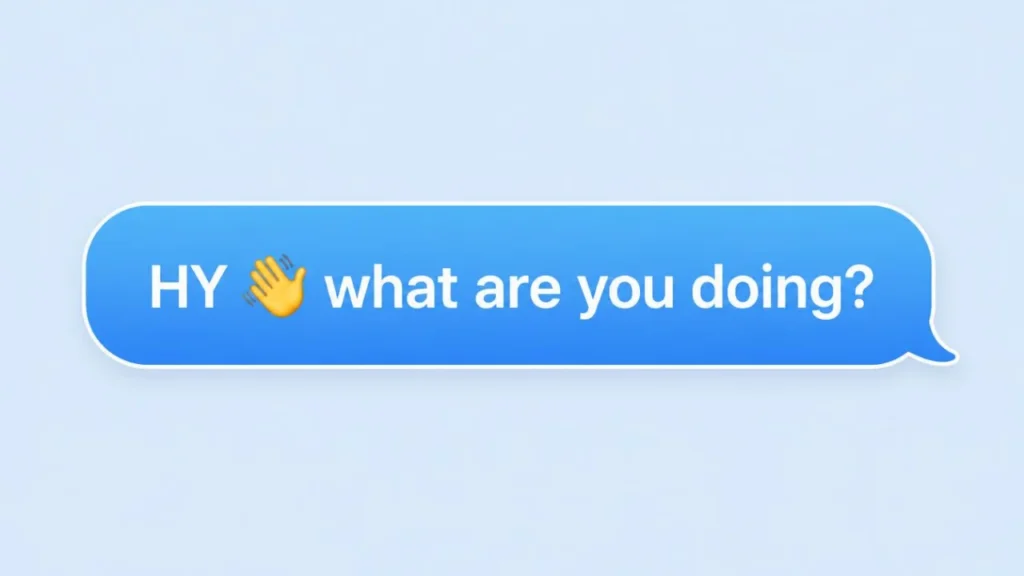
The other common use of HY is as a casual way to write “Hi” or “Hey.”
In this sense, it isn’t really an acronym. Instead, it works as a casual respelling of a greeting, with the “i” changed to “y.”
For example:
HY, what’s up?
means essentially:
Hi, what’s up?
You might also see:
HY 👋 how have you been?
or:
HY, are you free later?
Here, HY isn’t expressing excitement or agreement. It simply opens the conversation.
A less common interpretation is “Hey y’all,” particularly when addressing a group. However, this is a minor variant and shouldn’t automatically be assumed whenever someone writes HY.
The safest approach is still to look at the rest of the message.
Other Meanings of “HY” Outside of Texting
Although this article focuses on slang and texting, HY can also have unrelated meanings in specialized contexts.
In Finance “High Yield”
In finance and investing, HY can stand for “High Yield.”
The term is commonly associated with investments or bonds offering higher returns, which can also involve greater risk.
So if you’re reading a financial article and see HY used alongside terms such as bonds, credit, or investment returns, don’t automatically interpret it as “Hell Yeah.”
As a Language Code Armenian
HY is also the ISO 639 1 language code for Armenian.
This is completely unrelated to the texting slang.
The surrounding context makes the difference obvious when you’re dealing with language codes or technical information rather than a casual conversation.
In Dictionaries “Heavy” or “Henry”
Merriam Webster lists hy as a dictionary abbreviation for heavy or henry, with henry referring to a unit of electrical inductance.
This is a technical or dictionary abbreviation, not the normal meaning of HY in casual texting.
So if you see “HY” in a regular conversation with a friend, these specialized meanings are generally not what the sender intends.
“HY” in a Real Chat Example
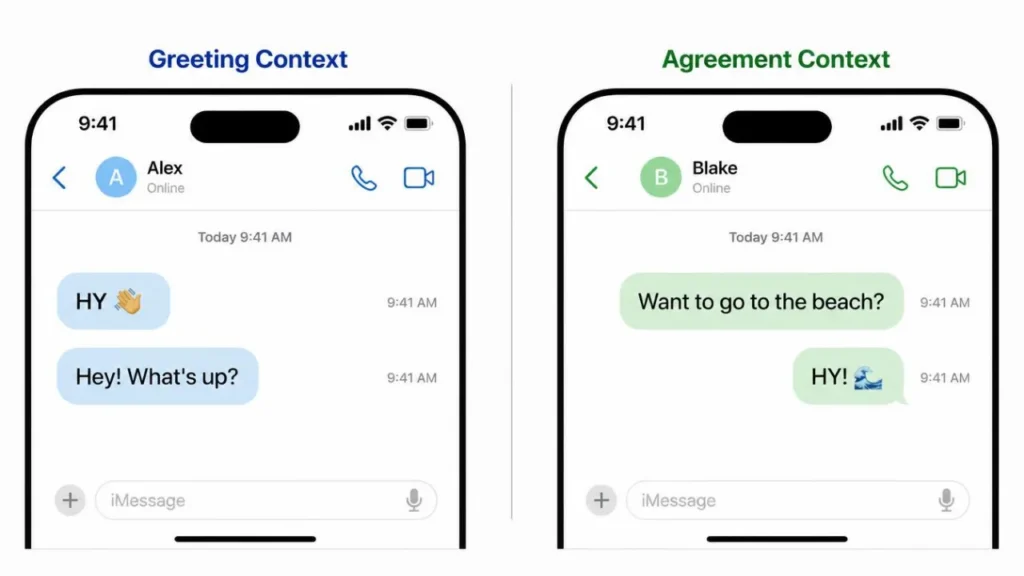
Seeing both uses side by side makes the difference much easier to recognize.
HY meaning “Hell Yeah”
Gilbert: Want to go to the beach this weekend?
Sam: HY! 🌊
Because HY is answering a question, it expresses an enthusiastic yes.
HY meaning “Hi”
Abraham: HY 👋
John: Hey! What’s up?
Because HY starts the conversation, it functions as a casual greeting.
The same two letters can therefore communicate completely different things without changing their spelling.
How to Reply When Someone Sends “HY”
Your response depends on which meaning the sender intended.
If HY means “Hell Yeah”
Match the enthusiasm and continue the conversation.
Them: Want to watch a movie tonight?
You: HY! What are we watching?
Or:
Them: That song is so good.
You: HY, seriously!
You don’t need to respond with another abbreviation. A simple “Absolutely,” “Nice,” “I’m in,” or a natural follow up works just as well.
If HY means “Hi”
Treat it like any other casual greeting.
You could reply:
- “Hey!”
- “Hi! What’s up?”
- “Hey, how are you?”
- “Hi! What are you doing?”
If you’re unsure which meaning was intended, simply continue naturally. The next part of the conversation will usually make it clear.
Is It OK to Use “HY” in Professional or Formal Messages?
It’s better to avoid HY in professional, academic, or formal communication.
The problem isn’t that the abbreviation is inherently rude. It’s that both meanings are casual and potentially ambiguous.
For example, instead of:
HY, I wanted to ask about the meeting.
use:
Hi, I wanted to ask about the meeting.
And instead of using HY as an enthusiastic professional response:
HY, that works!
you could write:
Yes, definitely.
or:
Absolutely.
In casual conversations with friends, classmates, or online communities, HY is much more natural. In formal settings, spelling out the intended meaning keeps your message clearer and more professional.
Words Similar to “HY” (Related Slang)
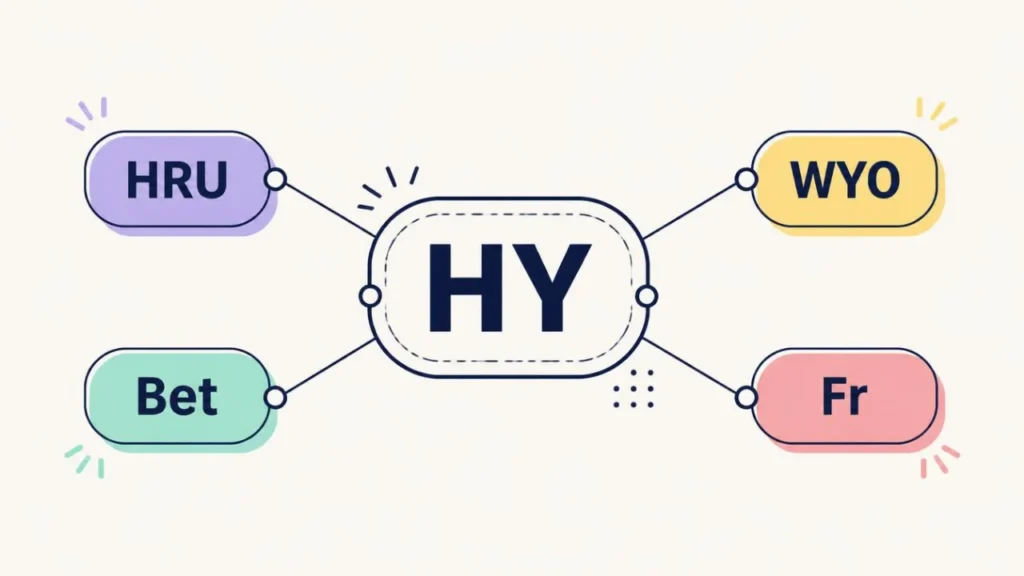
When HY means “Hell Yeah” or “Hell Yes,” these casual expressions can communicate a similar idea, although their tone can be slightly different.
| Slang | Meaning | Tone |
| WYO | What you on? | Casual and conversational |
| defs | Definitely | Positive but less energetic |
| HRU | How are you? | Casual conversation starter |
| yasss | Yes | Playful and enthusiastic |
| fr | For real | Genuine agreement or emphasis |
| bet | Agreement or acceptance | Confident and casual |
| For sure | Strong agreement | Clear and confident |
For example, “HY!” usually sounds like an especially enthusiastic yes, while “def” feels more like a straightforward confirmation. HRU and WYO are different from HY because they are mainly used to start or continue a casual conversation rather than express strong agreement.
Just like HY can work as a casual greeting, WSG is another short opener people use to start or keep a conversation going.
Common Mistakes and Misunderstandings With “HY”
Assuming HY has only one meaning
The biggest mistake is assuming that HY always means “Hi” or always means “Hell Yeah.”
Neither interpretation works in every situation.
Compare:
HY, how are you?
with:
Want to come with us? HY!
The first is a greeting. The second is an enthusiastic response.
Missing the tone and punctuation
A plain “HY” can be difficult to interpret without context.
Compare:
HY, what’s up?
with:
HY!!! Let’s goooo!
The first looks like a casual greeting, while the second strongly suggests excitement.
Punctuation isn’t a guaranteed rule, but it can help reveal the tone the sender intended.
Final Words
HY isn’t limited to one meaning in texting. It can be a casual “Hi/Hey” when opening a conversation or an enthusiastic “Hell Yeah/Hell Yes” when responding with strong agreement.
When you’re unsure, check what comes before and after it. A greeting usually opens the conversation; an enthusiastic HY usually responds to something. That simple distinction solves most cases.
FAQs
What’s the full form of “HY”?
There is no single fixed full form. In casual texting, HY can mean “Hell Yeah/Hell Yes” or “Hi/Hey,” depending on the context.
Does HY always mean “Hell Yeah”?
No. HY can also be a casual way of saying “Hi” or “Hey.” Look at how it is used in the conversation to determine the intended meaning.
Is HY the same as “Hey”?
Sometimes. When HY is being used as a casual greeting, it can function similarly to “Hey.” However, HY can also mean an enthusiastic “Hell Yeah,” so the two aren’t always equivalent.
Is HY rude?
No. HY isn’t inherently rude, but it is casual slang. Because of that, it may not be suitable for formal or professional communication.
Can HY mean something outside texting, like in finance?
Yes. In finance, HY can mean “High Yield.” It also has other technical meanings, including the ISO language code for Armenian and dictionary abbreviations such as “heavy” or “henry.”
Someone Texted You a Word You Don’t Understand?
MeaningInsider Gives You the Real Meaning, Real Examples, and How to Reply All in One Place.
